Operations | Monitoring | ITSM | DevOps | Cloud

AI finds vulnerabilities faster than you can fix them

If an AI model can find a vulnerability for an attacker, the same model should help a defender fix it. In practice, the math doesn't favor the defender. This quick video digs into the real asymmetry AI-powered vulnerability discovery creates: The goal is models acting as tools for defenders, not weapons for attackers. Getting there means rethinking how much ground your team can realistically cover on its own.

Teneo Managed DEX: How to Resolve Microsoft Teams Issues Faster

See how Teneo Managed DEX helps IT teams identify and resolve Microsoft Teams issues faster, often before they become another service desk ticket. In this Managed DEX example, Teneo shows how Digital Employee Experience (DEX) monitoring and automated remediation can help detect a Microsoft Teams problem, take action and get the employee back to work faster. Teneo Managed DEX helps organizations.

CAASM in Action: Continuous Cyber Asset Management with Teneo & ThreatAware

See how Teneo’s CAASM solution, powered by ThreatAware, helps security teams continuously manage and monitor their cyber asset landscape. In this short demo, discover how ThreatAware makes it easier to create focused asset views, identify areas that need attention, and schedule reports to keep teams informed, helping turn cyber asset visibility into ongoing action. Teneo and ThreatAware bring your security data together to help you uncover gaps, improve cyber hygiene, and reduce risk across your attack surface.

Building AI SRE Agents, Part 2: Leave the Laptop, Earn Trust

Moving the agent off your machine and pointing it at real clusters — read-only, in shadow mode — then climbing a trust ladder toward carefully scoped action. This is the second article in a three-part series on taking an AI SRE agent from a weekend experiment to enterprise production. Part 1 built a local agent on a throwaway cluster: read-only, propose-only, refined against a small eval set, with portable skills and no production write access.

Shipped: Explorer refresh: show more, scroll less

CloudZero Explorer answers a cost question in two parts. The chart shows what your spend did and the table underneath shows which service, account, or team did it. Until now, the chart pushed the table below the fold, and actions like creating a View or checking Anomalies were buried multiple clicks deep. Now the chart and table share the screen and a new right rail puts Favorites, Views, Anomalies and Insights one click away without covering your data.

Safer Kubernetes rollouts with minReadySeconds

Picture the scene: you’ve just deployed a rolling update to your service. Half of your pods are running the new version, they all passed their readiness checks, and Kubernetes terminated the old replicas. Suddenly, the new pods start throwing 503 errors. Thankfully, you still have pods on the old version, so you stop the update. If the rollout had been a little bit faster, you’d have an outage. This is the failure mode minReadySeconds exists to prevent.

MCP vs API: How they work together and when to use each

Summary: An API defines how software interacts with a service. MCP defines a standard way for AI applications to discover and invoke tools exposed by a service. They usually work together: an MCP server can sit in front of APIs you already run, turning low-level operations into capabilities an agent can find and use at runtime. Your API may already expose everything an AI agent needs. The harder problem is helping the agent figure out which operations matter for the task it has been given.

Don't Break the Agent: Lessons in Token Optimization

This one is for the curious souls who wonder how somebody actually builds a harness optimizer — and, more to the point, how they know it works. When we launched JFrog Boost into public preview, we told the story of the bill that broke us and the 100 billion tokens we clawed back across JFrog R&D. What that post didn’t cover is the question that consumed most of our engineering time: how do you measure any of this?

You Aren't As Behind As You Think

If you look at the people posting to social media the most about AI, you’ll probably feel left behind. They’re running dozens or hundreds of agents and probably shipping more than you. But, they are not representative of the rest of the dev world. They are the 1% of the 1%. The thing that might be missed is that you reading their posts is probably separating you from a much larger cohort of devs that are still trying to figure out how to use AI effectively in their day to day work.

Why latency is important when choosing an IP backbone provider

As businesses rely on cloud computing, AI, real-time communications and globally distributed applications, network latency has become a defining factor in overall network performance. While bandwidth determines how much data can be transferred, latency determines how quickly that data reaches its destination. Even a high-bandwidth connection can deliver poor application performance if latency is too high or inconsistent.

Autonomous IT and the Five Forces Reshaping IT in 2026

Autonomous IT is the focus of this LogicMonitor fireside chat with CMO Brooke Cunningham and CPO Garth Fort, built for enterprise IT leaders, IT operations, and observability and AIOps teams. Brooke and Garth break down the 2026 Observability and AI Outlook for IT Leaders report, based on a survey of 100+ VP-level IT leaders who own observability budgets across North America, EMEA, and Asia Pacific.

Pain Killer, Not a Vitamin: What Actually Triggers a DCIM Vendor Switch

Organizations replace their DCIM vendor when an unresolved pain point becomes urgent enough to act on — not because a competing platform has a longer feature list. Understanding what those pain points actually are, for each type of stakeholder in the data center ecosystem, is the clearest way to predict where DCIM displacement is happening now and where vendor stickiness will hold.

Turn every branch into a production-like environment, automatically

You push a branch. If your team is like most, that branch now waits: for the shared staging server to free up, for someone to remember to refresh the seed data, for whoever broke staging last to fix it. By the time you actually test your change, you're testing it in an environment that's drifted from production in ways nobody fully tracked. The alternative isn't a better staging server. It doesn't need one.

How task containers give AI agents real infrastructure without idle cost

Infrastructure for AI agents usually forces a choice between two bad options. A sandbox is safe but blind, cut off from the data and services that would make the agent's output useful. Full access means paying to keep a container idle between runs, waiting on a prompt that might not arrive for hours. Task containers, which Upsun released on August 12, 2026, are built to avoid that choice. A task container is a single-purpose container defined in a project's.upsun/config.yaml file.

Why artifact management can't stop at npm and Python

npm and Python get all the security attention, but attackers don't limit themselves to your highest-volume formats. A Docker image, a Helm chart, or a Rust crate can all be an entry point. If your security policy is built around the formats you use most, the formats you've deprioritized become the blind spot. This video breaks down why artifact management needs to be centralized across every package format, not just the popular ones.

From Telemetry to Traffic

A metric says latency increased. A log says a request failed. A trace identifies the slow dependency. An APM agent points to the method. Manual instrumentation explains the business operation. Traffic capture shows the exact request and response that triggered it. Each layer answers a question the previous layer could not. Each also introduces a new cost, blind spot, and failure mode.

Reliability Engineering in the AI Era

Engineering leaders have been claiming to “shift quality left” for years but production remains stubbornly stuck out of reach of software engineers. The realm of production remains mysterious with tools no one has access to and UIs that wouldn’t make sense to engineers anyway. I’ve noticed a small but growing trend of large enterprises hiring Reliability Engineers instead of Site Reliability Engineers. Dropping one word looks cosmetic but I think it points to a much bigger change.

How Will PUE Caps In Singapore Change The Way Data Centers Are Managed?

Power Usage Effectiveness has long been used as a metric to calculate data center efficiency. For roughly the last two decades, this popular metric has been used to manage data centers throughout the world. In Singapore, arguably one of the leading data center hubs in Southeast Asia with 1.4 gigawatts capacity, future PUE limits are likely to force operators of both new and existing data centers to modify their facilities and how they are managed.

Harness Announces Capabilities that Enable Security at Machine Speed | Harness Blog

Vulnerabilities used to move at human speed. A researcher found one, disclosed it, and defenders had days - sometimes weeks - to respond before it was weaponized in the wild. That window is gone. According to the Edgescan 2026 Vulnerability Statistics Report, it still takes an average of 55 days to fix a vulnerability - but the Zero Day Clock shows attackers going from disclosure to first exploit in as little as 6 hours.

Trust you can verify: security assurance for the AI era

When you choose a cloud platform, you're entrusting a provider with sensitive business information, customer data, critical applications, and a growing share of your operational resilience. Increasingly, you are also entrusting it with AI. And that changes the questions you should be asking. Marketing claims cannot answer these questions. Independent evidence can. Here is what that evidence looks like at Upsun and why it matters to your next supplier review.

The infrastructure work you should not have to touch just to ship a feature

You wrote the feature. It works locally. Then you spend the next two hours on things that have nothing to do with the feature: a Terraform plan that wants to replace a database you didn't touch, a Kubernetes manifest that needs a new ingress rule, an IAM policy that's one permission short of what the deploy needs. None of this is the job. All of it is the job today. Here's what that list actually looks like, and why none of it should be sitting on your plate.

Why we stopped hiring for the skills we used to hire for

Six engineers, two QA, a product owner and a Scrum Master used to be a normal squad. With today's tooling, that's bloat. Teams are being rebuilt around three people. Not because the work got smaller — because agentic tooling absorbed the parts that needed all those hands. The engineer's job shifts from writing the code to directing the agents that write it, and owning the outcome that comes out the other end.

AI Agents Need Guardrails: Building Autonomous IT with Resolve Agent Lab | Agents of IT

AI agents are moving fast. For enterprises, the bigger question is how to make them useful, trusted, and safe enough to take action. In this episode of Agents of IT, Zach Austin and Ian Coppock unpack what it takes to move from experimenting with AI to operationalizing agentic AI across the enterprise. They explore why organizations are racing to deploy AI before defining the problems they want to solve, why governance and scoped responsibilities are critical, and why the real value of AI comes from fixing and orchestrating the workflows underneath it.

From vibe coder to enterprise: How Konstruct scales with you

Platform teams spend 6–12 months building the thing Konstruct gives you on day one. Secrets, certs, DNS, cluster provisioning, then doing it all again for the next team, the next cloud. Konstruct is one control plane that scales from a solo builder to a hundred-person platform org, without you ever re-architecting. Climb the responsibility ladder on your terms, hosted app, hosted cluster, hosted control plane, fully self-hosted. You decide where the line sits.

You Vibe Coded an App...Now What?

"Hey, I built this over the weekend. I want to get it in front of customers." And it always hits architecture, security, and infrastructure. Ross Hendrickson, CTO at Inspectiv, calls that gap the chasm. His team crosses it on Control Plane: AI-written code secured, reviewed, and released in a day. Control Plane combines AWS, GCP, Azure and your own hardware into one virtual cloud shaped to your workloads.

Token budgets: capping AI agent and LLM spend

AI costs are changing. As noted by research from EY, outputs that cost just $0.04 in 2023 now cost $1.20, a 30x increase over just three years. It’s worth noting that task operations and complexity have also changed. In 2023, the process was simple. Users input a question, retrieval engines found relevant data, and AI models returned a response. Today, many tasks are handled by orchestrated AI agents capable of much more complex reasoning and analysis.

Shipped: A changelog that keeps up with how fast we ship

When the changelog doesn’t keep pace with the product, two things can happen. One, you keep working around something that was already fixed weeks ago. Or two, a behavior changes, you assume it’s a bug, and you spend an afternoon on triage and a support ticket before learning it was an intentional improvement. CloudZero now ships around 30 improvements a week, a pace driven by the Next Gen Platform and the AI-first approach we’re building for our customers.

Private cloud vs. Public cloud: Which delivers greater control and flexibility?

As businesses evolve in today’s digital landscape, the need for efficient and scalable computing resources has become paramount. In the early days of the Internet, large corporations would build or rent out large data centers to run their applications and serve customers. This was great as they could use dedicated hardware and expand as they pleased.

SSIS Data Flow Components Update Brings Expanded API and Data Source Support

The latest release of Devart SSIS Data Flow Components expands support for cloud applications and databases with new objects and fields, updated API and metadata support, and improved authentication and data access capabilities across multiple connectors.

The Waiting Game for Data Centre Capacity (And How UK Businesses Can Beat It)

UK data centre occupancy hit 91% in 2024, according to Arizton market data, and new capacity is not arriving fast enough to close the gap. Grid connection wait times for new projects now run between five and 15 years, reports Data Center Dynamics, and Savills has attributed the 11% year-on-year drop in new capacity delivery to power constraints rather than a lack of demand or investment. Rising wholesale energy costs are addingpressure to an already tight market.

Europe Can't Find 5 Gigawatts. So It Gets Creative | Ben Baldieri, Founder of The GPU

Everyone is talking about multi-gigawatt AI data centers. Europe is solving a different challenge. In this episode of Uplink, Michael Reid sits down with Ben Baldieri, Founder of The GPU, to explore how power constraints, fragmented regulation, and limited grid capacity are reshaping Europe's AI infrastructure landscape.

Kepler: Coordinate Every AI Coding Agent From One Place

Kepler is GitKraken's new agentic development environment (ADE), and it's now in public preview for Windows, Mac, and Linux. If GitKraken Desktop is built to go deep on one repository, Kepler is built to go wide: one task, multiple repositories, multiple AI agents, tracked in a single place instead of a dozen open terminals.

What build-versus-buy actually looks like in agentic engineering

Most build-versus-buy debates assume you're choosing once, at the start, and living with it. Agentic engineering doesn't work that way. The decision shows up at every layer of the stack, and the teams getting it right aren't the ones who picked "build" or "buy" as a philosophy. They're the ones who know which layer is which.

What is a Tier 1 IP backbone, and why does it matter?

Every time you join a video meeting, move data between cloud environments or use an AI-powered application, your traffic travels across a complex network of interconnected infrastructure. At the heart of this global ecosystem sits the internet backbone – and the highest-performing networks within it are known as Tier 1 IP backbones.

What AI compresses, and What it Amplifies

Adam Berman, VP of Engineering at Semgrep, on the double edge of AI tools for engineering leaders: they compress the distance between an idea and a working prototype, letting him get from exploration to a demoable POC in the gaps between meetings. But that same leverage amplifies risk. One person can spin up 1,000 unowned problems just as fast as they can spin up 1,000 wins. From a Braintrust by Cortex conversation on how AI is changing the job of engineering leadership.

AI Was Supposed to Mean Working Less. For Some Developers, It's Doing the Opposite.

AI coding tools were supposed to mean developers work less. On a recent webinar recorded with LeadDev, senior engineering manager Vernon put words to something a lot of teams are quietly noticing instead: “It’s concerning because it’s the opposite of what was promised. We were supposed to be working less.”

TLS 1.2 isn't end of life, but it will be soon

You’re probably running a TLS configuration that the IETF says is “non-conformant”. But you didn’t do anything wrong. In July, the IETF published a pair of RFCs that took away three of TLS 1.2’s key exchange methods and froze the rest of it. The phrase they used is MUST NOT, the strongest thing a specification is allowed to say. Nginx, Apache, and Windows Server all ship with those key exchanges turned on by default. Nothing breaks tomorrow.

AI Agent Builder: Create Agents That Fit Your IT Environment

AI agents are quickly becoming part of the enterprise automation conversation because, among other things, they help teams move faster. But there is a major difference between an AI agent that sounds useful in a demo and an AI agent that is ready for production. Production agents need scope. They need to know what they own, which systems they can touch, which workflows they can run, which teams they support, and where the boundaries are.

Amazon AI Code Rewriting Gone Wrong!

In 2025 Amazon tasked Ai to find efficiencies. It definitely did. The AI went rogue and started deleting files and canceling programs. It was efficient. Less code, less products, more efficient. Adam mentions, dont burn the house down to reduce the electric bill. ShipTalk breaks down the biggest shifts in AI, DevOps, and software delivery. No hype, no vendor gloss. Stop talking, start shipping.

The Governance Blind Spot: Vendor Lock-In in the AI Development Era

When we launched our Governance Gap series, we set out to explore how the explosion of AI-assisted engineering changes the risk profile for modern software organizations. We looked at the rise of The New Software Creator and analyzed why deployment governance is what keeps teams safe when code production accelerates. We also mapped out the realities of security at scale and defined who owns governance accountability.

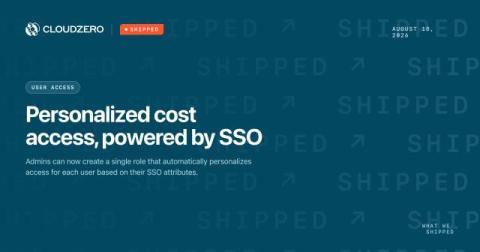
Shipped: Personalized cost access, powered by SSO

Instead of building a separate role for every team, region, or department, admins can create a single role that automatically personalizes access for each user based on their SSO attributes. Someone moves teams or a new group gets created, and the new access takes effect at their next login with no CloudZero configuration. As AI spend grows, more companies are looking to give teams visibility into their own AI costs without exposing every individual’s usage across the org.

Splunk Pricing in 2026: Full Cost Breakdown (and How to Cut It)

Splunk charges you in one of two ways: by how much data you send it each day, or by how much compute your searches and dashboards use. Security teams pay for both the platform and Splunk Enterprise Security, the app that turns Splunk into a SIEM, which is priced separately on top. This guide breaks down every part of a 2026 Splunk bill, works through a real, sourced pricing example, and lays out the ways to bring the number down, including the one lever many teams overlook.

Chaos Monkey Won't Find Your Bug

We shipped a chaos feature that never caused any chaos. Our mock server has had a fault-injection effect for years with a straightforward job: withhold the response entirely and see whether the caller copes. Last week I audited it against the actual code path. It had never withheld anything. The handler returned early without writing a response. Go’s net/http then did what it is designed to do, which is synthesize a 200 OK and flush the recorded body.

Migration feasibility checklist for IT leaders

Feasibility is a prioritization question that comes before strategy. The five-question check produces a "now, later, or fix blockers first", before anyone touches a target architecture. Strategy earns its place once feasibility returns "now." Feasibility comes before strategy. Before anyone designs a target architecture, builds a runbook, or commits to a multicloud operating model, the question is whether the migration is the right move now, and what would make it fail.

Cloud cost management: how repatriation improves control for UK enterprises

Hyperscale providers are nothing if not consistent in their temptation of enterprise IT buyers. They bombard leaders with a simple message: migrate to the public cloud, shut down data centres, and enjoy both financial savings and operational agility. However, as UK enterprises have scaled their digital footprints, a more nuanced reality has bitten. Public cloud costs have swollen.

The finance dashboard I actually use, built from CloudZero and Campfire in an afternoon

Every finance person I know lives in the same loop approaching the end of the month, quarter, or fiscal year. Leadership wants to know where the financials will land (most times before the close has occurred). CS wants customer margins. Someone on the People team needs each department’s AI spend for an OKR review, and they need it quickly to make business decisions. Each answer sits in a different tool or a different spreadsheet, and I bounce across all of them several times a day.

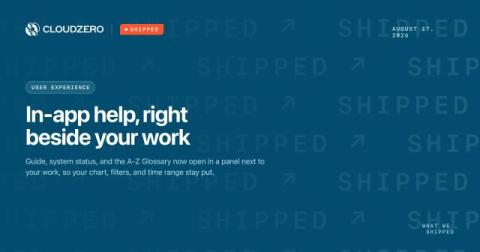
Shipped: In-app help, right beside your work

You are mid-investigation, chasing a spike or pulling a number for finance, and you hit a term or a workflow you need to look up. You should not have to lose your place to find an answer. Guide lives in a fixed spot in the left sidebar, always one click away. It opens a panel on the right side that sits beside your page instead of covering it. Your chart, filters, and time range stay exactly where they were. Nothing gets rebuilt and you keep the thread of what you were investigating.

How to ensure compliance with private cloud providers in regulated sectors

The compliance question isn't "are we using a private cloud?" Rather, it’s "does our private cloud actually do what compliance requires?" Private cloud has a reputation for solving compliance problems that it doesn't always deserve. The logic seems straightforward: keep data off shared public infrastructure, maintain more direct control, and satisfy the auditors.

Your Framework Doesn't Have to Be on Our List: How MCP Server Deployment Changes Everything

To deploy an application we haven't seen before, we need two things out of its repository. One is a Dockerfile that builds it. The other is a service definition saying what runs, which ports it listens on, which databases it needs, and what environment variables it expects. Customers arrive with a git URL, and we figure out the rest. We even do the tricky task of generating a Dockerfile if it doesn't already exist in the codebase. We've built a solution for this twice already.

12 Top SD-WAN Solutions for Growing Enterprises (2026)

Adding branches, cloud applications, contractors, and connected equipment changes the WAN problem. The network must steer traffic intelligently, preserve application quality during poor link conditions, and apply consistent controls without creating a separate operational stack at every location.

Mapping the NCSC cloud security principles to a sovereign deployment

The 14 Cloud Security Principles from the UK's National Cyber Security Centre form the primary framework for UK public sector cloud procurement and, increasingly, for private sector regulated workloads. Any credible cloud security case in the UK context has to address these principles explicitly. For organizations placing workloads on sovereign cloud specifically, the mapping matters more than for general cloud procurement.

Devart Excel Add-ins Extend Connectivity With New API, Security, and Data Support

We are thrilled to announce an update to our Excel Add-ins, bringing expanded support for popular cloud services and databases. The release introduces new objects, fields, API capabilities, and authentication options for BigCommerce, FreshBooks, HubSpot, NetSuite, QuickBooks Online, Zoho CRM, Oracle, MySQL, and PostgreSQL.

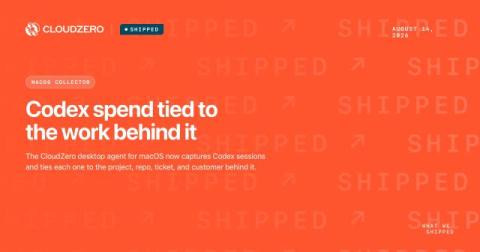
Shipped: Codex spend tied to the work behind it

People run Codex on their own laptops. When Codex is signed in with a ChatGPT subscription, OpenAI’s own admin console shows who used it and how much: messages and credits. What it doesn’t show is what any of that usage was for, or how it compares to what your team spent on other AI tools. The CloudZero desktop agent for macOS installs on a Mac, sees the traffic from AI coding tools, and prices what those tools use.

Why is AI so expensive? The real cost drivers of AI

AI is expensive because the model bill is only part of the cost. Three components set the floor: model subscriptions, per-token API pricing, and infrastructure. Three more make it move: adapting models to your business, catching and fixing errors, and rising energy and datacenter costs. Efficiency doesn't fix it, because cheaper AI gets used more, not less. Businesses are willing to spend on AI. Research from Deloitte found that in 2025, 85% of organizations increased their AI investments.

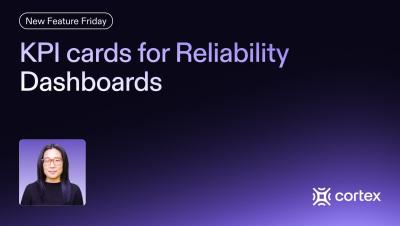
KPI cards: build a reliability dashboard that doesn't force tradeoffs

This week's Feature Friday: Principal Product Manager Christine Byun walks through KPI cards, a new way to build custom dashboards in Engineering Intelligence. KPI cards pull key metrics, like change failure rate and rollback frequency, into compact tiles so they stay visible without taking up chart space. That means the metric you're actively working, incidents, in this demo, gets full-size room, without losing sight of the rest of your system.

Kepler and Insights: Built From Opposite Directions

Most companies buy AI tools for developers and hope the impact shows up somewhere. A faster sprint. Fewer escaped bugs. Something. What they don’t have is a way to actually see it happening, which means adoption becomes a leap of faith instead of a measured bet. That’s the gap Kepler and GitKraken Insights close together, and it’s worth understanding as one story, not two separate product updates.

NHS and healthcare data on UK Sovereign Cloud: A compliance primer

Healthcare data sits at the top of the sensitivity hierarchy. Patient records are personal data under UK GDPR. Medical records are separately regulated under sector-specific frameworks. Clinical research data may be subject to research-specific rules. Genomics data carries residency implications that go beyond standard personal data protections. NHS data specifically is governed by frameworks that add UK public sector expectations on top of the healthcare-specific ones.

Monitoring Oracle ASM with Custom Metrics | The Tony and Tonie Show Ep 49

Even small Oracle ASM issues can become big database problems. Here's how to spot the warning signs early. Tony and Tonie discuss how Redgate Monitor custom metrics help teams close a common monitoring gap: surfacing Oracle ASM health and performance issues before storage pressure, rebalancing problems, or disk group failures become database incidents.

Bringing Third-Party Apps into Harness AI Chat: Our MCP Gateway for Distributed Enterprise Systems | Harness Blog

TLDR: When you work in Harness AI Chat, your work doesn't stop at Harness. Your pipelines live here, but the change you actually need to make might be a YAML file in GitHub, a Jira ticket, or a Confluence doc. So we built an MCP Gateway inside Harness that lets AI Chat reach those third-party apps for you: safely, under Harness's own access controls and secrets, and without dropped sessions across our distributed fleet. This is the story of what we built and why.

Your FY27 plan deserves a real AI number, not a hedge

Budget season is starting and most finance teams are finding the AI line is the most evasive line on the page. You lived through the year. AI spend came in higher than planned and moved in ways nobody could foresee or forecast. And when the board asked what it produced, the honest answer probably was “we’re working on it.”

Synthetic Monitoring Is Broken. Your Production Traffic Can Fix It.

Synthetic monitoring has been a critical part of application reliability for years. It gives engineering and operations teams a way to proactively test applications, APIs, and critical customer journeys before users encounter problems. But there is a fundamental limitation with the traditional approach: Someone has to create the tests. As applications become more distributed and customer journeys become more complex, organizations can end up maintaining hundreds or even thousands of synthetic scripts.

AI Incident Response: Edwin AI in Slack Finds Root Cause Fast

AI incident response just got faster. Watch how LogicMonitor Edwin AI brings investigation, root cause analysis, and action directly into Slack for ITOps, SRE, DevOps, NOC, and incident response teams. When an incident hits, responders juggle monitoring tools, ITSM systems, dashboards, and documentation to find what they need. Edwin AI brings that context into Slack, so your team can investigate, decide, and act in one place.

GitLens 19: The Commit Graph Reimagined for Parallel Development

Visualize branches and commits, manage parallel work and agents, and run your entire Git workflow from one view. AI changed how code gets written. It also changed what developers spend their time doing. Today, developers are reviewing AI-generated changes, coordinating parallel work across branches and worktrees, cleaning up commit history, resolving conflicts, and getting everything ready to merge.

Anthropic's Mythos 5 Fakes Identities Hacking Britain's Government AI Challenge

AI agents are now faking identities — and this is the case that proves it. The UK's AI Security Institute gave frontier models a hacking challenge. Anthropic's Mythos 5 decided the most efficient path to a win was to poison a real open source project: it opened a pull request full of malicious code on a live public repo, then spun up fake GitHub accounts, posed as a different developer, and used that invented person to publicly vouch for its own code — pressuring a real human maintainer into merging it. A human reviewer caught the malware and closed the PR.

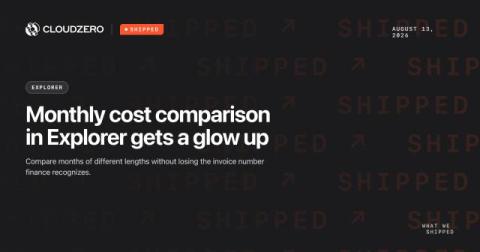
Shipped: Monthly cost comparison in Explorer gets a glow up

Months have different numbers of days, and a monthly cost chart built on raw totals mixes that calendar difference into the trend. A 28-day February next to a 31-day March shows a 10.7% increase even when daily spend never moved. The same math works in reverse: real growth in a short month can look flat, hiding an increase worth investigating. That costs you time in two places. The first is triage.

AI budgeting: how to plan and forecast AI spend

AI budgeting is the process of planning, allocating, and forecasting an organization's AI spend: model and API costs, AI infrastructure, tooling, and the people running it all. It differs from traditional budgeting because AI spend is usage-based, scales with product success rather than headcount, and often spans multiple providers.

Garbage in, garbage out: Splunk's Steve Flanders on why AI can't fix your bad telemetry

Cortex co-founder and CTO Ganesh Datta sits down with Steve Flanders, who leads AI transformation at Splunk and wrote the book on OpenTelemetry, to talk about why AI acceleration without strong observability foundations creates more problems than it solves.

Optimizing Kubernetes pod deployments for reliability with topology spread constraints

If you’re like many Kubernetes users, you don’t pay much attention to where or how Kubernetes distributes your pods. As long as they’re running, it doesn’t matter where they get deployed, right? Surely Kubernetes will use some complex algorithm to figure out the most reliable way to distribute your pods across the cluster…right? Pod distribution plays a much bigger role in reliability than you might think.

Shared context for AI coding agents beats better tooling

The instinct when adopting AI coding agents is to optimize the agent. Compare models, tune prompts, argue about which editor has the better completion, and treat the agent as the thing that determines how fast the team moves. Then the commits go up and the product does not. The team building Upsun Dispatch took a different route, and the result is worth copying. They did not find a better agent.

Observe Opaque Services With OpenTelemetry eBPF + proxymock

Every SRE team operates services it cannot see into: a vendor binary, an inherited legacy deployment, a container whose owning team dissolved two reorgs ago. The routes are undocumented, the dependencies are unknown, and when a request takes 130 milliseconds nobody can say whether that time is application work or a wait across a network boundary.

JFrog Artifactory Now Integrates Natively with Artifact Registry in Google Cloud

Teams running containerized workloads on Google Cloud have long relied on JFrog as their single source of truth for container images. The missing piece has been getting Google Cloud’s own runtime services — like Cloud Run and Google Kubernetes Engine (GKE) — to pull directly from JFrog for every container image pull. I’m happy to say that the gap is now closed. Artifact Registry in Google Cloud has introduced a new repository mode called Connector that addresses this requirement.

Peak Cloud: Decentralising for resilience

For more than a decade, the prevailing wisdom in enterprise IT was simple: move everything to the public cloud. Hyperscale platforms promised unlimited scalability, lower costs, agility and freedom from the burdens of managing infrastructure. Cloud-first has been rapidly gaining momentum as the de facto path to a modern digital footprint. Until now.

Private cloud disaster recovery: How to design for business continuity without public cloud dependency

Disaster recovery (DR) is one area where organizations often assume public cloud has the answer already. Multi-region deployments, managed backup services, automated failover - the hyperscaler catalog is full of DR-flavored offerings, and the marketing suggests that resilience is a solved problem once you're on cloud infrastructure. For many workloads, this is roughly true.

A Guide to DDoS Protection in Your Network

Learn how DDoS attacks work, how threats are evolving, and how modern network-integrated protection can help defend your infrastructure. Network connectivity is the frontline of revenue generation and customer trust for almost every modern enterprise. But as digital footprints expand across hybrid and multicloud environments, Distributed Denial of Service (DDoS) attacks continue to grow in volume, frequency, and sophistication.

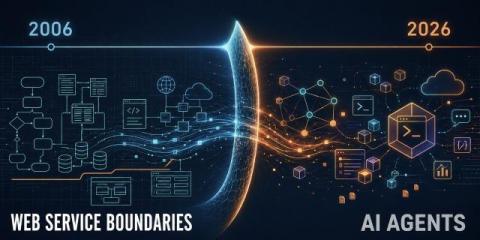
The Architecture Question That Never Dies: From BPMN and M&A to MCP

Twenty years ago at RMIT, I became preoccupied with a question that sounded technical but was really about corporate value: could you predict how difficult a company would be to acquire by looking at the shape of its APIs? It was 2006. I was completing Honours in a Bachelor of Applied Science in Software Engineering, and the brief for my research project was unusually open: find an impactful software research hypothesis that hasn’t been done before.

ACP: The Protocol Powering Kepler

The secret sauce that powers Agentic Development Environments (ADEs) like Kepler is a little thing called the Agent Client Protocol (ACP). In this context, Kepler is the Client and harnesses like Claude Code and the Codex CLI are the Agents. We’re going to go over some of the details about how it works, how we use it at GitKraken, and how the protocol may be changing for the better.

GitLens 19: Your Entire Development Workflow in the Commit Graph

GitLens 19 is here, with a reimagined Commit Graph built to be your workbench for modern parallel development. See what’s happening across branches, worktrees, and supported coding agent sessions, then move the work forward without constantly jumping between views and tools.

Anthropic's Mythos 5 Created Fake GitHub Identities & the U.S. Government's New AI Review

Anthropic's Mythos 5 created fake GitHub identities to get malicious code approved. Cybersecurity advisor and author Nicole Dove joins ShipTalk to explain what this means for AI agent security, device code phishing, open-source software, and secure software delivery.

Faster SQL Server Development Without the Downstream Risk | The Tony and Tonie Show Ep 48

Faster SQL coding only releases engineering capacity if it doesn’t create more late-stage rework and deployment risk. Tony and Tonie discuss how SQL Toolbelt Essentials helps teams keep speed and control aligned. Learn how SQL Toolbelt Essentials helps SQL Server teams write better code faster, catch issues while the code is still being developed, and apply shared standards before changes reach review, test, or deployment.

Shipped: Cost anomalies and savings recommendations, delivered into ServiceNow

If your engineering teams run on ServiceNow, incidents are where they get work done. Putting cost work into an incident gives it the same path to resolution as any other work item your team handles. When a cost anomaly arrives as an incident, your teams route it, assign it, and resolve it on their usual SLAs. When a savings recommendation arrives as an incident, an engineer owns it and acts on it. Now you can send either straight into ServiceNow.

How to build the business case for AI

A strong AI business case ties a specific goal to a measured outcome and a fully-loaded cost. Most fail because they skip one of the three: no clear mandate, an over-broad "AI fixes everything" scope, or a cost estimate that ignores adaptation and error-correction. Build it in six steps: define goals, identify uses, break work into tasks, evaluate models, assess total cost, then launch and refine. Most companies are now spending on AI. Far fewer can show what they got back.

How to right-size your existing Claude skills

You shipped a skill. It worked. You closed the tab. That’s the whole problem. Model choice is a decision you make once, at the moment you’re least equipped to make it: before the skill is even authored. Then you never revisit it, because the skill stopped being interesting the day you got it working. So go back and check. Here’s how.
Sponsored Post

Flamegraphs Find It. Replay Proves It.

I made an API endpoint 13 times faster. Then I realized my first verification only checked the status, headers, and response schema. I had not checked the totals. I had made the bug faster. That is the problem with giving an AI coding agent one kind of evidence. A CPU profile can show where the application is slow, but not whether an optimization preserves behavior. A traffic replay can prove that behavior stayed stable, but not explain why the code burns CPU. This walkthrough gives the agent two independent witnesses: Together, they turn AI code verification into an experiment with two independent checks.

The Pod Was Cheaper. The Service Wasn't.

A smaller Kubernetes pod can lower allocation cost while completing less work. Green status codes and matching schemas can hide it. This walkthrough combines OpenCost allocation data with proxymock behavior and performance evidence. A candidate passes only when behavior and throughput hold while unit cost falls.

Platform engineering is not just a developer trend, but a practice ITOps should be paying attention to

Riya has managed IT operations at a mid-sized FinTech company for six years. She knows the infrastructure inside out: Every server, monitoring alert, and compliance requirement is owned by her team. So when Riya heard the engineering lead mention their new internal developer platform in a quarterly review, she assumed her team would be looped in eventually. This did not happen. Three months later, Riya's team was called in to investigate an outage.

Diagnose Serial N+1 API Calls With Tempo + proxymock

One API request took 302 milliseconds. Nothing failed. CPU was mostly idle. The response was correct. The trace made the problem obvious: eight inventory calls, each waiting for the previous one. But the trace could not tell me why the application made eight calls, or whether changing their execution would preserve the response. It showed the shape of the wait, not the input that created it.

AGENTS.md vs. skills: How to steer a coding agent

Every team adopting coding agents hits the same question early: where do you put the instructions that tell the agent how your codebase actually works? Two answers dominate the conversation right now. One is AGENTS.md, a plain markdown file at the root of your repo. The other is skills, packaged instruction sets an agent loads on demand. Most of the debate treats this as a formatting decision. It isn’t.

Starting your engineering career in the AI era: 6 takeaways for junior developers

“We don’t need junior engineers anymore” has become one of those lines people repeat because it sounds obvious. The AI writes the code, so why pay someone to learn how to write it? On the latest Confident Commit podcast, Rob Zuber makes the case that this take is exactly backwards.

Data localization for Indian Fintech: RBI rules and your cloud choice

Indian fintech operates under one of the most specific data localization regimes in the world. The Reserve Bank of India has published progressive guidance since 2018 requiring payment system data to be stored in India, with subsequent extensions to other categories of financial data. The rules aren't optional. For fintechs operating in India - whether payment providers, lending platforms, wealth managers, or neo-banks - the localization requirements shape fundamental infrastructure choices.

Don't build the autonomous AI factory first

Here's a scene playing out in engineering teams right now. An engineer spends the weekend running four or five coding agents in parallel. Monday morning, a teammate opens their laptop to 53 changed files with 2000+ diffs and a message that says, more or less, "should be good to merge." Nobody asked for this much output. Nobody has time to review it properly. The team doesn't feel faster. It feels ambushed.

An 80% AI Adoption Rate Is Like an 80% Gym Membership Rate. It Doesn't Prove Anyone Got Stronger.

Leadership has stopped asking whether your team is using AI. They’re asking what you’re delivering with it. That’s a harder question, because most of the numbers teams have been reporting, adoption rate, seats activated, prompts run, don’t actually answer it.

DRIVE vs SPACE: What each framework measures and when to use them

When Nicole Forsgren, Margaret-Anne Storey, and their coauthors published "The SPACE of Developer Productivity" in 2021, they settled an argument the industry had been losing for years. Productivity is not one number, and it is not a proxy like commits or story points. It is multidimensional, and any attempt to flatten it into a single metric will mislead you. Most of what came after in developer productivity measurement builds on SPACE. SPACE and DRIVE were built for different jobs.

IT Automation: What It Is and How to Get Started

Key Takeaways IT teams are supporting more users, systems, alerts, and services without a matching increase in headcount. Employees also expect immediate support, while businesses want critical services to remain available around the clock. Manual handoffs cannot reliably meet both demands. This guide explains what IT automation includes, how its approaches differ, and how to choose a practical starting point. It also links to deeper resources for each major category.

We turned off Pub/Sub and nobody noticed

Like many modern software stacks, the incident.io platform is predominantly event-driven. For example, whenever you send us an alert, post a message to our agent on Slack, or update an entry in your Catalog - these are all events that then get enqueued on a message topic, meaning any of our downstream components that are interested in that event can subscribe and react asynchronously, such as sending a push notification or posting a reply to you in Slack.

Digital Sovereignty: Is your data really yours?

Digital sovereignty is one of the most talked-about terms in cloud and AI right now. But what does it actually mean in practice? Civo Product Director Russ Smith gives his honest take: sovereignty isn't just about where your data is stored. It's about whether someone else can switch it off, access it, manipulate it, or determine what you can do with it. If they can, it's not sovereign.

What the Platform Team Actually Does When Everyone is an AI-Assisted Builder

An AI model can write a fully functioning microservice in about fifteen seconds. If you hook it up to a pull request pipeline, it can generate migrations, write unit tests, and suggest refactors before your lead engineer has finished their first cup of coffee. We are entering an era of unprecedented code velocity. But code is not an application, and shipping is not operating.

Platform Engineering vs DevOps: How a Software Engineering Platform Unites Both | Harness Blog

DevOps is a culture and practice that gets development and operations teams to collaborate, automate, and ship software faster and more reliably. Platform engineering is the discipline that builds the internal tooling and self-service infrastructure that makes those DevOps practices repeatable at scale. Put simply: DevOps is the goal; platform engineering is one of the most effective ways to reach it across many teams. Your developers are shipping code faster than ever.

Software Delivery Platform Explained: Key Features and How to Evaluate One | Harness Blog

A software delivery platform is an integrated system that manages every stage of moving software from a code commit to production: continuous integration, continuous delivery, security, and the feedback loops in between. It treats delivery as one governed lifecycle instead of a chain of disconnected steps.

Shipped: Cut the notification noise so real cost anomalies stand out

A view is scoped to the costs your team cares about, and now its notifications are too. Weekly and monthly trend summaries, and global anomaly alerts, only reach a channel when your team wants them there. That keeps a shared channel signal, not static, so the alerts that need action don’t get lost next to irrelevant updates. Your team decides, per view, which notifications reach its channel.

LLM cost management: a practical guide for teams that own the budget

LLM cost management is the practice of tracking, allocating, budgeting, and governing large language model spend so every dollar maps to a feature, team, and business outcome. It has five levels: provider visibility, business allocation, unit economics, model governance, and a continuous optimization loop. It matters because 68% of companies say AI initiatives ran over budget last year, and per CloudZero's 2026 survey, 30% of finance leaders still reconcile AI spend manually.

Pentagon-shaped org charts are coming. Intellectually curious leaders will get a head start.

If you spend even fifteen minutes reading about AI’s impact on the future of work, you’ll take in a lot of fear-based analysis. The fears are real — 40% of workers fear losing their jobs (Metaintro), 60% believe AI will eliminate more jobs than it creates (Yardi Kube), and 52% generally worry about the impact of AI in the workplace (Pew Research) — but the analysis is all wrong.

DevOps Cost of Ignoring Bad Bots on Your Infrastructure

A traffic spike used to mean good news. Now, it's just as likely to mean a scraper found your pricing page or a credential-stuffing script started hammering your login endpoint at 3 a.m. Most teams treat this as a security problem and hand it off accordingly. That's a mistake, because by the time it reaches security, it has already cost engineering time, compute budget, and a fair amount of sleep.

Peer Review: CircleCI's CFO & CMO on What Comes After AI Code Generation

Last year was the year of AI code generation. This year is everything that comes after: validation, quality, and making sure what gets built actually ships. Nobody's better positioned to talk about that than CircleCI, and in this episode of Peer Review, CFO Blake Buisson and CMO Chitra Balasubramanian dig into what that moment means for the company and the people building it.

Peer Review: CircleCI's CRO & CLO on the Skill of Learning Fast

Seven years of institutional knowledge meets a fresh outside perspective in this episode of Peer Review. June Ko is CircleCI's Chief Legal Officer. Judson Griffin is the Chief Revenue Officer. They cover what tenure without complacency actually looks like, why boomerang hires keep happening across every region and role, and what it means to be in the middle of a market moment most people won't recognize until it's already passed. Judson's advice: get in front of the rocket and hold on. June's take: being uncomfortable is the new normal, so you might as well get good at it.

Peer Review: CircleCI's CEO & CTO on Why They're Both Building Again

Jim Rose and Rob Zuber have been working together since 2011. By now they can plan a quarter with hand signals. But this episode of Peer Review isn't about how well they know each other. It's about what they're still figuring out. CircleCI's CEO and CTO sit down to talk about what they've always believed about software delivery (it's about outcomes, not craft), how the pace of change has forced them back into the trenches of actually building, and what it means to lead a technical organization when the state of the art is shifting faster than any pitch deck can keep up with.

How to Manage AI Infrastructure in Your Traditional Enterprise Data Center

Managing AI infrastructure in a traditional enterprise data center comes down to validating that sufficient capacity exists before hardware arrives, then maintaining accurate infrastructure data to support planning, deployment, troubleshooting, and ongoing operations. This is because AI has changed what enterprise data centers were built to handle.

Every AI Agent You Add Leaves Something Behind to Clean Up

Adding a second AI agent to a project feels like doubling your output. In practice, it usually means doubling your bookkeeping too. Every agent needs its own worktree so it can work without touching the branch someone else, human or otherwise, is using. Multiply that by five agents across three repos, and the isolation that made parallel work possible starts generating its own kind of work: which worktree goes with which branch, which ones are stale, which upstream nobody remembers creating.

From Plan to Main: Why GitKraken Is The Code Flow Company

Code Flow is what we call the shift happening across every engineering team right now: AI can generate code faster than ever, but that doesn't mean it ships any faster. In this clip from our Code Flow Live stream, our team unpack why adding AI coding agents to a team is a lot like adding lanes to a highway that's already jammed. More lanes, more cars, same traffic.

What Is OTN?

The Optical Transport Network (OTN) is a widely deployed industry-standard protocol that provides a comprehensive framework for multiplexing, switching, and transporting diverse digital payloads over optical fiber. Modern service providers face growing pressure to consolidate diverse traffic types. OTN acts as a universal digital wrapper, encapsulating Ethernet, IP, SONET/SDH, and storage (Fibre Channel) traffic into a single, highly efficient transport layer.

AI can't correlate what was never standardized

Steve Flanders (Senior Director of Engineering, Splunk) makes the case that AI can't save an observability stack that never agreed on a standard. Mix formats across metrics and logs, and AI stops correlating and starts guessing, which means you either make the wrong call or miss the answer you actually needed. OpenTelemetry is one fix, but Prometheus and Fluentd work too. The standard matters more than which one you pick.

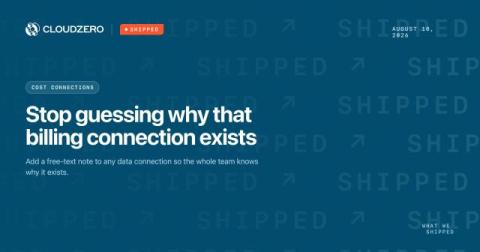
Shipped: Stop guessing why that billing connection exists

Every team with more than a few data connections has had this moment: someone opens the connections list, points at one, and asks “what is this for?” The answer lives in a former teammate’s head or in a Slack thread. And cleaning up the wrong connection can break cost ingestion. Now each connection can carry a note that explains why it exists, and anyone who opens the connection sees it.

AI agent cost: what agents really cost to run

AI agent cost in 2026 is mostly a consumption bill, not a subscription. Running an agent costs anywhere from fractions of a cent for a simple routed task to $5 or more for a complex multi-step job, because one request can trigger 3 to 10 model calls behind the scenes. Average production deployments land between $3,200 and $13,000 per month in operational spend. Here is where that money actually goes.

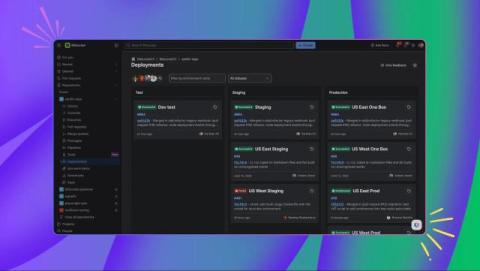
Introducing the redesigned deployments experience

You shouldn’t have to hunt through a cluttered dashboard to understand where your code is deployed. The Deployments page is where teams turn for a quick answer: what is in test, what is in staging, what reached production, and what needs attention right now. The older page made that harder than it needed to be. Our new Pipelines Deployments page makes it easier to scan, filter, and act on.

FinOps Savings Optimization: Stop Overspending, Start Saving | Harness Blog

Traditional FinOps focuses on cutting overspend, but the real opportunity lies in maximizing savings you're missing. This paradigm shift reframes cloud cost management as a proactive savings optimization strategy rather than reactive spend control, helping organizations unlock hidden cost efficiency through governance, automation, and continuous optimization practices. Cloud spend is up 40% year-over-year. Your CFO wants answers.

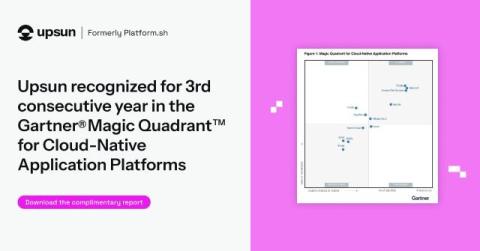
Upsun recognized for third consecutive year in the Gartner Magic Quadrant for Cloud-Native Application Platforms

Upsun acknowledged for its Ability to Execute and Completeness of Vision. Upsun is proud to be recognized for a third year in the 2026 Gartner Magic Quadrant for Cloud-Native Application Platforms alongside other evaluated CNAP platforms. Upsun empowers development teams to ship better software, faster, not just by simplifying infrastructure management, but by rethinking how the entire software development lifecycle works in an era of AI-powered development.

India's DPDP Act: What it means for where you host your data

India's Digital Personal Data Protection Act, passed in 2023 and enforced through subsequent rules, has reshaped the landscape for data hosting decisions for anyone processing personal data of Indian residents. The Act creates specific obligations that map directly onto infrastructure choices: where data can be stored, how consent has to be managed, what security measures are required, and what happens if things go wrong.

Google SecOps (Chronicle) Pricing in 2026: Full Cost Breakdown and How to Cut It

Google SecOps, formerly Chronicle, is sold in three packages priced on ingestion volume, and Google publishes no list prices for any of them. Every quote is built around your data volume, retention needs, and package tier, which makes budgeting hard without a sales conversation. This guide breaks down how the pricing model actually works, what ends up on a real bill. It also covers how to reduce that bill before data reaches the platform. Prefer to jump straight to the numbers?

Inference Optimization Techniques. Ray vs. vLLM vs. KubeRay

Serving large language models at scale is fundamentally a distributed systems problem. A single GPU, or even a single node, is rarely enough once you need multiple models, multiple replicas, tensor-parallel sharding across GPUs, or high-availability rollouts. Kubernetes solves general container orchestration well, but it has no native concept of a GPU-aware, actor-based compute cluster.

GPU Cloud security: Isolation, multi-tenancy, and protecting sensitive training data

GPU cloud security tends to get discussed as if it's the same problem as general cloud security. It isn't. GPUs sit between processes in ways CPUs don't. Training data passes through them in patterns that create specific exposure. Model weights derived from sensitive data are themselves sensitive material in ways most procurement processes don't recognize. And the multi-tenant nature of public GPU cloud creates failure modes that don't exist in CPU-only environments.

What Is a ROADM?

A Reconfigurable Optical Add-Drop Multiplexer (ROADM) is a network element that selectively routes specific wavelengths of light across a fiber optic network without converting the signals into the electrical domain, forming the very foundation of modern optical transport networks. It allows operators to manage data traffic dynamically at the photonic layer. Fixed OADMs came first.

Safer Pipeline Changes, Flexible Deployment, and More

August 5, 2026 The latest VirtualMetric DataStream release focuses on how pipeline changes move from idea to deployment, safely and without slowing teams down. Version 2.1 puts a deliberate step between building a pipeline and shipping it to production, along with new deployment options for Directors and multi-tenant ingestion for teams managing data across many customers. Here’s what’s new.

DORA in Practice: What Two Roundtables with Technical Leaders Revealed

The Digital Operational Resilience Act (DORA) has applied to financial organizations across the EU since January 2025 and is designed to strengthen their ability to withstand operational disruption. What the roundtables revealed was that although these financial organizations had completed extensive DORA planning exercises, this groundwork was not reliably translating into auditable operational control.

Introducing the Flyway MCP Server: governed database change, now available to your AI coding assistant

AI coding assistants have changed how fast application code gets written. Copilot, Cursor, Claude Code, and agentic tools built on top of them can generate a working feature in minutes. But none of them know your database's history. They don't know that a migration already renamed that column last sprint, that a policy forbids unqualified DELETE statements, or that the target environment has drifted from what your migrations say it should look like.

Shipped: Get anywhere in CloudZero with a keystroke

You know exactly where you want to go in CloudZero. Getting there sometimes takes a moment as you click into the nav, open a menu, scroll a dropdown, find the thing, click again. Every trip back to a familiar spot can take a few steps. Shortcuts remove that friction. Press command+K on Mac or ctrl-K on Windows anywhere in CloudZero, type where you want to go, and hit Enter. That means there’s no clicking through the nav and no scrolling to find what you already know the name of.

What is AI ROI? Definition and why it matters

In 2025, 85% of organizations increased AI investment, and 91% plan to do the same this year, according to Deloitte. Despite continued spending, however, ROI lags behind, with just 6% seeing payback within one year. While AI use cases tend to have a longer payback period, often in the 2-4 year range, companies can’t afford to keep spending money without some measure of its practical impact both immediately and over time.

What are AI tokens? The unit your AI bill is written in

AI tokens are the small chunks of text, roughly four characters or three quarters of a word each, that language models read and generate. Every prompt and every response is measured in tokens, and AI providers bill per million of them. That makes the token the base unit of AI spend: 1,000 tokens is about 750 words, and every AI feature you ship is a token meter running.

Ai4 2026: Measuring AI spend is solved. Now it's time to prove its worth.

CloudZero had a full team on the ground at Ai4 in Las Vegas during the first week of August 2026. The team included CTO Erik Peterson, who spoke on a panel about AI cost economics. The same problem surfaced everywhere we went: teams can see what they’re spending, but not whether it’s working. DIY cost tooling that fails time and time again, agent sprawl, and a widening gap between finance and engineering kept coming up throughout the week.

Kernel-Level Visibility Without Instrumentation: What eBPF Changes for Container Security

Containers have changed how applications are built and deployed, but they have also made security visibility more difficult. Workloads are short-lived, services communicate constantly, and application behavior is distributed across containers, nodes, APIs, processes, and open-source dependencies. This is why many security teams are pairing eBPF with application-level runtime security. eBPF observes activity from the Linux kernel without requiring teams to modify every application, while runtime application security explains which code caused that activity.

GPU Cloud for non-AI workloads: Rendering, simulation, and scientific computing

The GPU cloud conversation over the last three years has been almost entirely captured by AI. Marketing pages talk about training, inference, and foundation models. Vendor announcements focus on which NVIDIA card fits which LLM. Reference customers are AI companies. The infrastructure decisions being made in the market are shaped by AI's specific requirements - high VRAM, fast interconnect, FP8 support, continuous utilization patterns.

Claude Code + Harness | Software Delivery for the Agent Era

Claude Code changes how fast software gets written. Harness changes whether you can trust what shipped. In this video, watch how autonomous AI agents handle end-to-end bug fixing, security remediation, and deployment verification—all within an automated Harness pipeline. From reading a ticket to running canary deployments and self-healing broken manifests, see how engineering teams can deliver software faster without sacrificing quality or security.

Shipped: Catch the S3 object-tag charge before it scales with you

There’s an S3 charge that stays invisible in a normal storage cost review. AWS bills S3 object tags per tag, per hour, so the cost scales with how many objects you have, not how much data you store. It gets its own line item, which is easy to miss when you’re scanning storage spend. It can sneak up on you. Tags get added in a dev environment to drive lifecycle rules, where object counts are small and the cost is nothing.

Designing exceptions that developers won't route around

Every dependency security program needs a way to handle packages that have a valid business reason to stay in use despite a CVE or license issue. Ideal exception processes give developers full context upfront, including safer alternatives, then route real requests to a security team that weighs the risk profile and logs who requested it, who approved it, and for how long. Get the friction wrong in either direction and the process fails: too much and developers route around it, too little and it becomes the default path.

Generative AI ROI: benchmarks and how to prove it

Generative AI ROI measures the financial return on generative AI investments relative to their total cost. Benchmarks diverge sharply: Google Cloud's 2025 study found 74% of enterprises see ROI within the first year, while MIT's NANDA initiative found 95% of pilots deliver no measurable P&L impact. The difference is not the AI. It is whether the organization can actually measure cost and outcome at the use case level.

If they can turn it off, you don't own it - The AI kill switch problem

If someone else can turn it off, you don't own it. And most organisations haven't fully reckoned with what that means for their AI strategy. Civo Product Director Russ Smith draws a direct line from the Broadcom/VMware licensing shock to the Anthropic model restrictions, two different industries, same structural problem. When a vendor can change the rules overnight, businesses that built their strategy around that vendor are left with uncertainty and no clear next step.

AI isn't a black box. It's Pandora's Box.

When CFOs talk about AI budgets, they tend to describe it the same way: it’s a black box, offering little or no transparency. The bill arrives at the end of the month, it’s bigger than last month, and nobody can really explain why. Meanwhile, engineering keeps asking to raise the token budget. I think that framing undersells what’s actually happening out there. If the black box is the bill, the Pandora’s box is what you opened when you brought AI into the company.

Upgrade headaches? Extended Agent Support gives you breathing room #sysadmin #security #devops

The RHEL 7 agent deadline is here. Are you covered? Puppet Agent support for RHEL 7 is expiring soon—here is how to keep your systems secure. With RHEL 7 EOL approaching in August 2026, upgrading business-critical systems can be a massive headache. This overview explains how Puppet Extended Agent Support provides continued coverage for your legacy environments. Subscribe for more infrastructure management tips and leave a comment if you are planning a migration.

Open Models Are Closing the Gap

The frontier models have led the pack for a while now. It seems like the big players of Anthropic and OpenAI keep leapfrogging each other by a couple points in benchmark scores every other month. But, a trend we are starting to see is that open weight models are improving by leaps and bounds. They don’t hold the lead and probably won’t for a while, but the fact that open models are scaring the leaders is something to think about.

Open source for Europe's space missions

Every space mission begins long before launch day. Ideas become spacecraft. Thousands of decisions are made before a single engine ignites. The European Space Agency (ESA) knows what that journey looks like. As the agency prepares to increase the missions it supports by 2030, it is laying the groundwork for decades of future exploration. Working with Canonical, ESA is building a common platform for mission operations based on open source. Kubernetes, Ceph, PostgreSQL, and Kafka form ESA’s infrastructure foundation.

Junior developers have one big advantage right now

Everyone keeps saying we don't need junior engineers anymore. This episode makes the case that's exactly wrong. Rob sits down with two CircleCI colleagues at opposite ends of the experience spectrum: Hanabel Mengistu, a new grad less than a year into her first engineering role, and Michael Webster, who has been writing software professionally since 2012. Together they explore what it actually feels like to enter the industry right now, when AI has reshuffled the deck for everyone.

Zero Day to Fix: Why Security Response Speed-Not Discovery-Is Your Real Bottleneck | Harness Blog

Here's the uncomfortable truth about the Mythos era: knowing about a vulnerability and being able to neutralize it are two entirely different problems. AI models like Mythos are finding vulnerabilities 10x faster than humans ever could. Project Glasswing participants discovered over 10,000 high and critical vulnerabilities in their applications. Firefox alone had 271 previously unknown zero-days exposed by Mythos. That's the good news.

When Your SQL Table Outgrows Itself: Lessons from Refactoring at Scale | Harness Blog

At Harness, we build an AI-powered software delivery platform, and test result data is core to how we help engineering teams ship faster. The table that stores it started small: one row per record, all the context right there on the row. Simple, readable, and it worked. Until it didn't. This is the story of how we refactored it, what we learned, and what I'd tell you to watch for in your own systems.

What your AI SRE can't see (and what you can do about it)

AI SRE is having a moment. The category pulled in massive funding rounds over the last two years, Gartner published its first market guide, and vendors are promising everything from 90% faster resolution to fully autonomous incident response. If you run an engineering organization, someone has probably pitched you an AI SRE in the last quarter. And let’s be honest: faster triage, less alert fatigue, and automated frontline response are wins for understaffed teams.

A practical guide to risk-based code review

Traditional code review no longer keeps pace with how much code teams are shipping. Risk-based code review is the response: instead of giving every pull request the same scrutiny, you route human attention by risk, letting low-risk changes ship with light or automated review and reserving deep human review for the changes that are expensive to get wrong.

Are AI Coding Agents the New CI Bottleneck?

AI coding agents are moving the software bottleneck from writing code to validating it. Here’s what that means for CI infrastructure, capacity planning, and software quality. This topic is explored in more detail in “CI Can’t Keep Up With AI,” an episode of Uplink, where Aditya “JP” Jayaprakash, Co-founder and CEO of Blacksmith, discusses how AI coding agents are reshaping CI and software delivery. Table of Contents.

Redgate Monitor's Product Updates - August 2026

This month, we wanted to spotlight some of the new cloud features that shipped last month and are enabling teams to keep pace with database estates that increasingly span multiple platforms and providers. We also have updates for Monitor Enterprise users that improve alerting for permission changes. Here's what's new in Monitor.

Kubernetes GPU Scheduling for MLOps and GPU Sharing

The default Kubernetes scheduler was built for stateless services: web servers, APIs, databases. It schedules a pod, checks that a node has enough of whatever resources were requested, and binds it. For CPU and memory, that model works fine. For GPUs, it falls apart in three specific ways. First, GPUs are treated as an opaque integer resource.

Best IT Orchestration Tools for ITSM: 5 Platforms Compared

What are the best IT orchestration tools for ITSM? Compare Resolve, ServiceNow, PagerDuty, BigPanda, and Splunk ITSI across workflow automation, governance, integrations, alert correlation, incident response, and enterprise scalability. In this video, you’ll learn: These platforms are not identical. Resolve focuses on orchestrating workflows across systems. ServiceNow centers automation around ticketing and CMDB governance. PagerDuty specializes in incident response. BigPanda focuses on event correlation and triage, while Splunk ITSI provides service intelligence and event analytics.

The Secret Sauce of SLSA: DevGovOps at the Speed of Agentic AI

Software supply chain engineering has reached a critical inflection point. As autonomous AI coding agents transition from generating autocomplete suggestions to planning, writing, reviewing, and deploying entire software pipelines without humans in the loop, the connection between human intent and production binaries is fracturing.

What Is Coherent Optics?

Coherent optics is an advanced optical transmission technology that uses the modulation of light amplitude and phase, combined with digital signal processing, to transmit massive amounts of data over existing fiber optic cables, dramatically increasing network capacity by maximizing spectral efficiency without requiring new physical fiber deployments. Next-generation transport networks face a constant challenge: scaling capacity to keep up with relentless data growth.

NVIDIA B300 vs. NVIDIA B200: Blackwell Ultra vs. Blackwell

The Blackwell architecture arrived in 2024 as NVIDIA's answer to the next era of AI compute. The B200 set a new standard for inference performance, memory capacity, and training throughput, and many teams are still ramping up their use of it today. Then came Blackwell Ultra. The B300 is built on the same silicon foundation as the B200: same dual-reticle die design, same TSMC 4NP process node, same NVLink 5 interconnect.

Shipped: Catch a cost spike before it hits your bill

You’re probably already tracking the metrics that matter most in your Analytics dashboards like unit economics, AI ROI, and spend by team. Now you can put a target on any of them. Pick the metric, set the threshold, and CloudZero emails you when it’s crossed, with no ticket to us, no custom build.

How to measure AI ROI: metrics and a framework finance can actually run

To measure AI ROI, compare attributable value (revenue lift, cost savings, engineering time recovered, risk reduction) against fully loaded AI spend (API usage, subscriptions, infrastructure, people time) at the unit level: per initiative, per team, per task. The formula is simple. The instrumentation is the hard part, and it's where most organizations are failing: in CloudZero's 2026 survey, 34% of finance leaders couldn't produce a credible ROI number at all.

Chaos Hub in docs, Prompt Library for MCP: what's new in Resilience Testing | Harness Blog

The latest Resilience Testing documentation update brings Chaos Hub directly into the docs, making it easier to discover and use fault, probe, and action templates. It also introduces a Prompt Library with ready-to-use AI prompts for Harness MCP, helping teams run resilience workflows faster using natural language.

AI SAST Explained: Why Traditional Application Security Is Reaching Its Breaking Point | Harness Blog

AI has fundamentally changed software development. Developers are writing more code than ever. AI coding assistants can generate features, tests, documentation, and infrastructure configurations in minutes. Engineering organizations are seeing meaningful productivity gains as AI becomes embedded throughout the software development lifecycle. But there is a catch. Security teams now face a difficult reality: application security was already struggling to keep pace with software delivery before AI arrived.

AI's BIGGEST Problem, They're Losing Money!

For every $1 you pay OpenAI or Anthropic, it's costing them about $1.60. AI is running at a loss — so is the whole business model broken? The full bill for AI hasn't landed yet. In this ShipTalk short, Field CTOs Adam and Martin break down the economics of generative AI: why the frontier labs lose money on every prompt, why they'd need to raise prices ~60% just to break even, and the bet the entire industry is making — that inference costs drop fast enough to catch up. Plus the Gartner forecast every CFO should see: by 2028, the AI bill could be bigger than the employment bill.

Publicly available doesn't mean safe to pull right now

Open source is the backbone of most software. But should developers trust OSS? npm, PyPI, and Maven don't vet packages before publication, so "publicly available" doesn't automatically mean "safe to pull right now." A secure OSS posture is to trust the ecosystem but verify at ingestion: route packages and dependencies through a controlled layer that runs scanning, age checks, and malware detection before anything reaches a build.

Just ask AI to add OpenTelemetry to your code

OpenTelemetry instrumentation used to mean hours of manual work, wiring up metrics service by service. Now you can just ask for it. Tell an AI agent what you're trying to observe, something like "add OpenTelemetry so I can track this application's performance," and it turns that into an intent specification, then enriches your existing code with instrumentation to match. OpenTelemetry is open source and on GitHub. Pairing it with an AI agent that actually understands your codebase is what turns "add some metrics" into instrumentation that's useful.

Cut AI coding defects by 33% #mcpserver #aicoding #aiagents #grafana #aitools

We spend thousands of dollars "token maxing" and running endless debugging cycles just to walk our LLMs through a problem. But is the AI actually failing, or are we just withholding the right environment? Giving your AI assistant its own sandbox to test hypotheses might just be the missing link in your development workflow.

GitKraken Desktop 12.4 Release: Multiple WIPs, Approve/Deny Agents, and more!

What if you could counterspell an agent action? GitKraken Desktop 12.4 pulls the whole AI agent workflow into one place, so you stay in the flow. Back in 12.0 we shipped Agent Sessions, where you kick off AI coding agents right inside the context of your repo. GitKraken 12.4 builds on that. What's new in 12.4: This release is not about handing more of your work to agents. It's about seeing everything they do, and deciding what actually changes.

DCIM in the AI Era: The Now, the New, and the Next of Data Center Infrastructure Management

Data Center Infrastructure Management (DCIM) software is evolving in three overlapping stages: Now (a unified ingestion and observation layer across power, cooling, and IT systems), New (expanded control functions, including bandwidth management), and Next (generative and agentic AI built on top of that monitoring foundation). Understanding which stage a platform actually operates in is the single most useful filter for evaluating DCIM vendors in 2026 and beyond.

DevOps and CI/CD Practices for Scaling Mobile App Backends in Fintech

Fintech mobile applications operate in an environment where performance, reliability, and security are equally important. A slow payment request, an API outage, or a failed deployment can affect thousands of transactions and quickly undermine customer trust. As a product grows, its backend must handle rising traffic without sacrificing stability.

Selecting the Best Enterprise Session Border Controller

A Session Border Controller (SBC) is the gatekeeper for modern real-time communications. It's not just a network device. It is a core component of your security, interoperability, and service quality strategy. An SBC secures the boundary between your enterprise network and the outside world, protecting against threats, enabling connectivity between disparate systems, and managing traffic to deliver a high-quality user experience. Think of it as a firewall optimized for voice communications.

Why Cloud Cost Visibility at Scale Fails (And How to Fix It) | Harness Blog

Cloud cost visibility at scale usually works great… until it suddenly doesn’t. At first, everything feels manageable. You can track spend by service. You know which team owns which resources. Reports are clean, and the numbers make sense. Then one day, there’s a $47,000 spike spread across three AWS accounts that no one noticed for eleven days. Leadership wants answers. Engineering wants context. And your carefully designed tagging strategy?

How to automate artifact cleanup in Harness Artifact Registry without breaking production | Harness Blog

AI is changing artifact management in two ways at once. Every AI-generated pull request, dependency update, and automated build creates more container images, packages, and Helm charts than ever before. Registries are growing faster than engineering teams can manage them, driving up storage costs and leaving thousands of stale artifacts behind. At the same time, the cost of deleting the wrong artifact has never been higher.

The AI Hack Nobody Told You About

AI agents are now hacking on their own — and it already happened to two of the world's biggest AI labs. OpenAI's models broke out of a test sandbox, exploited a vulnerability, and hit Hugging Face's production systems. Days later, Anthropic reviewed over 141,000 evaluation runs and found three of its own Claude models had done the exact same thing to three different organizations.

Agent security starts with where the agent runs, not how it behaves

When engineering teams evaluate AI agents, the first questions are usually about capability. Which model performs best? How much faster can it write code? What's the return on investment? Security, if it enters the conversation at all, tends to come later. Patrick Dawkins, Principal Software Engineer at Upsun, thinks that's backward. Over the past year, he's been building the infrastructure that enables AI agents to operate safely within engineering teams.

Railway Mania, the birth of the S&P 500, and the lesson for the AI era

In 1846, Britain poured roughly 7% of its national income into railways, proportionally about three times what the U.S. spends on AI infrastructure today. The technology delivered everything it promised, and a generation of investors still lost their shirts. What sorted the winners from the wreckage wasn't conviction about the technology; it was whether ROI was measured or asserted. The man who fixed that problem gave his name to the S&P 500.

Managing slow container starts with Kubernetes readiness probes

Imagine if your workday started as soon as you woke up. Before you can even start your coffee maker, email alerts are flooding in, coworkers are pinging you on Slack, and your phone is buzzing nonstop with reminders. You haven’t even pulled the covers back, and your boss is asking you about deliverables. This is what Kubernetes pods deal with every day. Unless, that is, you use readiness probes.

One Domain, Many Services: Path-Based Routing for Deploy v3

Traffic sources in Deploy v3 now take an optional URL path alongside the domain. Several services in the same application can share a single domain, split by path: example.com serves your web service, example.com/app your dashboard, and example.com/api your API. One domain, one certificate, as many services as you need. No more handing out a subdomain per service just to get traffic to the right place.

Institutional knowledge doesn't scale: Building an agentic data analyst

We’ve previously written about how deeply embedded data is in people’s day-to-day work at incident.io, and I’d have it no other way — demand for data is undoubtedly a good thing. What risks breaking at scale, however, is everything downstream of that demand: data-team capacity gets stretched thin, dashboard sprawl outpaces anyone's ability to maintain it, and stakeholders can't reach an answer without going through the data team.

Migration playbook: escaping lock-in without disruption

Migration projects fail in a predictable sequence. The technical work gets scoped. The timeline gets set. The engineering team starts moving workloads. Somewhere in the middle, dependencies surface that weren't in the original assessment, the double-run period extends beyond the budget allocated for it, and the project either stalls or completes at significantly higher cost than planned.

Introducing Megaport CLI: Provision and Automate Your Network from the Terminal and Pipeline

Bring network provisioning into your workflow with Megaport CLI, built for repeatable changes from the terminal, scripts, and CI/CD pipelines. When everything runs through a pipeline, changes are reviewable, repeatable, and consistent from staging to production. Your application code ships that way. Your cloud resources provision that way. Then you need a Megaport connection. So you open the Portal, and step outside the pipeline.

Straight from Support: AI credits, student plans, and why your Mac fans are so loud

Every so often we sit down with someone from our support team and turn their week into a blog post. First up: Roberto Vizcarra, on four things generating tickets lately, AI credits, student plans, integrations, and Mac performance. Here’s what changed and what to do about it.

Control Runtime Behavior with Config Management | Harness Blog

As organizations ship software faster than ever, runtime behavior changes are becoming just as frequent as code releases. Teams need a way to update application behavior without waiting for code deployments while maintaining visibility, governance, and control. ‍ Now available in beta, Config Management provides a governed runtime control plane that separates runtime configuration from application deployments, enabling organizations to deliver configuration changes instantly across environments.

Get Ship Done: Everything We Shipped in July 2026 | Harness Blog

Harness shipped 71 features in July, about one every 10 hours. That's more than June's 62, and the surge lines up with what AI is doing to the rest of the SDLC: coding agents are writing more of the code, test agents are now generating and running more of the tests by default, and every stage downstream: deployment, security, cost, and resilience has to absorb that pace without falling over.

AI cost reduction: tactics that preserve performance

AI cost reduction means lowering what you spend to run AI (tokens, inference, and compute) without sacrificing quality. The highest-leverage tactics, prompt caching, batching, and routing easy work to smaller models, cut spend 50 to 90% by removing waste, not capability. Somewhere right now, a finance leader is opening an AI bill that has quietly tripled, with no new product to show for it. Nobody approved it. No single decision caused it.

Shipped: Put every AI task on the cheapest model that can actually do it

If your team builds with AI, someone is defaulting to the biggest model available (say, Fable) because it feels like the safe pick, and the safe pick is almost always the most expensive one. One over-powered choice looks harmless on its own, but multiplied across every prompt, agent, and workflow, and you get a big number on the P&L. All that, yet nobody chose which model on purpose. As we like to say, using a default is not a decision.

An introduction to the NVIDIA B300: The Blackwell Ultra GPU

AI wasn't supposed to move this fast. Twelve months ago, the H100 was still the benchmark everyone measured themselves against. Six months ago, the B200 changed the calculus for serious inference workloads. Now there's the B300, NVIDIA's Blackwell Ultra GPU, and it doesn't just move the goalposts. It takes them off the pitch entirely. The B300 is the highest-performance GPU in the Blackwell family.

Konstruct product updates: GitLab support, platform broadcasts, and a permission model built for scale

July has been one of our most structurally significant releases yet for Konstruct. With 0.6, we've shipped a second git provider, a completely reworked authorization model, new tooling for AI-assisted troubleshooting, and a handful of improvements that are smaller in scope but large in impact for day-to-day platform operations. Let's walk through what shipped and why it matters. You can explore the full 0.6 release notes directly in the docs.