Operations | Monitoring | ITSM | DevOps | Cloud

You probably already have most of what CRA requires

CRA compliance is similar to other frameworks, like ISO 27001, SOC 2, GDPR, or PCI DSS, in that the same approach applies: define your scope, figure out your product classification, then work through the list of controls. This video covers why that's less daunting than it sounds: CRA compliance isn't a one-time milestone. If you're selling into Europe, you need to continuously meet it.

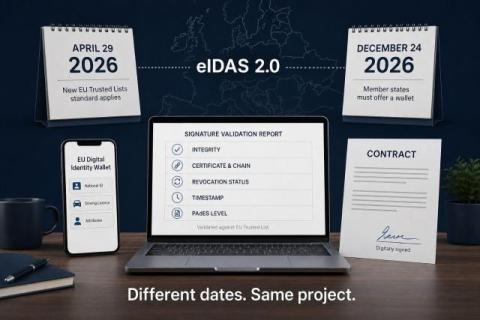
December 2026 Is the Wallet Deadline. The Harder Question Is What Companies Do With What Comes Out of It

Every EU member state has to offer at least one European Digital Identity Wallet. Regulation (EU) 2024/1183 sets the obligation, and the implementing regulations apply from 24 December 2026. Most coverage has focused on the citizen side: one app, national ID inside, log in anywhere in Europe. The business side has had less attention, and it's the side that involves work.

The Cyber Resilience Act isn't just for hardware

There's a common assumption that the EU Cyber Resilience Act is a hardware and IoT manufacturer concern. Actually, it affects any SaaS company selling into the EU too, and that's a gap in awareness worth closing. This video covers what the CRA is actually there to do and what it means for your own software supply chain: Securing your customers' supply chain starts with being able to account for your own.

Building Quality and Compliance Systems That Hold Up to an FDA Inspection

For any company operating in an FDA-regulated industry, the inspection is the moment of truth. It is when the quality and compliance systems a company has built, or failed to build, are examined by investigators trained to find exactly the gaps a company hopes it does not have. A successful inspection reflects systems that were designed to withstand scrutiny; a difficult one, with findings and follow-up, reflects systems that were not. The difference is rarely luck. It comes down to whether a company has built genuine, robust quality and compliance systems well before an inspector ever arrives.

NYDFS Part 500 Asset Inventory Requirements: How Technology Can Support Section 500.13

Financial-services organizations may already have multiple tools telling them what exists across their environment. The problem is that those tools do not always agree. An endpoint platform may recognize a device that a vulnerability scanner does not. A network system may identify an active device that is missing from another asset record. The same device may even appear under multiple names across different platforms. That creates a simple but important question: Which view can you trust?

The EU Is Starting to Put Labels on the Synthetic Internet

It's getting harder and harder to distinguish between content produced by people and content produced by machines on the internet. AI can now create convincing articles, images, audio and video that may not be immediately recognized as being AI-generated. Europe has decided that this uncertainty cannot be left to users to deal with on their own. The EU AI Act introduces new transparency obligations, which are beginning to establish a more structured framework for identifying synthetic content.

India's DPDP Act: What it means for where you host your data

India's Digital Personal Data Protection Act, passed in 2023 and enforced through subsequent rules, has reshaped the landscape for data hosting decisions for anyone processing personal data of Indian residents. The Act creates specific obligations that map directly onto infrastructure choices: where data can be stored, how consent has to be managed, what security measures are required, and what happens if things go wrong.

School at Home Is a Data Problem Before It Is a Teaching Problem

A family pulls their daughter out of school in March, planning to finish sixth grade at home and re-enroll her in the fall. In September the district registrar asks for an account of the spring: days of instruction, subjects covered, evidence of progress. What the parents have is a stack of finished workbooks, a library card with a long history, and a phone full of undated photos. They spend a weekend reconstructing five months from memory.

CRA turns software trust from assumed to legally required

For years, buying software meant trusting the vendor. The Cyber Resilience Act changes that relationship by codifying what vendors must do – auditing dependencies, confirming exploitable vulnerabilities, and enforcing security best practices – as legal obligations, not internal choices. For customers, that means software safety is no longer a matter of brand reputation. For vendors, it means governance gaps that were once internal concerns are now deal blockers.

Prepare for the EU AI Act with Harness AI Security | Harness Blog

Harness AI Security provides a unified control plane for AI discovery, risk visibility, and runtime protection, helping organizations operationalize key requirements of the EU AI Act. Instead of relying on manual audits or fragmented tooling, teams get continuous insight into how AI systems are built, exposed, and used, along with the evidence needed to demonstrate compliance.