

|
By Amber Weaver
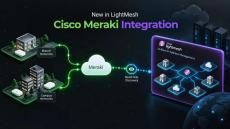
Some features start on a roadmap. Others start with a recurring customer request: Can LightMesh connect to Meraki? That request kept coming up. Now the answer is yes. LightMesh supports Meraki sites with multiple VLANs or a single LAN through the new cloud integration for Cisco Meraki. Appliance addressing from Dashboard syncs into LightMesh as subnets (with VLAN ID when Meraki provides one), and device or client LAN IPs only when they fall inside those CIDRs.
|
By David Colebatch
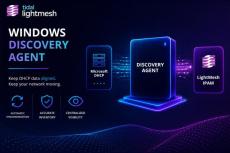
Your DHCP server knows which addresses it assigned. It does not know which of those addresses are answering on the wire right now. That gap shows up in every hybrid network where static devices, reservations, and stale leases sit beside active workloads. Leased and live are different questions. DHCP scopes answer the first. Subnet ping-sweep answers the second. Together they give IPAM fresher last-seen context without handing an NMS credentials across the network.
|
By Amber Weaver
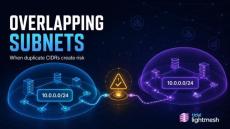
An overlapping subnet can sit quietly for years - until two networks need to connect. A duplicate CIDR (Classless Inter-Domain Routing), an IP address range such as 10.0.0.0/24, may cause you no immediate trouble while networks remain isolated. During an expansion, acquisition, or cloud migration, however, that same overlap can become a connectivity blocker. Cloud peering is one place where the issue becomes unavoidable.

|
By David Colebatch
Twenty years ago at RMIT, I became preoccupied with a question that sounded technical but was really about corporate value: could you predict how difficult a company would be to acquire by looking at the shape of its APIs? It was 2006. I was completing Honours in a Bachelor of Applied Science in Software Engineering, and the brief for my research project was unusually open: find an impactful software research hypothesis that hasn’t been done before.
|
By David Colebatch
For years, the cloud migration business case was framed around one comparison: “Will AWS be cheaper than our data center?” That question still matters, but it is no longer where the value is. The 2017-2024 wave of mass migration is largely complete. Most enterprise workloads are already in the cloud - often in a lift-and-shift state: oversized instances, commercial-OS BYOL, on-prem-shaped network designs, and legacy frameworks that block the next step.
|
By Amber Weaver
Infrastructure assessment tools scan your servers and estimate migration cost based on CPU, memory, and storage. They do not read your application code. Applications that appear migration-ready at the infrastructure layer may contain thousands of lines of code that block cloud adoption. Without code-level visibility, teams cannot make accurate 6R decisions.
|
By David Colebatch
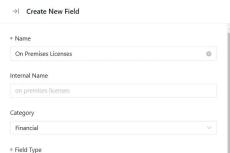
Modernization assessments move faster when the structure is already in place. Instead of recreating custom fields, interview questions, and assessment workflows for every customer, you can use a custom field template to standardize how data is collected from the start. This guide shows you how to create a reusable Tidal Accelerator custom field template using Node.js and the Tidal API, so your assessments are easier to repeat, compare, and scale. So you’re starting a modernization practice.
|
By Amber Weaver
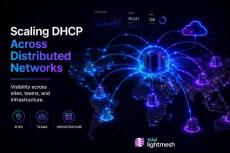
Managing DHCP across distributed networks gets messy fast. Lease activity changes constantly. Naming conventions drift. Infrastructure changes happen independently across locations. Before long, your team no longer has a complete view of what’s happening across the network. What started as a straightforward service becomes a records problem with real operational consequences.
|
By Amber Weaver
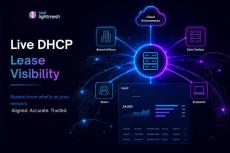
Dynamic Host Configuration Protocol (DHCP) activity changes faster than most IP inventory systems can keep up. Devices reconnect. Leases expire. Infrastructure changes constantly across servers, endpoints, and cloud environments. If your IP inventory cannot reflect those changes automatically, teams quickly lose confidence in the data they rely on to operate the network.
|
By Amber Weaver
Your Dynamic Host Configuration Protocol (DHCP) server already knows what’s connected to your network. The problem is that DHCP data rarely stays aligned with the rest of your infrastructure systems. Instead, it becomes fragmented across Windows servers, branch offices, spreadsheets, and disconnected operational tools. Lease data ages, assignments go untracked, and teams lose confidence in their network inventory.
|
By Tidal
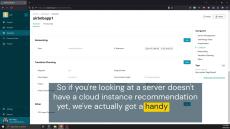
Tidal.cloud's AWS Optimization and Modernization Assessment provides organizations with a no-cost assessment capability for modernizing applications into the cloud. By leveraging Tidal Accelerator, your infrastructure, databases, source code and the business of your application, are all analyzed and considered for one of the 6Rs of migration.

|
By Tidal
AWS Optimization and Modernization Assessments give organizations an actionable cloud migration plan and business case that maximizes their ROI.

|
By Tidal
This episode discusses using Nmap for network-based discovery to fill server inventory gaps in data centers. The integration with Tidal Accelerator allows for quick scans and discovery of servers and devices, providing peace of mind for data center closure and migration programs.
|
By Tidal
Modernize as you Migrate Episode 4: Discovering Your Servers with Ease using VMware Integration.
|
By Tidal
Episode 3 of our 'Modernize as you Migrate Series' explores how to efficiently scale cloud migration work across teams using @tidal4774 's latest features. Tidal Accelerator now integrates with Jira templates, allowing teams to replicate workflows and manage tasks consistently and in real-time. The episode highlights simplified workflows, timelines, tasks management and the elimination of manual errors and repeat work. Increase productivity and streamline your cloud migration process today with Tidal Accelerator's project templates and Jira integration.
|
By Tidal
Explore the significance of Application Owner Interviews in your migration strategy from @tidal4774. Learn how these interviews help you align technology with business objectives, maximize ROI, and streamline the migration process efficiently.

|
By Tidal
Unlock the secrets to streamlining cloud migration and breaking free from Analysis Paralysis with Tidal Accelerator from @tidal4774. Discover how Tidal Accelerator empowers organizations to make informed decisions, optimize costs, and accelerate their cloud migration journey.
|
By Tidal
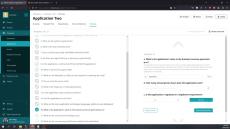
We are thrilled to announce the latest update to Tidal Accelerator, which focuses on optimizing one of our most popular features: Application interviews. This update was designed to make the interview process faster, more intuitive, and easier to use. The latest update of Tidal Accelerator includes pre-filled interviews, which save time for users who are completing interviews for similar applications.
- September 2026 (2)
- August 2026 (2)
- July 2026 (4)
- June 2026 (2)
- March 2026 (1)
- August 2025 (1)
- July 2025 (2)
- June 2025 (1)
- April 2025 (2)
- March 2025 (6)
- February 2025 (5)
- January 2025 (4)
- December 2024 (2)
- November 2024 (1)
- September 2024 (2)
- April 2024 (1)
- March 2024 (4)
- February 2024 (4)
- November 2023 (4)
- October 2023 (4)
- September 2023 (2)
- May 2023 (3)
- February 2023 (2)
- January 2023 (1)
- December 2022 (4)
- June 2022 (4)
- March 2022 (4)
- February 2022 (2)
- January 2022 (4)
- December 2021 (2)
- November 2021 (1)
- October 2021 (1)
- August 2021 (1)
- April 2021 (1)
- March 2021 (2)
- December 2020 (1)
- September 2020 (2)
Tidal is a Software-as-a-Service platform built for companies migrating to the cloud. Our collaborative, application-centric approach allows you to discover, assess, plan, and manage your migration with actionable insights to transform your applications and support your business goals.
Leverage your data. Migrate faster, make savings. Plan successfully from day one.
- Discover your data. Lightning fast. Analyze databases, source code and technologies in minutes with agentless discovery. All in one convenient source of truth. The Tidal Platform integrates with your existing tools to save you time and fill in the gaps.
- Cloud Readiness Assessment. Identify roadblocks and quantify the difficulty of Replatform and Refactor migrations. Tidal makes it easy to assess all your source code and database configurations, and get a recommended application migration plan. Drive faster modernization of legacy applications and move towards database freedom.
- Easy prioritization, tracking and design. Tidal brings prioritization and assessment automation to help your team plan, and the data to ease your transition. Build migration waves leveraging dependencies to collaborate and ensure success.
The Leading Planning Platform for Cloud Migrations.