Do you find yourself lying awake late at night, worried that your greatest observability fears will materialize as one of the most horrific specters of Kubernetes-driven chaos reaches up through your mattress to consume your very soul?
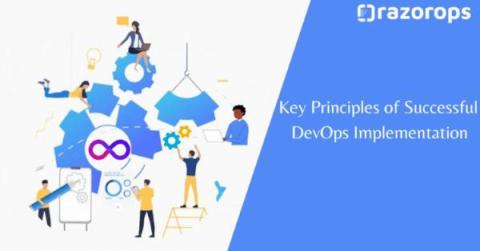
Software development, DevOps has emerged as a game-changer. It’s not just a buzzword; it’s a cultural and technological shift that allows organizations to accelerate their software delivery while maintaining high quality and reliability. However, successful DevOps implementation is not merely about adopting a set of tools or following a predefined set of rules. It’s a holistic approach that requires a deep understanding of key principles.
What better motivation to start adopting a technology than the need to completely replace the alternative. From a world driven on limited resources like gas, coal, and oil to wind, hydro, nuclear, geothermal, and solar… we find ourselves, as a species, evolving past a first generation we envisioned as abundant, but turned sparse. Adopting IPv6 networking is another version of this same story.
Kubernetes or K8s is an open-source production-grade container orchestration system for automating, scaling, and managing containerized applications. A container is a lightweight, standalone, executable ready-to-run software package that contains everything needed to run an application. It includes the runtime, code, libraries, systems tools, and default values for any essential settings.
You'll often hear the term "containers" used to refer to the entire landscape of self-contained software packages: this includes tools like Docker and Kubernetes, platforms like Amazon Elastic Container Service (ECS), and even the process of building these packages. But there's an even more important layer that often gets overlooked, and that's container images.
Kubernetes offers unparalleled flexibility and scalability for containerized orchestration. However, this dynamism can also lead to unexpected costs if you don’t efficiently manage your corresponding cloud resources. In this blog, we’ll outline a series of best practices for Kubernetes cost optimization that will help you keep your infrastructure running smoothly while staying within your budget.
As Kubernetes continues to dominate the container orchestration landscape, ensuring the reliability and stability of applications running on this platform is paramount. Testing in a Kubernetes-native environment demands specialized tools that understand the intricacies of containerized deployments. Enter TestKube, a powerful testing framework designed specifically for Kubernetes.
While Kubernetes revolutionized distributed orchestration, it also added complexity to logging and monitoring. To keep up with the challenges of working with Kubernetes clusters, you need to adapt your monitoring strategy. This includes changing the tools you use. To help keep your Kubernetes environment healthy, we made a list of the best Kubernetes monitoring tools. This list includes both open-source and commercial.
It's one of the most dreaded words among Kubernetes users. Regardless of your software engineering skill or seniority level, chances are you've seen it at least once. There are a quarter of a million articles on the subject, and countless developer hours have been spent troubleshooting and fixing it. We're talking, of course, about CrashLoopBackOff.
In the modern web-app space, there’s been a trend going around that I like to describe as “getting back to basics”. It seems as though over the years, the tooling and complexity around building web-apps has gotten more and more complex. In that time, we’ve strayed further from browser primitives into highly abstracted and javascript-heavy solutions to solve problems our browsers solved back in the 90’s.
In the ever-evolving world of software development and operations, DevOps has emerged as a game-changer. DevOps, short for Development and Operations, is a set of practices and principles that bridge the gap between these two traditionally siloed domains, fostering collaboration and accelerating the delivery of high-quality software. At the heart of DevOps lies automation, a powerful force that revolutionizes the way software is developed, tested, and deployed.
As more organizations embrace containerized applications, Kubernetes has emerged as the leading platform for orchestrating these containers. However, its complexity, combined with the inevitable reality of IT incidents, demands a well-defined strategy for managing disruptions. This article introduces Kubernetes incident management, describes common Kubernetes errors, and provides practical guidance to efficiently handle incidents.
Kubernetes (K8s) is at the forefront of modern infrastructure, but with its capabilities comes a deluge of telemetry data. Efficiently managing and optimizing this data is crucial to harnessing the full potential of your Kubernetes deployments.
Kubernetes integrations are now available for AutoSys, dSeries, and Automic Automation. It wasn’t that long ago that teams in many organizations started dipping their toes into the world of containers and microservices. It didn’t take long for this approach to application development and orchestration to take hold, and for Kubernetes to emerge as a dominant, broadly used technology.
If you’re sick with a cold then measuring your body temperature is a wise move or maybe if things are really bad a visit to a doctor might result in testing vs. what are considered “normal” levels in order to diagnose the issue; seasonal flu or infection? To improve our health after picking up a bad bug, we do things that affect our situation back to normal levels once again where we can then declare ourselves healthy.
Kubernetes has been around for nearly 10 years now. In the past five years, we’ve seen a drastic increase in adoption by engineering teams of all sizes. The promise of standardization of deployments and scaling across different types of applications, from static websites to full-blown microservice solutions, has fueled this sharp increase.
Software development, the evolution of DevOps has been nothing short of revolutionary. What began as a simple concept has transformed into a best practice that is reshaping the way organisations develop, deploy, and maintain their software. In this blog post, we will take a journey through the evolution of DevOps, from its humble beginnings to its current status as an indispensable part of modern software development.
One of Kubernetes' killer features is its ability to seamlessly update applications no matter how large your deployment is. Did a developer make a code change, and now you need to update a thousand running containers? Just run kubectl apply -f manifest.yaml and watch as Kubernetes replaces each outdated pod with the new version.
Control over operational costs is pivotal in Kubernetes' deployment and management. Although Kubernetes brings power and control over your deployments, it also necessitates thorough understanding and management of costs. OpenCost, specifically designed for Kubernetes cost monitoring, combined with VictoriaMetrics, an efficient time series database, offers a comprehensive solution for this challenge.
In 2022, Ofcom, a UK regulator, began its market study into the cloud industry to investigate the dominance that hyperscalers, especially AWS and Microsoft, hold over the industry and the limits this creates for customers. This investigation follows concerns surrounding customers feeling “locked in” to a single provider, potentially leading to inflated prices in the market¹.
Most IT firms build their empire on Kubernetes, for its amazing flexibility and super scalability. RedHat OpenShift Container Platform (formerly OpenShift Enterprise) is a hybrid cloud application platform powered by Kubernetes, which initially only operated on-premise, and has been open to service for more than nine years.
Welcome to the Calico monthly roundup: September edition! From open source news to live events, we have exciting updates to share—let’s get into it!
In our last blog, we talked about the importance of setting memory requests when deploying applications to Kubernetes. We explained how memory requests lets you specify how much memory (RAM for short) Kubernetes should reserve for a pod before deploying it. However, this only helps your pod get deployed. What happens when your pod is running and gradually consumes more RAM over time?
Grafana is an open-source platform for metric analytics, monitoring, and visualization. In this article, we will explore the basics of Grafana and learn how to deploy it to Kubernetes. You will find specific coding examples and screenshots you can follow to deploy Grafana.
If you work with Kubernetes, you know that any number of issues can pose a serious threat to the stability and security of your deployments. One that's subtly damaging is configuration drift, which occurs when the actual state of how your system is set up — its configuration — strays from the way you defined. Configuration drift in Kubernetes can happen when people make changes manually, systems aren't synchronized properly or monitoring falls short.
Kubernetes is one of the most important and influential technologies for building and operating software today because it’s so incredibly capable. It’s flexible, available, resilient, scalable, feature-rich and backed by a global community of innovators — that’s a pretty impressive list of intangibles to apply to any particular capability.

Continuous Integration/Continuous Deployment (CI/CD), the ability to adapt swiftly to fluctuating workloads is paramount. Kubernetes, with its dynamic orchestration capabilities, offers an invaluable toolset for achieving seamless scalability. This article explores the concept of Kubernetes autoscaling and its pivotal role in optimising CI/CD pipelines.