



Boston, MA, USA
2014
  |  By Tomer Levy
OrionIQ is Logz.io’s new agentic observability platform designed to move teams from detecting issues to resolving them automatically. As AI accelerates software development, operations remain manual: engineers still wake up at 2 a.m. to investigate alerts and rebuild context. OrionIQ uses AI agents to analyze real-time telemetry, investigate incidents, identify root causes, and take action across systems.
  |  By Spencer Bos
For years, organizations tried to solve operational pain by collecting more data, adding more dashboards, and consolidating more tools. But 2025 exposed a deeper mismatch. Systems had become more distributed, AI-assisted, and interdependent than ever before, while teams had shrunk and on-call pressure had intensified. This wasn’t a tooling failure. It was an architectural and cognitive one.
  |  By Asaf Yigal
It’s 2026, and developers have more tools at their disposal than at any point in the industry’s history: CI/CD platforms are richer; observability stacks are deeper; security, data, and AI tooling have exploded into crowded, competitive ecosystems. And yet, delivery is still slow, incidents are still noisy, workflows are still brittle. The problem is no longer tool scarcity or feature depth. It’s integration debt.
  |  By Amos Etzion
We’ve updated Logs Explore to integrate the real-time streaming capabilities of the old “LiveTail” into our new Explore environment. The result? A faster and more seamless experience. Customers can now benefit from.
  |  By Yotam Loewenbach
Distributed tracing is a core tool for operating modern microservices platforms. For SREs and DevOps teams, it is often the fastest way to understand latency issues, service dependencies, and unexpected failure modes. But achieving comprehensive tracing coverage is resource-intensive and time-consuming. It usually requires application changes, language-specific instrumentation, agent lifecycle management, and ongoing coordination with development teams.
  |  By Asaf Yigal
What remains of the 2025 AI hype? After a year of “AI will fix everything” promises, engineering teams in 2025 hit a wall of reality: AI is a tool, not a magic bullet. We’re now seeing a more practical approach: identifying broken workflows and tasks where AI can help and leveraging AI strengths like data analysis at speed and scale to derive meaningful, valuable insights. Looking ahead, 2026 will reward organizations that combine AI innovation with a practical approach.
  |  By Jade Lassery
Now available: Secure, real-time access to your observability data via Logz.io’s Model Context Protocol (MCP) Server. The Logz.io MCP Server brings your logs, metrics, and telemetry data into the Model Context Protocol (MCP), an emerging open standard that lets AI systems query real data securely and contextually, in real time. That means any MCP-compatible LLM, like Claude Desktop, Cursor, your own AI agent… can now connect directly to your Logz.io environment.
  |  By Jade Lassery
We’re expanding the Open 360 AI experience to more users with a modernized navigation and full access to Grafana and OSD dashboards. Your existing dashboards, alerts, bookmarks, and integrations remain unchanged, while new AI-powered capabilities provide deeper explanations and actionable insights. Existing customers can request early access through their account team.
  |  By Logz.io
At Logz.io, we speak with hundreds of companies every month. One thing is consistent across the board: everyone ships logs. But the challenges are equally common: What are the best practices for logging? How do we reduce noise? How should we architect our logs to make them truly useful? The reality is that logs are noisy for everyone. The best time to standardize your logging practices is when you write your first line of code—though that rarely happens. The second-best time is now.
  |  By Asaf Yigal
Companies invest millions of dollars in observability platforms, yet they often still struggle to get application monitoring right. This is because most organizations focus on the technology, while neglecting the business. In this article, we’ll show you how to combine business requirements with technological needs. As the CTO of Logz.io, these are based on my experience working with global companies on their application observability needs.
  |  By Logz.io
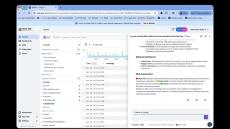
Experience the new Open 360 AI, built to help you explore, analyze, and act on your observability data in a smarter way. See how the AI Agent works directly inside dashboards to explain anomalies, summarize trends across your telemetry data, and guide you to root cause, without switching views or writing queries. Everything you know and love is still here, now enhanced with AI.
  |  By Logz.io
A short demo showing how Logz.io, powered by the AI Agent, helps investigate security incidents by analyzing and correlating data. The AI Agent uses natural language to: This video demonstrates a practical SIEM use case for the AI Agent inside Logz.io.
  |  By Logz.io
Watch how AI is reshaping observability for the years ahead. In this fireside chat, Logz.io founders Tomer Levy and Asaf Yigal reveal how the most innovative AI-first companies are breaking free from dashboards, avoiding common RFP mistakes, and building future-ready stacks. You’ll see: Watch and learn how autonomous AI eliminates noise, slashes costs, and gives engineering teams back their velocity.
  |  By Logz.io
Watch AI transform alert management in real-time. This technical demonstration compares manual alert investigation with AI alert investigation. It shows how AI agents automatically investigate production alerts, correlate telemetry across distributed systems, and identify root cause, faster and with more insights than manual processes. Watch and learn how to shift your team from reactive firefighting to proactive system reliability management with agentic AI.
  |  By Logz.io
Logz.io’s OpenSearch Optimization Tool is a free, open-source CLI utility that gives you fast, actionable insights into your cluster’s performance, cost, and configuration.
  |  By Logz.io
Struggling with high observability costs? In this video, Jade Lassery breaks down the challenges of managing excessive data and skyrocketing expenses. She introduces the Logz.io AI agent, a powerful solution designed to optimize data usage, reduce unnecessary costs, and improve efficiency. Learn how to take control of your observability spending while maintaining high performance. Watch now to discover smarter data management strategies!
  |  By Logz.io
Struggling with Kubernetes performance issues? This video introduces an AI-powered agent designed to help users quickly identify and resolve bottlenecks. By analyzing logs, the AI detects performance issues, streamlining troubleshooting and improving system efficiency. Watch now to see how AI can simplify Kubernetes performance management and keep your infrastructure running smoothly!
  |  By logz.io
In the video, Jade Lassery discusses how to effectively manage complex environments, especially when faced with unexpected spikes in errors. She introduces a Logz.io AI agent prompt that assists users in quickly identifying the root cause of these issues. By simply asking the right questions, users can streamline their troubleshooting process and enhance their operational efficiency.
  |  By logz.io
Welcome to Logz.io, where we make monitoring, troubleshooting, and optimizing your systems easier than ever. Our AI-driven observability platform helps you: Ingest and manage your logs effortlessly Analyze and visualize data with powerful filtering & alerting Pinpoint root causes instantly with AI-powered RCA Optimize observability costs with DataHub Ensure peak system performance with Kubernetes 360 & App 360.
  |  By logz.io
Managing logs in a fast-paced cloud-native world can be tough. Log data is growing, and traditional tools just can’t keep up. That’s where Logz.io comes in—a log management and analytics platform powered by AI to make troubleshooting, performance monitoring, and collaboration faster and easier than ever.

Logz.io is an AI-powered log analysis platform that offers the open source ELK Stack as a enterprise-grade cloud service with machine learning technology. Our platform uses AI and and machine-learning algorithms to help DevOps engineers, system administrators, and developers to find critical events in the volumes of information that are now constantly generated in IT environments.

Created by a Check Point veteran and a former algorithm engineer for the Israeli military, the enterprise-grade, cloud platform is built on top of the ELK Stack and provides real-time access to data insights based on the collaborative knowledge of IT executives throughout the world. The ELK Stack -- Elasticsearch, Logstash, and Kibana -- is the world’s most popular open-source log analytics software stack.