Operations | Monitoring | ITSM | DevOps | Cloud

Following the Money: 3 Transaction Pathways to Monitor

If all you have is the beginning and the end, you’re left with a short, boring story: “Once upon a time, it was UP…then, it was DOWN.” Knowing the twists and turns of your transaction pathways is not only illuminating, but profitable. Information channels dry up when all you have are pieces.
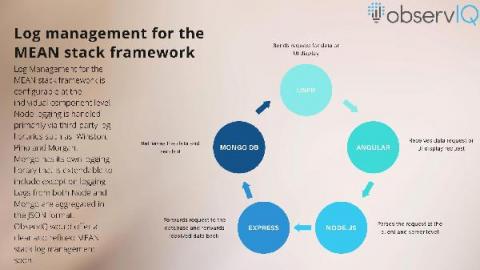

Log Management for the MEAN Stack Framework

MEAN is evolving as a popular web stack for developing cloud native applications because of its scalability, ease of extension, and high reliability. Each component in MEAN is built on JavaScript, contributing to a cohesive development platform. In this post, we take you through the log management options that are available for each component of the MEAN stack framework and their respective limitations – limitations that are addressable with a refined log management solution like observIQ.

Facilitate DevOps Monitoring with Synthetics and RUM

DevOps is a common name in the technology household. Teams, small or big, are embracing this concept to deliver applications faster, improve software quality, and add efficiency in the development process from the very beginning. Shortening the feedback loop leads to a cost-effective way for businesses to find and fix defects earlier in the cycle process. Plus, it lowers the software failure rate in production and minimizes time wastage for the development team.

DevOps' Problem with Speed-to-Market Explained: IBM MQ, Multi-Middleware Role in Deploying New Applications & Updates

If your organization is frustrated with how long it takes to roll out new applications and updates, they are not alone. Speed-to-market is an obsession at many companies today (see call-out box below), so anything that restricts or slows it down is a problem.

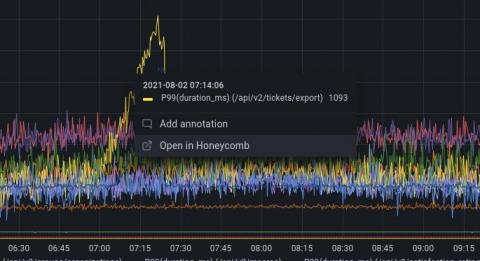
Introducing the Honeycomb plugin for Grafana

Over the years, we’ve heard many versions of the same familiar story: large businesses struggling with observability data living in several different systems. At Grafana Labs, our “big tent” philosophy is based on the belief that our users should determine their own observability strategy and choose their own tools. Grafana allows them to bring together and understand all their data, no matter where it lives.

Logging Best Practices: Knowing What to Log

First of all, don’t ask this! Instead of asking what to log, we should start by asking “what questions do we want to answer?” Then, we can determine which data needs to be logged in order to best answer these questions. Once a question comes up, we can answer it using only the data and knowledge that we have on hand. In emergent situations such as an unforeseen system failure, we cannot change the system to log new data to answer questions about the current state of the system.

Deploy ASP.NET Core applications to Azure App Service

The ASP.NET Core framework provides cross-platform support for web development, giving you greater control over how you build and deploy your.NET applications. With the ability to run.NET applications on more platforms, you need to ensure that you have visibility into application performance, regardless of where your applications are hosted. In previous posts, we looked at instrumenting and monitoring a.NET application deployed via Docker and AWS Fargate.

Improving Web Page Load Time

HTTP/2 (originally named HTTP/2.0) was a major revision of the HTTP network protocol used by the World Wide Web published in 2015. Indeed, those in the Citrix/EUC ecosystem may remember Marius Sandbu investigating the benefits of HTTP/2 for NetScaler, Microsoft IIS, and Storefront users back in 2015/6. HTTP/2 was the first new version of HTTP since HTTP/1.1, which itself was standardized in RFC 2068 in 1997.