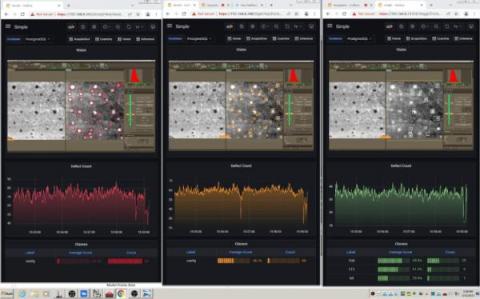
Dr. Christopher Field is Co-Founder, President, and Principal Investigator at Theia Scientific. With formal education in analytical chemistry and instrumentation, Chris has expertise in scientific hardware and software design, deploying embedded Linux devices for Internet of Things (IoT) and sensor fusion applications, and developing computer vision and image processing pipelines for cell analysis.
Watch our on-demand webinars about moving forward the digital experience conversation from monitoring to observability and learn how to implement a total experience observability strategy.
When do you delete instrumentation? You delete instrumentation when you delete code. Other than that, if you’re doing things right: almost never. One of the best things about honeycomb is that it completely transforms the incentives around preserving instrumentation. With metrics-based tools, the most valuable metrics are always custom metrics. You need to define a custom metric for literally any question you might ever want to ask about the app and its utilization or performance.
StatusGator has a wide a variety of use cases: from education to help desk to IT and managed services and DevOps, too. All corners of an organization depend on cloud services and StatusGator gives you visibility into the status of all of your vendors. We’ve heard over and over from our DevOps users that alerts and notifications for their teams are already centralized into a single incident management platform such as OpsGenie, PagerDuty, or FireHydrant.
Since its origins as MOM 2000, SCOM has been widely regarded for being awesome at two things: firstly, being the hands-down best solution for monitoring Windows Server environments (it is Microsoft’s monitoring tool, after all); and secondly, being an extensible monitoring platform that can act as a single pane of glass across your data center environment.
Deciding between SAP cloud integration methods can be confusing. There are so many options out there, with each one offering different benefits. In this article, we’ll discuss the benefits and drawbacks to a SAP cloud on Rise integration methods. We’ll also cover the steps you’ll need to take to choose the method that’s right for your organization. Take An in depth look at SAP cloud on Rise integration, what it involves, and how you can begin planning your own path.
Developed and released by Google in 2018 with contributions from IBM, VMWare, Red Hat, and other companies, the Knative project is designed to make it as simple as possible to build, deploy, and scale serverless containers across your existing Kubernetes infrastructure. By operating on top of Google Anthos, Knative for Anthos takes this even further by allowing developers to build and deploy applications across any hybrid environments that include both on-prem and cloud-hosted serverless clusters.
Quik Pick Express, a California-based trucking company, provides a variety of services, including container drayage, warehousing services, container shipping, transloading, and much more. The company services seven locations in the state of California, with its IT infrastructure network being critical for its business. After a thorough evaluation, Quik Pick Express’ IT team chose OpManager, an all-inclusive network monitoring solution, to monitor its business-critical IT infrastructure network.