Full-Cycle Observability With Dynatrace and Lightrun
Getting a good grasp on your application, especially when it is distributed across multiple clouds, kubernetes clusters and serverless functions is not an easy fit.


Getting a good grasp on your application, especially when it is distributed across multiple clouds, kubernetes clusters and serverless functions is not an easy fit.
Quality control and observability of your platform are critical for any customer-facing application. Businesses need to understand their user’s experience in every step of the app or webpage. User engagement can often depend on how well your platform functions, and responding quickly to problems can make a big difference in your application’s success. AWS Canaries can help companies simulate and understand the user experience.
Our amazing user community is growing so fast that we want to give you more resources to learn and share your knowledge and experience with others. So…today we launch Cribl Curious! Curious is a Q&A site for asking and answering technical questions about Cribl Stream, Cloud, Edge, Packs, and AppScope. Goat a question about how something works in Cribl? Come on over to see how your peers have solved similar problems. Checked the docs and it’s just not clicking for you?
In this blog post, we will walk you through how to develop a continuous performance management playbook for your business to effectively integrate and manage performance as an integral part of your development process – enabling you to build fast experiences faster than your competition. Let’s dive in!
For IT Operations and Site Reliability Engineering (SRE) teams, logging is nothing new. In fact, collecting and analyzing logs is one of the oldest cornerstones of performance management. Logs have been part and parcel of APM workflows for decades. Yet the logging strategies that worked in eras past often fall short today. That’s thanks to the advent of cloud-native computing, which has ushered in fundamental new challenges in the way teams aggregate, analyze, and manage logs.
Today, IT and site reliability engineering (SRE) teams face pressure to remediate problems faster than ever, within environments that are larger than ever, while contending with architectures that are more complex than ever. In the face of these challenges, artificial intelligence has become a must-have feature for managing complex application performance or availability problems at scale.
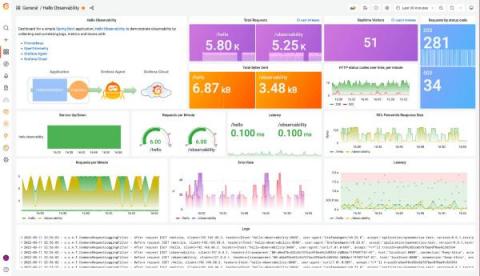
Spring Boot is a very popular microservice framework that significantly simplifies web application development by providing Java developers with a platform to get started with an auto-configurable, production-grade Spring application. In this blog, we will walk through detailed steps on how you can observe a Spring Boot application, by instrumenting it with Prometheus and OpenTelementry and by collecting and correlating logs, metrics, and traces from the application in Grafana Cloud.
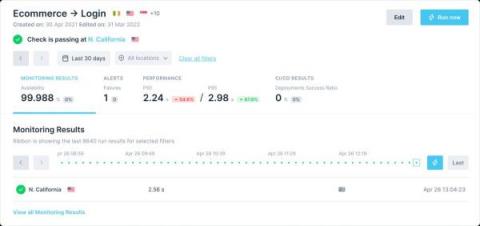
Today, I'm excited to share the release of a long-planned and requested feature - our new Check Overview Page. Until now, Checkly enabled you to troubleshoot single alerts, but a deep dive into the long-term performance trends was limited. That is not the case anymore. In the new Check Overview, we’re introducing the enhanced analytics in four distinct categories: The update is focused on two important outcomes.
As the adtech industry continues to expand and the volume of ads sold and served grows exponentially, the only way to manage the business is through programmatic advertising. This approach utilizes data insights and algorithms to automatically serve ads to the right user, at the right time, on the right platform, and at the right price. The speed and scale of online advertising means that adtech companies need to collect, analyze, and act upon immense datasets instantaneously, 24 hours a day.