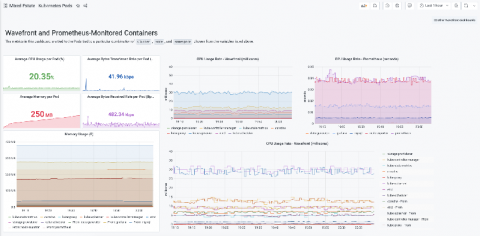
The new Wavefront Enterprise plugin brings the high-scale, high-speed SaaS to your Grafana dashboards
In early 2020, the Wavefront team was merged into the newly formed “Tanzu” portfolio under VMware’s Modern Applications business unit.


In early 2020, the Wavefront team was merged into the newly formed “Tanzu” portfolio under VMware’s Modern Applications business unit.
Whenever you build a service and expose a set of endpoints to provide API access to that service, you’ll likely need to track their availability and response times, aside from ensuring their functionality. But to actually know that “something is down” or just “not performing” you need to consistently monitor your services day in day out and that’s how Heartbeat from the Elastic Beat family helps you with Uptime Monitoring.
The abundance of programming languages available today gives programmers plenty of tools with which to build applications. Whether long-established giants like Java or newcomers like Go, applications need monitoring after deployment. In this article, you will learn how to ship Golang logs to the ELK Stack and Logz.io. It’s usually possible to get an idea of what an application is doing by looking at its logs. However, log data has a tendency to grow exponentially over time.
We’ve seen quite a bit of change this year as businesses have had to pivot to accelerating their digital transformation strategy, and placing even more emphasis on leveraging technology as a competitive differentiator. Most have continued to stress the importance of maintaining excellent customer relationships through their contact centers, but the playing field has changed as they now have to tap into data for insights that may have normally been gleaned through an analog approach.
This article describes an end-to-end solution built with open source components InfluxDB and Grafana and the ogamma Visual Logger for OPC, to collect industrial process control data, analyze it in streaming mode, and visualize it in a dashboard.
The latest Nexthink release has rolled out, and we couldn’t be more excited to help you go broader and deeper to solve even more digital experience challenges. What exactly do we mean? End-user computing involves an enormous array of technologies that interact to deliver services to employees—from devices and the operating systems that run on them, to virtual desktops, applications (local and SaaS), and the networks that enable these services.
Project owners and developers turn to open source APM tools to lessen the cost of application performance monitoring. In this entry, let’s examine the attributes of these open source tools. Years ago, traditional APM solutions were designed for IT only, particularly network operations. The APMs were used to monitor data to ensure the network’s Quality of Service(QoS). However, the landscape has changed.
Chicago, Illinois – October 1, 2020 – AlertOps has introduced Heartbeat Monitoring for its incident alerting, on-call management, and response platform. IT teams can use Heartbeat Monitoring to verify their monitoring tools are working properly, providing an added layer of redundancy and visibility. Signals, or “heartbeats,” from external sources verify whether systems connected to the AlertOps platform are working properly.
Many organizations aspire to become true, high-functioning DevOps shops, but it can be hard to know where you stand. According to DevOps Research and Assessment, or DORA, you can prioritize just four metrics to measure the effectiveness of your DevOps organization—two to measure speed, and two to measure stability.
The advancement of technology has brought with it the increased adoption of complex IT systems. Every company operates and maintains a gigantic amount of data that is essential to run their business. The server capacity required to handle this amount of data is huge, and the centralized servers are almost kept off-site in remote locations. Server virtualization technologies have also gained popularity since it helps to address data storage limitations and data security concerns.