Operations | Monitoring | ITSM | DevOps | Cloud

The latest News and Information on DevOps, CI/CD, Automation and related technologies.

The Bug Hiding in Your Production Traffic

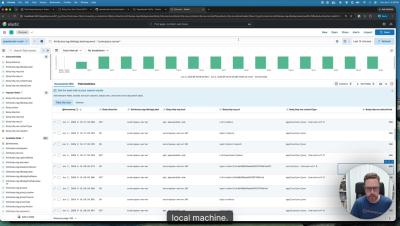
Your logs showed 500 errors. The traces showed the dependency graph. Neither showed the actual bug, a DEL control character getting appended to the query string. This is how I found it. In this video I walk through Speedscale BYOC (bring your own cloud): capture real production traffic, store it in your own Elasticsearch cluster inside your VPC, pull it down locally with a single script, and reproduce the exact bug using proxymock. The data never leaves your environment.

21 AI concepts every beginner should know before their first interview

If you’re prepping for your first AI or MLOps interview, the hardest part usually isn’t always the hands-on element. For me, it’s the vocabulary. Interviewers sometimes lob single-word concepts at you (“what’s quantization?”) and watch how far you can carry the thread. The questions sound clear-cut, but each one is really a doorway into a bigger topic, and the interviewer is judging how cleanly you walk through it.

Announcing HAProxy 3.4

HAProxy 3.4 is a milestone release that significantly advances HAProxy’s legendary flexibility, performance, security, reliability, and observability. Dynamic backend management simplifies integration with modern architectures, memory efficiency improves across a broader range of workloads, native cryptographic operations at the proxy layer open new possibilities for API security architectures, and OpenTelemetry support makes HAProxy a first-class participant in distributed tracing pipelines.

RISC-V profiles - why is RVA23 significant?

One of the important offerings of the RISC-V Instruction Set Architecture (ISA) is the ability to customize and extend the base instruction set. An initial reaction to hearing this is often to worry about software portability and compatibility, since if every RISC-V CPU offers a slightly different set of instructions, software won’t be portable.

10 Enterprise AI Infrastructure Voices Worth Following

Enterprise AI has crossed an inflection point. The model problem is largely covered. What remains unsolved is the operational impact: how to run AI inference and agentic processes continuously, reliably, and at a cost that doesn’t cancel out the value. Most enterprises are discovering this the hard way. GPU utilization dashboards show 80%. Actual compute efficiency is half that. Token demand is compounding at 200-500% annually as agents multiply every action into dozens of model calls.

AI Dev Tools: What 100K Engineers at Google Really Taught Us

AI developer productivity, agentic workflows, and the lessons learned running engineering tools for 100,000+ software engineers at Google. John Montgomery, CCO at GitKraken, sits down with Asim Hussain, co-founder of Alterion AI and former Google VP of Engineering Productivity, to get real about what AI actually changes for engineering teams in 2025.

Logs told me something broke. Traffic showed me what.

Here’s a problem I run into constantly: something breaks in production, I can see the 500 errors in my logs, but I can’t reproduce it locally. The trace shows me the dependency graph but not the actual request that failed. This is especially painful in microservices. I was looking at a CNCF example the other day (a simple demo app, like 4 pods) and it already had so many cross-service dependencies that understanding what broke required looking at the whole system at once.

IBM Think 2026 Infrastructure Insights for IT Leaders

IBM Think 2026 made one thing clear: infrastructure leaders are being asked to support more AI, more automation, and faster decision-making without adding unnecessary complexity or risk. Held earlier this month in Boston, IBM Think 2026 focused heavily on enterprise AI, hybrid cloud, automation, governance, and operational transformation.