Operations | Monitoring | ITSM | DevOps | Cloud

Slow and steady

“Remember that guy that gave up? Neither does anybody else.” Progress on the new Monitive has been slow as a snail in a marathon, but nevertheless the progress was there. Since the last update last year, a lot has been going on, and one day I woke up and just decided to write, even if small updates. Not only because Monitive is about transparency, but because I love writing.


Top 10 Free Tools to Check Your SSL Certificate Installation

You can utilize an SSL checker to troubleshoot the common SSL errors and vulnerabilities if you have installed an SSL certificate before. There is a plethora of tools you can choose from. You can also use a free SSL checker if you are working on a low budget. And using an SSL checker tool is quite simple. You simply must submit the domain name or IP address and the port number it requires to examine your website’s configuration and security.

Closer Look: Intelligent Infrastructure Monitoring

In this article: Infrastructure monitoring systems have been undergoing massive change in the past few years. Before the proliferation of cloud computing, IoT and edge computing, mobile apps and SaaS apps, the practice was fairly static, albeit traditionally quite siloed. IT managers needed to get data on a set of standard metrics, from a handful of tools.

Dissecting Customer Experience

With all the buzz surrounding user experience these days, I thought it might be worthwhile to start “at 50,000 feet” and dissect user experience into its component parts and see what all the fuss is about. User experience (UX) is somewhat different than customer experience (CX). Customer experience has been defined as the quality of all a consumer’s encounters with a company’s products, services, and brand. Today, user experience typically refers to the digital user experience.

Azure Monitor (Part 7): Mastering Application Performance Monitoring with Application Insights

In my last post I walked through a brief introduction to Application Insights, and APM tools in general, and hopefully the simple outside-in availability test I concluded the chapter with has been a useful starting point for you on your APM journey. In this post, I’m going to dig deeper into Application Insights and walk you through a use case that should make the purpose of Application Insights really clear.

Monitor Apache Flink with Datadog

Apache Flink is an open source framework, written in Java and Scala, for stateful processing of real-time and batch data streams. Flink offers robust libraries and layered APIs for building scalable, event-driven applications for data analytics, data processing, and more. You can run Flink as a standalone cluster or use infrastructure management technologies such as Mesos and Kubernetes.

How to simplify SNMP implementation

The following is a guest post from Jean Tunis, the principal consultant and founder of RootPerformance. You want implementations to be simple. Who doesn’t? But often, that’s not the case. SNMP is one of the oldest used protocols to manage a network. SNMP stands for simple network management protocol, but it might not have been all that simple for you. Maybe it was simple back in the late 1980s, when SNMP became a standard protocol for network monitoring.

How To Secure Home Computers That Are Connected To Corporate Networks

Coronavirus is changing everything. But amid all the talk of shut-downs, quarantine, and stock market crashes, another huge impact of the current crisis has been a little overlooked: it’s consequences for cybersecurity. With hundreds of thousands of employees now working from home – in the US, Europe, and all over the world – many companies have had to rapidly put in place systems for them to connect their home devices to corporate networks.

A Practical Guide to JavaScript Debugging

Being a UI developer, I’ve learned one thing: It doesn’t matter how carefully you write your code. Suppose you’ve double-checked that you defined and called all functions the right way or followed all the best practices. Even then you’ll see that a tiny variable can sneak behind and create an error. Now, suppose you find out that for some unknown reason a form validation or submit button isn’t working.

Elastic APM adopts W3C TraceContext

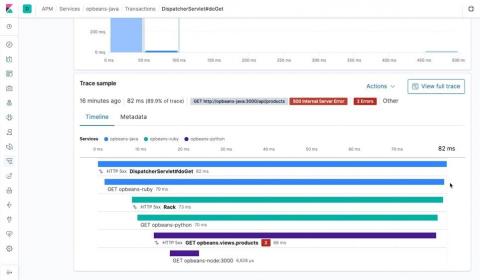
Distributed tracing remains one of the most important features of any tracing system. Nearly a year ago, we announced Elastic APM distributed tracing, let’s take a look at how this useful feature works behind the scenes. Over the past few years, many applications have adopted microservice architecture. Each of the services in a microservice architecture can have their own instrumentation to provide observability into the service.