Operations | Monitoring | ITSM | DevOps | Cloud

7 Ways To Tell If Your Website Has Been Hacked

In this day in age, businesses rely heavily upon their website as a means of driving sales and reaching customers. It is usually the first point of contact between a potential customer and the business, and thus, it commands a level of investment. Because of this, it can be frustrating and upsetting to have one’s web page hacked and rendered useless.


How to publish an asset with the Sensu Go SDK

We recently introduced the sensu-plugins-sdk and the new template plugin projects. In this post — based on our recent webinar — I’m going to dive deeper into those community resources and illustrate how to publish an asset using the Sensu Go SDK. I’ll also cover how to package compiled binary plugins (including dynamically linked libraries) as assets.

Monitoring Applications Written in Vue.js

Vue.js is a front-end JavaScript framework that you can use to build progressive Single-Page Applications (SPAs). Evan You, an ex-Google employee, created Vue.js in 2014 with an idea of building a lightweight solution that had the best features from Angular and React. Since the day of its inception, Vue.js has been steadily gaining in popularity. Currently, its user base is triple to that of Angular, and a little more than Facebook’s React framework.

Optimizing Web Performance: Understanding Waterfall Charts

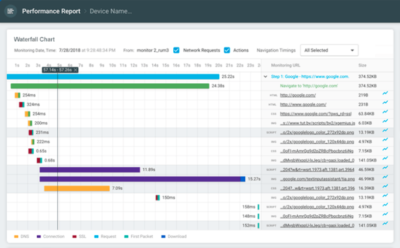
Waterfall charts are diagrams which represent how website resources are being downloaded, parsed by the engine, in a timeline that gives us the opportunity to see the sequence and dependencies between resources. It assists in identifying where important events happened during the loading process. They can also let the user easily see how good or bad the performance of their website is, showing you exactly what is slowing down your site.

Take It From Fujitsu: Digital Employee Experience Is Everything

There has been a lot of talk about transforming employees’ digital experiences, but what does this really mean, and how can it be achieved? This is what Nexthink and its partner Fujitsu are solving each and every day. Employee experience refers to the evaluation that employees make regarding their work environment.

Patching Operating Systems While Working from Home

IT leaders need a well-defined strategy for managing patches and upgrades for software applications and technologies. Planned patch management rollouts help combat security vulnerabilities as unpatched systems are highly vulnerable to data breaches and attacks from hackers. During Covid-19, IT organizations have struggled to keep systems updated using remote teams, especially as software vendors have recently released a record number of patch fixes and upgrades.

Centralize monitoring with our Metaconsole

Gradually, brick by brick, we will get the necessary toolkit to build a company and maintain it. If on previous occasions we have emphasized the importance of monitoring a company’s IT systems, today we will review what it is and what advantages we when we centralize monitoring. The goal is pretty simple: we want to have maximum control over the IT of a company moving unbridled to the summit.

Introducing ipl/Sql - OOP SQL abstraction for PHP

During the past few months while working on Icinga DB, we have tested our existing libraries on how we work with data and how we present them programmatically. Maybe it was because we were doing something new with Icinga DB or we weren’t entirely happy with the existing code. In any case, it was time for new libraries :-). The IPL – Icinga PHP Library was born. And we want to share that work starting with ipl/Sql an OOP SQL abstraction for PHP.

Ruby Garbage Collection: More Exciting than it Sounds

Running software uses computer memory for data structures and executable operations. How this memory is accessed and managed depends on the operating system and the programming language. Many modern programming languages manage memory for you, and Ruby is no different. Ruby manages memory usage using a garbage collector (also called gc). In this post, we’ll examine what you, a Ruby developer, need to know about Ruby’s gc. Use the links below to skip ahead in the tutorial.