Operations | Monitoring | ITSM | DevOps | Cloud

The latest News and Information on Monitoring for Websites, Applications, APIs, Infrastructure, and other technologies.

Golden Paths for AI agents: What changes when platform users aren't human?

Agents are already calling your self-service APIs, querying your catalog, and independently provisioning resources around the clock. According to Gartner’s 2026 Hype Cycle for Agentic AI report, agents have had the most aggressive adoption curve of any emerging technology. Gartner even considers agents to be a formal user persona, referring to the agent experience (AX) throughout the report.
Laravel vs. Ruby on Rails

Laravel and Ruby on Rails are both full-stack, batteries-included MVC frameworks with an ORM, a templating engine, a CLI, and a shared philosophy: going from an empty folder to a working app shouldn't take fifty decisions first. Laravel wins when your team already lives in PHP, or when you want the largest possible pool of developers, packages (code other people have already written for common tasks), and hosting options to choose from.

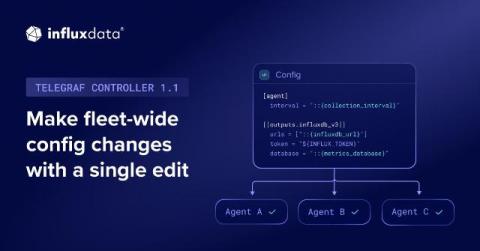
Telegraf Controller 1.1: Make Fleet-Wide Config Changes with a Single Edit

Summary Telegraf Controller 1.1 lets teams make fleet-wide configuration changes with a single edit using Global Constants, Configuration Groups, and Configuration Aliases. Configuration Versioning makes every change traceable, comparable, and reversible. High availability, available in Telegraf Enterprise, automatically fails over between Controller instances so agents can continue pulling configurations and reporting health if an instance goes down. Table of Contents.

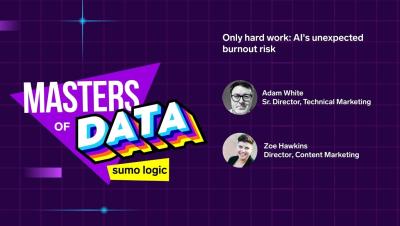
Only hard work: AI's unexpected burnout risk

On this episode of Masters of Data, we dig into what happens when AI actually delivers on its promise to eliminate busywork, and explore why removing the toil doesn't feel like the win everyone expected. We make the case that repetitive tasks build the intuition, pattern recognition, and muscle memory people need to do the harder work well. Security and engineering leaders rethinking how much triage and busywork to hand off to AI will find plenty to chew on here, especially anyone staring down a task list where every single item feels like the hardest one.

The AI Acceleration Gap Is Becoming Every CIO's Biggest Leadership Challenge

Today, I’m very happy to share a new report, Bridging the AI Acceleration Gap, from Harvard Business Review Analytic Services and sponsored by Nexthink. It examines how employee-led AI adoption is reshaping the role of IT—and what technology leaders need to do next.

The Grafana AI SDK for Go: a shared foundation for building AI applications

Starting an experiment with an LLM has never been easier. Keeping a growing collection of those experiments consistent is another matter. Earlier this year, as more teams began exploring AI features here at Grafana Labs, we repeatedly encountered the same pattern: a new experiment would start, move quickly, and build its own client for whichever model provider it needed. The next experiment would do the same, with a slightly different abstraction for streaming, tools, errors, or provider configuration.

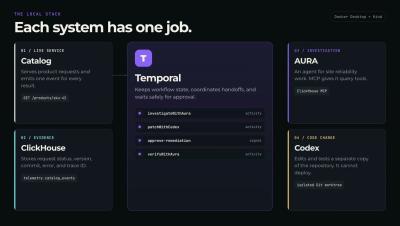
AI SRE Agent with Temporal, ClickHouse, and Codex: AURA in a Gated Run

1,133 requests failed on one bad commit. The patch and the regression test are already written by the time anyone is asked to read the exact diff. This demo runs AURA as one step inside a Temporal workflow, alongside Codex. A GET request against a product catalog service goes from success to HTTP 500, and ClickHouse records the version, commit, trace ID, and exact error for every request. By the time AURA investigates, all 1,133 requests on that version have failed.

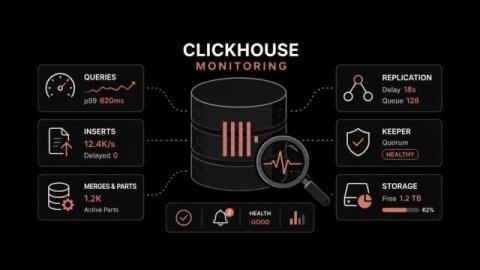
A Practical ClickHouse Monitoring Guide Built Around Failure Modes

Why does a ClickHouse cluster report every node as healthy while inserts start failing and dashboards go stale? Most often the failing subsystem was never represented in the metrics anyone had on screen. A node answers its health check while its replication queue has been growing for hours. ClickHouse breaks in specific, repeatable ways. Parts accumulate faster than background merges can consolidate them. Coordination drops quorum and every replicated table quietly turns read-only.

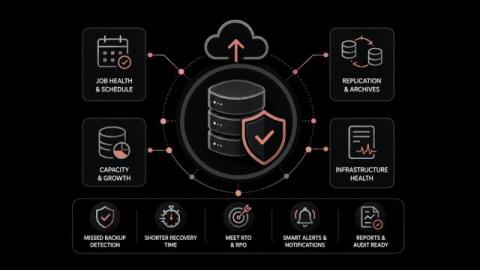
What Backup Monitoring Software Should Track to Protect RTO and RPO

How many backup jobs completed successfully in your environment last night, and how many of those systems could you bring back inside the window the business agreed to? Most backup consoles answer the first question well. They report job status, completion time and volume written, then roll it into a reassuring compliance summary. The second question needs different evidence, usually missing from that screen. The distance between those answers shows up during the recovery attempt.

Zero-Code Instrumentation in Kubernetes Without the Instrumentation CRD

The OpenTelemetry Operator changed how teams approach telemetry collection in Kubernetes. The core appeal of zero-code instrumentation is that you can bring up telemetry inside application containers to collect traces, metrics, and logs without touching your source code or rebuilding your container images. However, if you follow the default OpenTelemetry Operator documentation, you quickly run into a heavy operational prerequisite: the Instrumentation CRD.