The latest News and Information on Monitoring for Websites, Applications, APIs, Infrastructure, and other technologies.
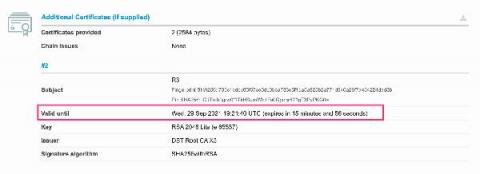
If you've been using Let's Encrypt for a while, you may have noticed that their certificates are signed by a root certificate titled DST Root CA X3. That root certificate is set to expire in a few hours. Any certificates still signed by that root will no longer be valid. But luckily, that shouldn't form a problem for most Let's Encrypt users. For a while now, new SSL issuances by Let's Encrypt have issued certificates against DST Root CA X3 (the one that is about to expire) and ISRG Root X1.
Not so long ago, development teams working for the U.S. Department of Defense could take anywhere from three to ten years to deliver software. “It was mostly teams using waterfall, no minimum viable product, no incremental delivery, and no feedback loop from end users,” Nicolas M. Chaillan, Chief Software Officer of the U.S. Air Force, said in a CNCF case study. “Particularly when it comes to AI, machine learning, and cybersecurity, everyone realized we have to move faster.”
Modern computing has come a long way in the last couple of years and the introduction of new technologies is only accelerating the rate of advancements. From the immense compute power at our disposal to lightning-fast networks and ready-made services, the opportunities are limitless. In such a fast-paced world, we can’t ignore economics.
Distributed systems are everywhere. Although many teams don’t think of their applications as distributed systems, if they’re developing using container-based microservices and serverless functions instead of a monolith, they’re creating a distributed system. This change also means that monitoring needs are becoming more complex.