Operations | Monitoring | ITSM | DevOps | Cloud

The latest News and Information on Monitoring for Websites, Applications, APIs, Infrastructure, and other technologies.

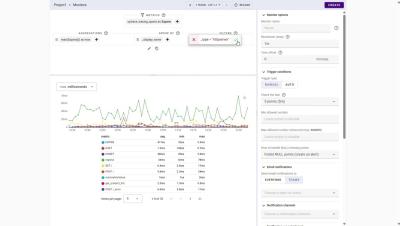
ServiceNow and Grafana: How to receive Grafana alert payloads via ServiceNow's scripted REST API

When you integrate Grafana-managed alert rules with ServiceNow, you can automatically capture and process alerts in ServiceNow’s events table—a common entry point for incident workflows, escalations, and ticket creation. And if you configure ServiceNow to receive Grafana Alerting payloads using ServiceNow’s scripted REST API, you can parse Grafana’s JSON alert payloads and insert them into a ServiceNow table.

Training Foundation Models on a Trillion Data Points with Apache Iceberg

Training an AI foundation model on over a trillion data points sounds impossible without hitting your production systems. Here's how Datadog did it with Apache Iceberg for their time series forecasting model TOTO. The key challenge: extracting massive historical observability data (metrics spanning years) and running incremental preprocessing pipelines without overwhelming production services. Iceberg solved this by providing schema governance, consistency guarantees, and seamless integration with ML tools like Ray and PyTorch.

Best Certificate Monitoring Solutions With Slack/Teams Integration: The Complete Guide

SSL certificates expire silently. When they do, websites instantly break. Users see warnings. Traffic drops. Security trust is damaged. This is why businesses now rely on certificate monitoring solutions that send alerts before a certificate expires. A growing number of teams want these alerts directly inside Slack or Microsoft Teams, because that’s where their operations already work every day.

Synthetic End User Monitoring simulates complex user journeys across global environments

Traditional monitoring solutions provide valuable infrastructure metrics, they fundamentally lack the capability to understand what users actually experience. There is a significant technical gap between server-side metrics and client-side experience. Research shows that traditional monitoring fails to detect 52–68% of user-facing errors since they happen outside of the server infrastructure.

Introducing the Databricks Destination: Powering governed, scalable analytics from day one

Modern enterprises are generating more high-volume observability and security data than ever, which means the cost and complexity of getting analytics-ready data into Databricks are only growing. With the new Databricks Destination for Cribl Stream, organizations finally have a governed, scalable, and cost-efficient way to take full control of their data pipelines, accelerate AI-driven analytics, and unlock real business value from their Databricks investment.

Nexthink Recognized as a Customers' Choice in Gartner Peer Insights Voice of the Customer for Digital Employee Experience Management Tools

We’re thrilled to share the exciting news that Nexthink has been recognized as a Customers’ Choice in the inaugural 2025 Gartner Peer Insights Voice of the Customer for DEX Tools. In our view, what makes this recognition truly special is that it comes directly from the people who know our platform best – the IT leaders who use Nexthink every single day. Apart from this, we are recognised as a Leader in the Gartner Magic Quadrant for DEX Management Tools for the second consecutive year.

Spotify's performance & control across large monitoring environments with VictoriaMetrics

When your active time series is in the billions and the total number of data points you need to monitor runs into the tens of trillions, you need a high-performance observability solution with operational simplicity. Streaming behemoth Spotify is one such case. Their observability team chose VictoriaMetrics as the fastest monitoring and observability solution on the market.

Building visibility and resilience across Kubernetes

Kubernetes has transformed how modern applications are deployed and scaled. Its flexibility and automation power innovation but also expand the attack surface. From control plane access to runtime drift, Kubernetes introduces layers of complexity that can obscure visibility if not properly monitored. For security leaders, Kubernetes is both an opportunity and a risk. While it enables agility, it also decentralizes security responsibility across teams, tools, and cloud layers.