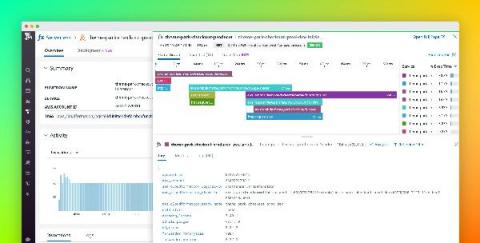
Real User Monitoring, also known as End User Monitoring or RUM, is a way of monitoring the client side portions of an application. Real User Monitoring for JavaScript allows developers to have access to key metrics for load times and user paths being used in production as part of their application performance management (APM).
In environments with large numbers of client machines, configuration management tools are often used to simplify and standardize the target state of each host in a seamless, automated and consistent manner. Software like CFEngine, Chef, Ansible, and others offer a high degree of granular control over software packaging and system configurations.
Deploying a stack into AWS is at the core of what Stackery helps you do. So much so that Stackery users deployed over 10,000 times last month! For the most part, this has been a manually executed process in our Web UI or command-line client. As teams grow and take on more work, fast and consistent deployments are key to scaling effectively. That’s why we’ve been working this year on continuous integration and deployment (CI/CD) features, tailor-built for serverless applications.
When I joined ServiceNow, IT Operations had what I’d call a “best effort” strategy—push hard, keep things running, meet your SLAs, and so on. This worked well enough, but that was hardly a formula for long-term success at scale. We needed a new way of thinking that would move us from our traditional role as incident firefighter to that
In this post, you’ll learn what causes high series cardinality in a time series database and how to locate and eliminate the culprits. First, for those of you just encountering this concept, let’s define it: The number of unique database, measurement, tag set, and field key combinations in an InfluxDB instance. Because high series cardinality is a primary driver of high memory usage for many database workloads, it is important to understand what causes it and how to resolve it.
Have you ever had to saw through a board by hand? I had to finish a partial cut by hand the other day while building a new mantle for my fireplace. It’s slow and difficult, and it often results in a lesser quality cut than one done with a power tool. It’s good exercise, though! We should all have to do it at least once so we appreciate our power tools more.
Cyberthreats have been coming at us from the left, right, and center. The number of cyberattacks is forever on the rise, and companies need to keep ramping up their security measures to protect themselves. It’s important that these measures cover every aspect of a network environment. To understand why monitoring your whole environment is so important, let’s take a look at what an attacker might do once they get inside your organization.
Auth0 provides identity as a service (IDaaS), allowing you to secure your apps and APIs without having to write your own authorization code. Auth0 can work with social identity providers (IdP) like Google and Facebook so your users can access your app by using their existing accounts for authentication. You can also use an existing enterprise identity provider (e.g., LDAP) to allow your users to leverage single sign-on (SSO) across multiple apps.