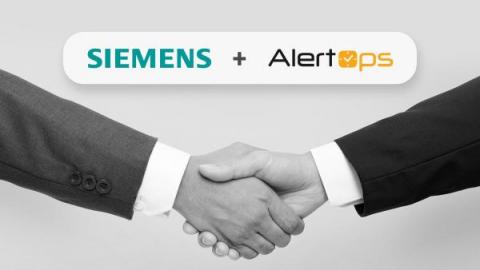
AlertOps joins Siemens Connect Ecosystem
Siemens and AlertOps today announced that AlertOps has joined the growing Siemens Connect Ecosystem – a network of experts from varied fields within Siemens.


Ubuntu Core, the Ubuntu flavour optimised for IoT and edge devices, has a new version available. With a 2-year release cadence, every new release is both an exciting and challenging milestone. Ubuntu Core is based on Ubuntu. It is open source, long-term supported (LTS), binary compatible and offers a unified developer experience. It allows developers and makers to build composable and software-defined appliances built from immutable snap container images.
If you are packaging your IoT applications as snaps or containers, you are aware of the benefits of bundling an application with its dependencies. Publishing snaps across different operating system versions and even distributions is much easier than maintaining package dependencies. Automated IoT software updates make managing fleets of devices more efficient.
SAN FRANCISCO, June 15, 2022 – InfluxData, creator of the leading time series platform InfluxDB, today announced Edge Data Replication, a new capability for centralized business insights in widely distributed environments. Edge Data Replication enables developers to collect, store and analyze high-precision time series data in InfluxDB at the edge, while replicating all or subsets of this data into InfluxDB Cloud.
There are technical and business reasons to have a time series data presence both at the edge and in the cloud – InfluxDB has always played a key role in both contexts. Today, we’re announcing Edge Data Replication, a new feature that combines these two deployment strategies. With this announcement, InfluxData begins a greater initiative to accommodate both edge and cloud data workloads in one unified solution.
This is the first blog in a three-part series about service providers and network compliance.
When Russia invaded Ukraine on February 24, 2022, it sent ripples through many markets. Ukrainian car factories which supplied Europe were interrupted, oil and gas supply from Russia was throttled, and the supplies of steel, sunflowers, corn, and wheat were affected. Prices of sugar and petroleum surged, a threat of long-lasting high inflation emerged, and social unrest began to foment, with cyber-attacks coming both out of and going into Russia.
When I joined SUSE I heard about our Kubernetes distributions: Rancher Kubernetes Engine (RKE), RKE2 and K3s. However, the differences between RKE and RKE2 were not clear to me. I decided to spend time with them and blog about the differences.