Apache has been around since 1995 and is the most important web technology. The majority of businesses nowadays run-on Apache servers. Different servers operate in different ways and have different features and functions. For simple debugging, several servers keep server logs. Understanding how the server works is essential. All errors encountered by the server while receiving or processing requests are recorded in the Apache error logs.
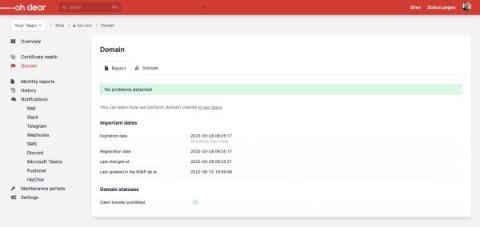
When registering a domain name, you could assume it is yours forever. Unfortunately, this is false, and most domains must be renewed periodically. If you fail to do this, you risk losing your domain, and ownership could be transferred away from you. Oh Dear's new Domain check can send you a notification days before your domain expires. This way, you still have time to renew it.
GrafanaCONline 2022 is off to a great start with exciting news from around the Grafana-verse and a jam-packed day filled with dashboards showcasing how Grafana is used in space, in industrial IoT, at live events, and even in an effort to prevent food waste.
15 June 2022: Canonical today announced that Ubuntu Core 22, the fully containerised Ubuntu 22.04 LTS variant optimised for IoT and edge devices, is now generally available for download from ubuntu.com/download/iot. Combined with Canonical’s technology offer, this release brings Ubuntu’s comprehensive and industry-leading operating system (OS) and services to a complete range of embedded and IoT devices.
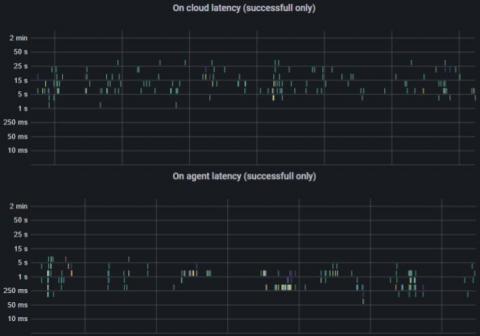
As of v1.35.0 the Netdata Agent can now run Metric Correlations (MC) itself. This means that, for nodes with MC enabled, the Metric Correlations feature just got a whole lot faster! The Netdata Metric Correlations feature uses a Two Sample Kolmogorov-Smirnov test to look for which metrics have a significant distributional change around a highlighted window of interest.
Mattermost v7.0 is generally available today and includes three of our top five most requested features, based directly on your input in our feature idea forum. The following new features are all included (see changelog for more details).
Building software is hard. Building cloud software is even harder because things move much faster — and require mission-critical reliability and availability. To effectively build software in the cloud, engineering teams need observability, CI/CD, reporting, and lots of tooling. At every organization I’ve worked at, we’ve needed a system of tools that lets us: But all the tools available to engineering teams never quite fit together with our specific processes.
For teams that follow a structured build and release cycle, having a reliable, shared workflow makes the difference between chaos and consistency. With every new feature in development the team needs to know what the specs are, how it fits in the roadmap, what the customer feedback was, where to find the repository, who is responsible for each step, and so much more.
Modern applications are designed to leverage cloud native technologies like serverless and containers to run at an unprecedented scale, moving the focus away from machines to the actual service. Lumigo’s observability platform was purpose-built for these evolving cloud environments, and we’ve been delivering the most advanced automated distributed tracing for serverless applications since 2019.