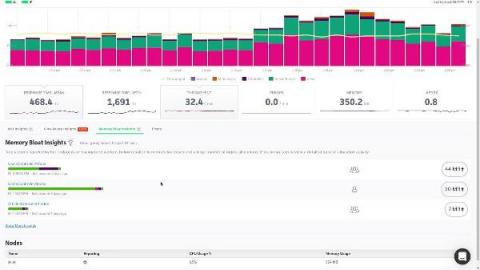
In this video, we are going to take a look at what memory bloat is, and how you can use Scout to eliminate it from your applications. Memory related performance issues have the potential to bring your entire application down, and yet, most APMs completely ignore this fact and fail to provide any useful way of monitoring memory usage at all.
Today, monolithic applications evolve to be too large to deal with as all the functionalities are placed in a single unit. Many enterprises are tasked with breaking them down into microservices architecture. At LogicMonitor we have a few legacy monolithic services. As business rapidly grew we had to scale up these services, as scaleout was not an option.
At Grafana Labs, we’re all big fans of the Prometheus and Grafana combination. To an extent, we just won’t shut up about it. We strongly believe in simplicity and think you shouldn’t need any extra effort to understand the metrics of your service(s) holistically. Yet we’ve all been in that situation where it is challenging to fully grasp what the metrics of our service(s) are and what they do. While naming conventions exist, at times they are not followed or enforced.
The promise of NoSample™ full-fidelity distributed tracing with unlimited cardinality exploration is that no application performance degradation will be sampled away. This ensures that executions, which exemplify problems related to latency and/or errors will be retained for further inspection and analysis. Additional value can be extracted from trace data by determining when such investigations should occur, in other words, by identifying spikes and anomalies in endpoint latency or error rate.
Having a functional and operative website is a critical asset. A well-optimized and smart website can act as a revenue generating machine. The idea is to attract more visitors for your site, increase web page traffic, and then make sales or conversions on the main page. There is, however, a lot of competition in the online world. And to get your audience to land up on your page might still be an issue. This is where you could lose out on a lot of money from the pages.
In this era, where there is a big competition in the digital world; web designing and web development plays a major role in the success of the web applications. Everyday advancements in the technologies pushes the developers to stay updated in the latest web development frameworks by learning various frameworks. In order to build a rich and interactive web applications thousands of developers are endorse in the use of frameworks.
The pandemic has heightened IT leaders’ need for efficiency in managing what we’re seeing more and more as a hybrid cloud world. We recently polled IT leaders across the US and EMEA on their current challenges, changes, and goals around hybrid cloud deployments, infrastructure visibility, use of AI/ML, and more.
Application developers and application operations personnel are together responsible for ensuring that Java web applications perform well. In an earlier blog, we had discussed 7 configurations that Application Operations teams can use to make their Java applications high-performing. In this blog, we will focus on Application Developers and discuss 6 ways in which they can enhance the performance of their Java applications.