Operations | Monitoring | ITSM | DevOps | Cloud

Integrate your IDS + monitoring with the Sensu Tripwire asset

Tripwire, created by our friend Gene Kim, is a popular intrusion detection system (IDS) with both commercial and open source offerings. As a fun side project, I put together a Tripwire asset for Sensu. While this is more a prototype than anything else, I wanted to take this opportunity to offer some background on IDS, Tripwire, and integrating intrusion detection into your monitoring workflow, with the overall aim of illustrating how easy it is to deploy solutions with Sensu.


Logging for Monoliths vs. Logging for Microservices

At first glance, microservices logging may seem simple. You just take the same principles you’ve always followed for monoliths and apply them to each microservice in your application, right? Well, no. The differences between microservices and monolithic architecture amount to much more than a difference in the number of services involved.

How we're helping siloed, global teams with disjointed operations gain full visibility of service health

For IT Ops people working in organizations with a truly global presence – say managed service providers, banking, finance, aviation and utilities, coherently maintaining full visibility of service health and identifying service-affecting issues can be a big headache. As a global enterprise expands and grows its operations, be it through acquisition, or during the onboarding of new customers, there’s a tendency for multiple incident management and monitoring tools to accumulate.

Monitoring Applications That Use Azure ADFS

ADFS (Active Directory Federation Services) is a solution from Microsoft for single sign-on (SSO) functionality. It is used by organizations that have their users on Windows Servers to provide authentication and authorization to web-based applications or services outside the organization. ADFS implements federated identity and claim-based access control to authenticate and authorize users, thus maintaining security.

SLA Compliance for SaaS Businesses

SaaS businesses are built upon the simplicity of computing, storage, and networking they provide to their users. Web and mobile applications provided by SaaS businesses are meant to be straight forward to consume for users. However, it’s important to deliver an excellent experience to your users who rely heavily on your reliability and performance. Service Level Agreements (SLA) plays an important role here.

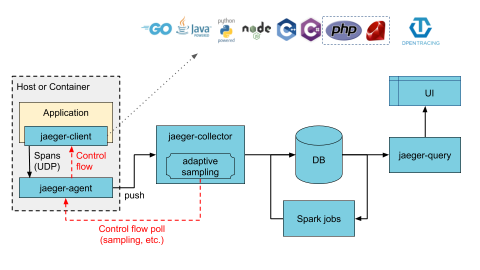
Tracing Tools Compared: Jaeger vs. OpenTracing

With the advent of microservices, technologies like Docker, Kubernetes and services like Cloud Computing, have showcased the broader need for observability. Collecting valuable information about the communication endpoints and how they propagate through the discrete components of the application stack is the key to understanding when, why and what happens in case of failure.

OpsRamp Achieves Certification to Monitor and Manage Nutanix HCI

We’re excited to announce that OpsRamp is now officially Nutanix Ready Certified as an AHV Integrated Technology Alliance Partner in the Nutanix Elevate Program. Our certified solution lets customers confidently discover, monitor, and automate not only their Nutanix hyperconverged infrastructure (HCI) but also their broader hybrid IT environment.

Calculating ingest lag and storing ingest time in Elasticsearch to improve observability

When viewing and analysing data with Elasticsearch, it is not uncommon to see visualizations and monitoring and alerting solutions that make use of timestamps that have been generated on remote/monitored systems. However, using remote-generated timestamps may be risky.

Optimize MariaDB: tips to deal with load spikes

This 2020 is perfect to check our beloved Pandora FMS server and precisely a very important component is the database (BD). As our loyal readers already know (and if you visit us for the first time you can read the introduction to architecture on our Wiki), MariaDB is one of the databases chosen by Pandora FMS to keep all your information about your device monitoring: Let’s see how to optimize MariaDB!

Unlocking new serverless use cases with EFS and Lambda

Today, the AWS Lambda platform has added a new arrow to its quiver – the ability to integrate with Amazon Elastic File System (EFS) natively. Until now, a Lambda function was limited to 512MB of /tmp directory storage. While this is sufficient for most use cases, it’s often prohibitive for use cases such as Machine Learning, as Tensorflow models are often GBs in size and cannot fit into the limited /tmp storage.