Operations | Monitoring | ITSM | DevOps | Cloud

Where did all my spans go? A guide to diagnosing dropped spans in Jaeger distributed tracing

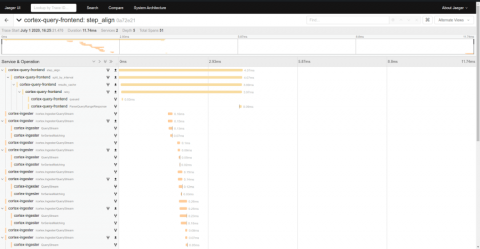
Nothing is more frustrating than feeling like you’ve finally found the perfect trace only to see that you’re missing critical spans. In fact, a common question for new users and operators of Jaeger, the popular distributed tracing system, is: “Where did all my spans go?” In this post we’ll discuss how to diagnose and correct lost spans in each element of the Jaeger span ingestion pipeline.


Embed Your Status Page Everywhere

A well-crafted status page is designed to save you time, energy, and resources when communicating service irregularities. Instead of fielding thousands of support requests when you experience an outage, a status page provides a self-service way for your customers to get up-to-the minute information about any current downtime. It also allows you to proactively communicate maintenance and other work in advance.

New free Ping Tool. Ping from multiple locations all at once.

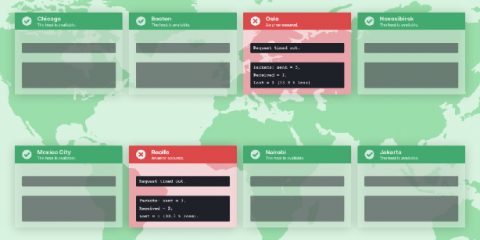
Ping is a network tool. The tool seeks out a given address over a network to check if one networked device can communicate with another device. The tool then reports on the quality of the connection based on data loss and response times. Uptrends’ new Ping Tool conducts ping tests from multiple worldwide locations at the same time. You can instantly spot localized downtime and latency issues from around the world using one simple tool.

Test on-premise applications with Datadog Synthetic private locations

Synthetic monitoring lets you improve end user experience by proactively verifying that they can complete important transactions and access key endpoints. But your applications serve many users, from customers to all the employees who run your business. This makes testing the performance of any internal-facing services within your private network just as critical as monitoring your external-facing applications.

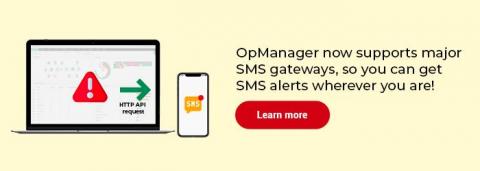
OpManager now supports SMSEagle, Twilio, and Clickatell, so you can get SMS alerts anywhere!

IT admins need to know the status of their IT devices, servers, routers, switches, and firewalls. To meet this need, OpManager has a highly responsive and robust notification and alerting system that sends alerts via email, Slack, and even SMS. Murphy’s law says anything that can go wrong will go wrong, and if you’re in IT, you’re probably familiar with how easily things can go wrong.

Monitoring 101: Collecting the Right Data

When it comes to business, data is everything. Whether it’s sales, supply, marketing, or your I.T. systems, every day is a constant stream of decisions to be made. To make the right decisions, you need enough knowledge. To have enough knowledge, you need the right data. What’s the best way to collect all this data? In the information age, there’s so much data out there, all the time.

Distributed Tracing & Logging - Better Together

Monitoring requires a multi-faceted approach if DevOps teams want end-to-end visibility and deep insight into issues. This is especially true in the case of modern microservices applications, which are essentially collections of distributed services that talk to each other over a service mesh. With monolithic applications, requests can be tracked easily from the client to the server and back, but with modern applications, every request passes through numerous services before completion.

Machine learning in cybersecurity: Detecting DGA activity in network data

In Part 1 of this blog series, we took a look at how we could use Elastic Stack machine learning to train a supervised classification model to detect malicious domains. In this second part, we will see how we can use the model we trained to enrich network data with classifications at ingest time. This will be useful for anyone who wants to detect potential DGA activity in their packetbeat data.

Enabling DevSecOps with the Elastic Stack

Software development and delivery is an ever-changing landscape. Writing software was once an art form all its own, where you could write and deploy machine code with singleness of purpose and no concern for things like connecting to other computers. But as the world and the variety of systems that software supports became more complex, so did the ecosystem supporting software development.