Starting today with version 0.6.0 of the Node.js integration, instrumenting a Node.js app that uses Redis is much easier. In fact, we instrument it for you - meaning that if you use Redis in your own app, there’s no extra work for you, everything Just Works™ out of the box! 🎉
Over the last few decades, some firms have worked hard to hire the right people and develop the right processes. However, those achievements have not translated into bottom-line growth. A more detailed examination of that matter shows that the issue lies somewhere in productivity.
All storage devices, whether on-premises or in the cloud, are used to store or maintain data in a server. To organize files based on usage and perform read/write operations, the disk is divided into separate portions called partitions. A partition can contain the entire disk space or some of it. Disk usage gives the amount of space used by the storage device to read/write an operation.
For the first 6 months of 2020, Google has continued its monopoly on search engine use with an average net market share of 69.24%. Google’s continued favoritism puts it in a position to funnel the bulk of interested organic web traffic to your business making its blacklist a costly place to be. So, how do you stay on this giant’s good side?
Monitoring your system and infrastructure is critical to ensure the performance of your services. In fact, as software development moves faster and faster, alerting and monitoring becomes an indispensable practice for modern DevOps teams. Why is that exactly? That’s what I’m going to discuss today.
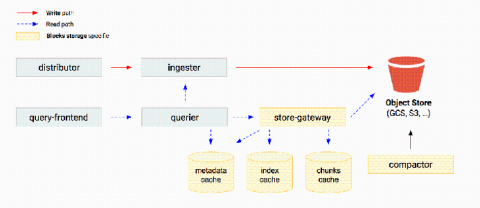
Cortex is a long-term distributed storage for Prometheus. It provides horizontal scalability, high availability, multi-tenancy and blazing fast query performances when querying high cardinality series or large time ranges. Today, there are massive Cortex clusters storing tens to hundreds of millions of active series with a 99.5 percentile query latency below 2.5s.