Operations | Monitoring | ITSM | DevOps | Cloud

What Are Unit Economics and How Are They Calculated?

Cloud spend is a significant line item in every company’s IT budget, and controlling it is especially important in today’s challenging economic climate. A steep decline in share prices, valuations, and a slowdown in venture capital funding have led CEOs to cut costs within their large line items, reduce their workforce, and reevaluate their unit economics — especially their margin per customer. The question is, how many organizations know their margin per customer?

Best Open Source Application Monitoring Tools

As businesses grow and develop, so must the tools that help manage them. Application monitoring tools provide enterprises with a way to keep track of the health and performance of their applications and ensure that everything is running smoothly. Application monitoring tools have a wide range of capabilities and data that enterprises can use to help answer questions about the current state of an application.

Monitoring Your Platform From Multiple Locations

Mature start-ups and scale-ups create wonderful and challenging environments for Engineers. As the product they’re creating matures and the brand becomes a successful one, the user base generally starts growing, and, for some companies, in places they might not expect it to grow. As that happens, new challenges arise for Engineers. One of these challenges is pretty straightforward to guess. Basically having a particular product available throughout different regions of the world.

Kubernetes 101: How To Set Up "Vanilla" Kubernetes

Kubernetes is an open source platform that, through a central API server, allows controllers to watch and adjust what’s going on. The server interacts with all the nodes to do basic tasks like start containers and pass along specific configuration items such as the URI to the persistent storage that the container requires. But Kubernetes can quickly get complicated. So, let’s look at Vanilla Kubernetes — the nickname for a a K8s setup that’s as basic and elementary as it gets.

Using Automation to Transform IT From Cost Center to Value Driver

In today’s digital age, IT has become the central component of business operations. Yet, despite its critical importance, skilled technicians continue to find their hands tied by time-consuming manual tasks. And, while many of these tasks are essential, they do virtually nothing to drive innovation. Introducing automation into the mix can free up IT talent to focus their skills on more important business initiatives – particularly those that drive change and generate revenue.

An Introduction to Kubernetes Observability

If your organization is embracing cloud-native practices, then breaking systems into smaller components or services and moving those services to containers is an essential step in that journey. Containers allow you to take advantage of cloud-hosted distributed infrastructure, move and replicate services as required to ensure your application can meet demand, and take instances offline when they’re no longer needed to save costs.

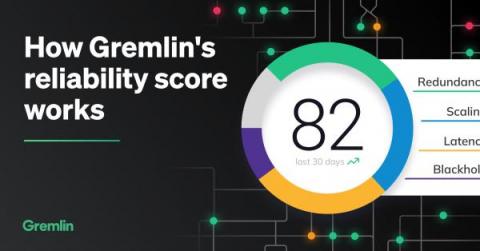
How Gremlin's reliability score works

In order to make reliability improvements tangible, there needs to be a way to quantify and track the reliability of systems and services in a meaningful way. This "reliability score" should indicate at a glance how likely a service is to withstand real-world causes of failure without having to wait for an incident to happen first. Gremlin's upcoming feature allows you to do just that.

Monitor your T2A-powered GKE workloads with Datadog

Arm processors have become increasingly popular in recent years, providing energy-efficient, cost-effective processing power to both mobile and cloud computing ecosystems. As a part of this growth, more and more organizations are choosing to leverage the many benefits of Arm-based architectures for their containerized workloads. Today, Google Cloud announced its Arm-based Tau T2A virtual machines (VMs), which you can also use to run workloads in Google Kubernetes Engine (GKE).

The Role of Middleware in Distributed Systems

In distributed systems, middleware is a software component that provides services between two or more applications and can be used by them. Middleware can be thought of as an application that sits between two separate applications and provides service to both. In this article, we will see a role of middleware in distributed systems.

We've raised $34M to help organisations be resilient in the face of failure

TL;DR: We’ve raised $34M to bring increased resilience to organisations around the world. With this latest round of investment we’re expanding internationally in the US, accelerating our product plans, and growing our amazing team 🎉 As technology becomes more complicated and runs an ever greater part of our lives, failure becomes more inevitable, and more costly.