Operations | Monitoring | ITSM | DevOps | Cloud

The Future of Tech: Exploring AI/ML and ChatGPT

You don’t often see real change, but when you do see it you know it. Artificial Intelligence/Machine Learning toolsets like ChatGPT are finally starting to offer broad capabilities that will benefit a mass audience. These tools are moving out of the domain of data scientists and math nerds and into mass markets with a little bit for everyone. The potential reach is awesome and a little scary.

6 steps to better infrastructure visibility

Picture this: A critical business service is offline. Instead of panicking, you’re calm yet concerned. You retrieve data about the service in question and instantly see exactly which infrastructure components the service depends on, as well as their statuses. You quickly engage IT operators to address the issue and notify the line-of-business lead with an estimated time for its resolution. This scenario doesn’t have to be an impossible dream.

The Evolution of Applications and Current Trends To Know

IT industry veterans have seen significant changes in the way applications are not only developed but also used. This evolution has been driven by several factors, including the ever-growing need for mobility, vast ecosystems, and the increasing demand for faster and more efficient ways to get work done. Let's take a closer look at how apps have evolved over time.

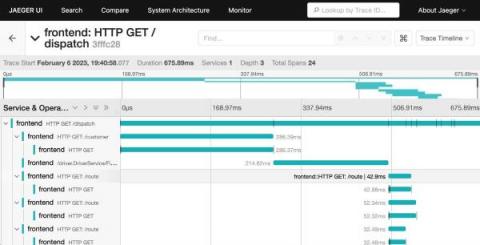
Experiment: Migrating OpenTracing-based application in Go to use the OpenTelemetry SDK

Jaeger’s HotROD demo has been around for a few years. It was written with OpenTracing-based instrumentation, including a couple of OSS libraries for HTTP and gRPC middleware, and used Jaeger’s native SDK for Go, jaeger-client-go. The latter was deprecated in 2022, so we had a choice to either convert all of the HotROD app’s instrumentation to OpenTelemetry, or try the OpenTracing-bridge, which is a required part of every OpenTelemetry API / SDK.

An Introduction to Talos Linux: The New Kubernetes Operating System

As the cloud native environment becomes increasingly more complex, new systems are needed to combat this issue and create simplified, secure, and stable working environments. Sidero Labs developed Talos Linux as a way to run Kubernetes consistently across all platforms, such as Edge, Cloud, Virtual, and Bare Metal. Talos Linux is a secured Linux distribution designed specifically for managing Kubernetes.

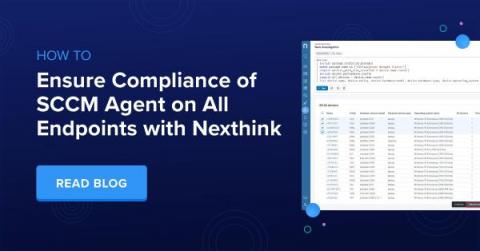
How to Ensure SCCM Client Compliance on All Endpoints with Nexthink

SCCM is one of the most business-critical applications—a must have on all the devices. Administrators use SCCM for endpoint protection, software distribution, and patch management. Any machine where the SCCM client is not functioning will be unable to receive necessary policies or application updates, which can create a significant vulnerability for your organization because this leads to compliance and security issues.

BIG Changes to Windows Feature Updates

It is safe to say that anyone responsible for patch management will have had their fair share of issues with Windows Feature Updates over the years. These updates have amounted to new operating systems versions being released up to twice a year, and needless to say, could be huge in size—ranging anywhere from 3GB to 6GB. This resulted in not only long download times, but also lengthy install times—anywhere from one to two hours—that required multiple reboots to complete.

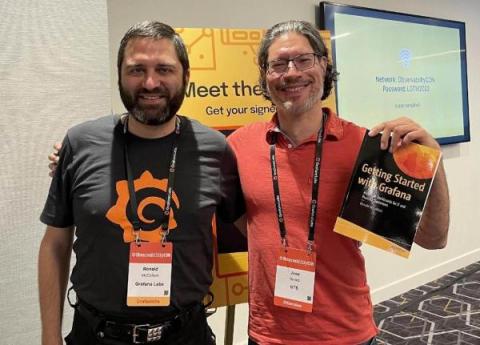
Inside ObservabilityCon: 'I picked up so much practical information'

I’ve always been wary about vendor events. In my experience, many of them are mostly marketing pitches, with little or no content that is applicable to my use cases. Despite that, last year I decided to convince my manager to let me attend ObservabilityCON 2022 to see what I could learn from it. My hope was that I would be able to get practical knowledge that could be applied as soon as I got back to work. (Spoiler alert: I did!)

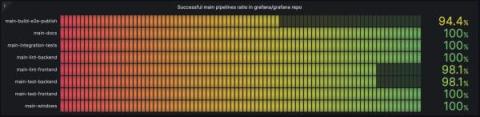
How we reduced flaky tests using Grafana, Prometheus, Grafana Loki, and Drone CI

Flaky tests are a problem that are found in almost every codebase. By definition, a flaky test is a test that both succeeds and fails without any changes to the code. For example, a flaky test may pass when someone runs it locally, but then fails on continuous integration (CI). Another example is that a flaky test may pass on CI, but when someone pushes a commit that hasn’t touched anything related to the flaky test, the test then fails.