Operations | Monitoring | ITSM | DevOps | Cloud

Coralogix is Live in the Red Hat Marketplace!

Coralogix is excited to announce the launch of our Stateful Streaming Data Platform that is now available on the Red Hat Marketplace. Built for modern architectures and workflows, the Coralogix platform produces real-time insights and trend analysis for logs, metrics, and security with no reliance on storage or indexing. Making it a perfect match for the Red Hat Marketplace. Request a Demo.

Git Integration for Jira v4.0 - New Git Indexing

Zip into Git Integration for Jira version 4.0! Our team has been whipping up some speedy new features and improvements to enhance your Git Integration for Jira Data Center and Jira Server experience. Do more in Git without leaving Jira, reducing context switching for a better workflow. Start using Git Integration for Jira free today! Start Free Trial.

Perfecting the Customer Onboarding Experience for MSPs

Onboarding is an in-depth process that sets the stage for relationships with Managed Service Providers (MSPs) and their customers. Perfecting the onboarding experience will give customers the confidence that choosing an MSP to manage their IT was, and is the best choice. A poor first impression can damage credibility, so it’s vital to have a solid plan in place.

Log4shell fix with the Bitbucket Cloud and Snyk integration

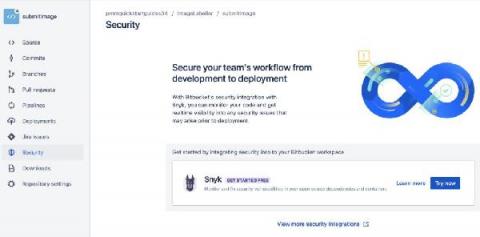
By now, you’re probably assessing your level of exposure — or are in the middle of remediating — the recently disclosed vulnerability known as Log4Shell. We recently introduced a native integration with Snyk, a leading provider of developer security solutions, to help you address zero-day vulnerabilities. Once enabled, Snyk scans your code and its dependencies, and alerts you about security vulnerabilities, including Log4j. All current versions of Log4j 2 up to 2.14.1 are vulnerable.

Build and deploy an ASP.NET Core application to Azure

Automating the deployment of a new web application and the release of feature updates goes a long way towards improving the productivity and efficiency of your development team. Another benefit of automation is that it minimizes or even eliminates repeated manual deployments. Manual deployments introduce the risk of human error during this critical part of the development process.

Breaking down complex projects into smaller, shippable increments

Building a complex new product can be scary. What if no-one gets value from it? What if it doesn't work? What if it's hard to change? One way to mitigate these risks is to break down the product into smaller shippable increments, allowing you to capture feedback early and confirming the most important assumptions before fully committing to a solution.

2021 Pepperdata Survey: The Reality of Kubernetes in Action

More companies than ever before are migrating to Kubernetes and seeing the results of Kubernetes in action. Kubernetes (K8s) is a key platform for big data users, and as such, we wanted to dive deeper and discover some new truths about current Kubernetes challenges and what the solutions might be. We surveyed 600 IT and big data professionals from various industries to determine which big data applications enterprises are moving or intending to move to Kubernetes.

Why is my SaaS application so slow?

Many companies today rely on SaaS connections in order for the business to function. Some users simply can’t operate in their job when an application becomes unavailable. When hundreds of users are impacted, this can cost a company serious money. That’s why keeping a proverbial finger on the pulse of application performance is generally worth the effort. But, it isn’t easy. Many popular SaaS applications are delivered from hundreds of locations around the world.

How to Perform Point-in-Time Recovery of a SQL Server Database

In a previous post in the backup and restore series, How to Restore Databases From Native SQL Server Backups, Tim mentioned some more advanced options when restoring a database backup, including performing point-in-time recovery of a SQL Server database (sometimes known as PITR). In this tutorial, I’ll build on the information in Tim’s post by showing you how to use backups to perform point-in-time recovery and a more advanced way to determine an exact point to restore to.