Operations | Monitoring | ITSM | DevOps | Cloud

Software Delivery Platforms to Benefit DevOps Practices

In this era where applications are taking over the world, delivering the service to your customer with scalability and security is of the utmost importance. The software delivery platform helps to manage the data flow, traffic management, and security of the data from both sides of the application. If you are studying software delivery platforms, then most of you must have heard about the Codefresh software delivery platform for continuous integration and continuous deployment of the application.

Harness Continuous Observability to Continuously Predict Deployment Risk

In my previous blog, I discussed how continuous observability can be used to deliver continuous reliability. We also discussed the problem of high change failure rates in most enterprises, and how teams fail to proactively address failure risk before changes go into production. This is because manual assessment of change risk is both labor intensive and time consuming, and often contributes to deployment and release delays.

Grafana alerts as code: Get started with Terraform and Grafana Alerting

Alerting infrastructure is often complex, with many pieces of the pipeline that often live in different places. Scaling this across many teams and organizations is an especially challenging task. As organizations grow in size, the observability component tends to grow along with it. For example, you may have many components, each of which needs a different set of alerts. You may have several teams, each with a different channel where notifications should be delivered.

Setting Up and Tuning Amazon S3 as a Cribl Stream Destination

Everybody is starting to look more at object storage to deliver on data lake initiatives, and S3, specifically Amazon S3, is the gold standard for that. In addition, we’ve heard from many of you that setting up S3 as a destination is a must when starting with Cribl Stream. So in this article we’ll walk you through the setup.

Introducing Nexthink Infinity

Today is one of the most special days in Nexthink history. I personally believe that founding and growing a tech company is mainly about developing amazing technologies which have the potential to change how people work. With the launch of our new Infinity platform, I feel we are truly transforming how digital workplace teams get their jobs done—not only for themselves but for all the employees in their companies.

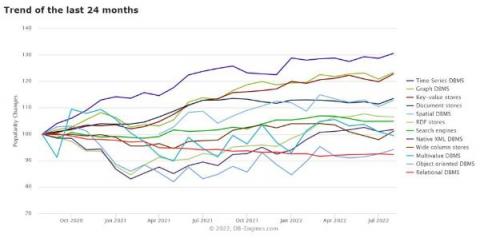
Relational Databases vs Time Series Databases

Databases are often the biggest bottleneck when it comes to application performance. Over the years a number of new database designs have emerged to help with not only basic scalability and performance but also to help improve developer productivity and make building certain types of applications easier. That isn’t to say these new databases are magical — there are always trade-offs being made and certain things are sacrificed for gains in other areas.

Part 4: Causal Observability - Level 3

It’s not surprising that most failures are caused by a change somewhere in a system, such as a new code deployment, configuration change, auto-scaling activity or auto-healing event. As you investigate the root cause of an incident, the best place to start is to find what changed. To understand what change caused a problem and what effects propagated across your stack, you need to be able to see how the relationships between stack components have changed over time.

Integration with Apache Kafka

You can integrate Edge Flow Manager (EFM) with Apache Kafka and forward agent heartbeats to defined Kafka topics. Learn how to perform the integration with Apache Kafka. To integrate EFM with Kafka, you need to configure Kafka and EFM properties. EFM supports the forwarding of agent heartbeats and acknowledges messages exchanged on the C2 protocol between the EFM server and MiNiFi agents.