Operations | Monitoring | ITSM | DevOps | Cloud

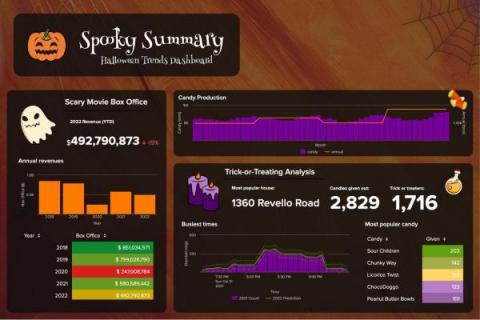
How We Built It: Getting Spooky with Splunk Dashboards

Dashboards are not just tools for businesses and other organizations to monitor and respond to their data, but can be a method of storytelling. All of our data has the potential to be crafted into compelling narratives, which can easily be accomplished with the help of Dashboard Studio’s customizable formats and advanced visualization tools. We can take a series of disparate datasets and bring them together in one place if they share a common theme — in this case, Halloween.

How Cribl's Suite of Solutions Help Prevent Zombie Data

In part 1 of this series, we talked about zombie data and what it means for your observability architecture. In this post, we’ll talk more about how to handle all of it. How well can your organization handle the firehose of data it’s collecting? Yes, you have the ability to collect it, but chances are you don’t have the financial or human resources available to analyze all of it effectively.

Bring Efficiency to Log Management in DigitalOcean

The ongoing partnership between Papertrail and DigitalOcean led to the development of the Papertrail software as a service (SaaS) add-on in the DigitalOcean Marketplace. With the add-on, developers can add powerful, simple, and scalable Papertrail log management to their DigitalOcean infrastructure in seconds. In two earlier posts, we reviewed how the add-on helps teams simplify and centralize log management.

Import Datadog Traces Into Honeycomb

Getting existing telemetry into Honeycomb just got easier! With the release of the Datadog APM Receiver, you can send your Datadog traces to the OpenTelemetry Collector, and from there, to any OpenTelemetry-compatible endpoint. Often, evaluating a new tracing solution requires re-instrumenting your applications from the ground up in a new vendor’s tooling. It’s a pretty high bar to clear just to see if a solution is worth adopting.

Grafana and Cilium: Deep eBPF-powered observability for Kubernetes and cloud native infrastructure

Today, Grafana Labs announced a strategic partnership with Isovalent, the creators of Cilium, to make it easy for platform and application teams to gain deep insights into the connectivity, security, and performance of the applications running on Kubernetes by leveraging the Grafana open source observability stack.

Reimagining the Modern Workplace Post-Pandemic

You’re probably bored with talking about Covid – we certainly are. But something that we still find interesting is that in the modern workplace, how people now interact with one another, how they work together and the communication tools that they use play a critical role in boosting their overall productivity. Because of the pandemic, many of us now split our time working between the home and the office – so how can we reimagine the modern workplace to get the most out of it?

Real-Time Embedded Linux Observability with Pantavisor and InfluxDB

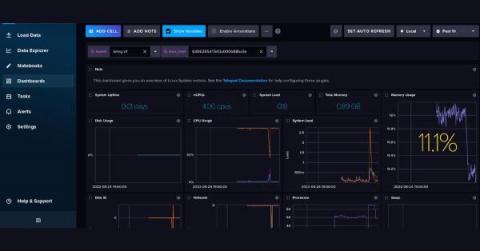
This article was originally published on HackMD and is reposted here with permission. Presently organizations are unable to monitor millions of embedded Linux devices in real-time. With so many different architectures and device types, aggregating telemetry and metrics and viewing that data in a centralized analysis tool is problematic. Onboarding embedded Linux devices into a telemetry service so that metrics can be easily observed is a significant challenge.

Unified Observability: Announcing Kubernetes 360

Ask any cloud software team using Kubernetes (and most do); this powerful container orchestration technology is transformative, yet often truly challenging. There’s no question that Kubernetes has become the de-facto infrastructure for nearly any organization these days seeking to achieve business agility, developer autonomy and an internal structure that supports both the scale and simplicity required to maintain a full CI/CD and DevOps approach.

It's all about the preparation - Automated preparation!

Recently I joined a team to run a ‘Ragnar’. A ‘Ragnar’ is a running race where you and an additional seven teammates run a course that typically lasts around 24 hours non stop. Our team joined over 300 other teams running this Ragnar trail course in the middle of the woods in northern Wisconsin. This course consisted of three loops, a 3 mile loop, a six mile loop and a seven mile loop.