Operations | Monitoring | ITSM | DevOps | Cloud

Sumo Logic Red Hat Marketplace Operator

Red Hat OpenShift is an open source container application platform that incorporates a collection of software that enables developers the ability to run an entire Kubernetes environment. It includes streamlined workflows to help teams get to production faster and is tested with dozens of technologies while providing a robust tightly-integrated platform supported over a 9-year lifecycle.

The Top 5 Node.js Performance Measurement Metrics

Using Node.js as a JavasScript runtime has its advantages. However, it requires significant maintenance to keep it working as expected. Here are the top metrics you should monitor for Node.js performance measurement analysis. Application programming interfaces or APIs that use the Node.js runtime environment are scalable. Node.js is asynchronous and event-driven, which means the application can handle multiple connections at the same time.

Why you should be using a VPN when working from home

With so many of us working from home full time for the last 16 months, VPNs have become essential tools for companies to keep their staff working in a safe environment. What we mean by “safe” is mainly about your online presence whilst performing daily tasks for your job.

Bolster OT Security with Graylog

Anyone tracking the evolution of the IT industry is probably familiar with the concept of Industry 4.0. Essentially, it describes the process by which traditional industrial tasks become both digitized and continually managed in an IT-like fashion via modern technologies like cloud computing, digital twins, Internet of Things (IoT) sensorization, and artificial intelligence/machine learning.

An Easy-to-Follow Guide on Migrating Your Website With Minimal Downtime

Businesses and successful social enterprises might need to move their website to a new host or server for various reasons. Perhaps you've expanded beyond what your current provider can offer or need a faster server or host. No matter the motivation, making website migrations more efficient is essential to keeping your business operations running. Although technological advancements have improved the delays that result from transferring sites, there can still be a lengthy delay.

The new world of hybrid work in Australia and New Zealand

Nathalie Tousignant, director of ITSM product management, co-wrote this blog. For decades, work was a place we went, where colleagues gathered in person for meetings, problem-solving, and chats over coffee. Then, the COVID-19 pandemic hit, and the way we thought about work changed overnight. Many tried to fit the processes of traditional in-person work into a virtual setting. The result?

Facilitate DevOps Monitoring with Synthetics and RUM

DevOps is a common name in the technology household. Teams, small or big, are embracing this concept to deliver applications faster, improve software quality, and add efficiency in the development process from the very beginning. Shortening the feedback loop leads to a cost-effective way for businesses to find and fix defects earlier in the cycle process. Plus, it lowers the software failure rate in production and minimizes time wastage for the development team.

Robotic Data Automation (RDA): Reducing Costs and Improving Efficiencies of Your Log Management Investment

People’s involvement has been inevitable with log management despite advancements in ITOps. Log management at a high level collects and indexes all your application and system log files so that you can search through them quickly. It also lets you define rules based on log patterns so that you can get alerts when an anomaly occurs. Log management analytics solution leveraging RDA has been able to detect anomalies and aid predictive models over a machine learning layer.

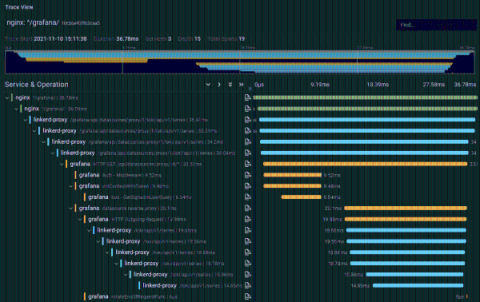
Introducing the Honeycomb plugin for Grafana

Over the years, we’ve heard many versions of the same familiar story: large businesses struggling with observability data living in several different systems. At Grafana Labs, our “big tent” philosophy is based on the belief that our users should determine their own observability strategy and choose their own tools. Grafana allows them to bring together and understand all their data, no matter where it lives.