Operations | Monitoring | ITSM | DevOps | Cloud

Latest posts

Our Limits Are Not Our Imagination

Yesterday, my partner told me about his new automated pipeline from a conversation recording to publication of a whole podcast, with social media blurbs and graphics and everything. It did more than he'd predicted the agent could do. "We are limited by what we can imagine," he said. Cheesy, but it kinda gave me goosebumps because it's (almost) true. Most of the experienced developers I know are concerned.

ObservabilityCON 2026: A guide to all the announcements from Grafana Labs

Today at ObservabilityCON 2026 in San Francisco, we unveiled a range of new Grafana Cloud capabilities designed to reshape cloud economics, bring richer context and deeper visibility across your systems and end-user experiences, and help teams move toward autonomous operations. Check out the keynote to learn more about the latest updates to the open agentic observability cloud, and read on for a quick recap of all the news from ObservabilityCON 2026.

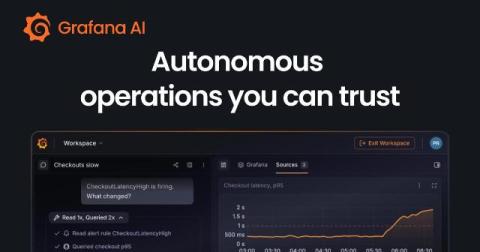
From production problem to proposed fix: Implement autonomous operations with Grafana AI

You've just finished a deployment, and though your service is up, you start to notice some requests are getting slower. To address the lag, someone—or, more likely, some group of people on your team—needs to watch the dashboards, decide whether the change matters, investigate what happened, and turn the findings into a fix. At each step you're gathering context—and often explaining that context again to the next person or tool.


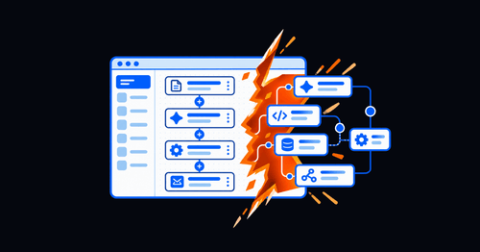
What Happens When You Outgrow a No-Code AI Agent Builder?

A no-code AI agent builder can get a defined agent into production quickly. The risk appears when added branches, exceptions, integrations, and controls exceed the visual canvas. Organizations should look for a platform that lets teams extend individual steps with reusable code without rebuilding the agent or abandoning its governance.

Build better SLOs with RUM and synthetic SLIs

Well-designed service level objectives (SLOs) help you track the benchmarks your app needs to meet to deliver a successful user experience (UX). To track performance against these SLOs, many SRE teams are turning to real user monitoring (RUM) and synthetic monitoring for their service level indicators (SLIs), as these forms of data provide more direct measurements of UX than backend performance metrics.

We used our own product to cut our AI tooling bill without cutting AI usage

The problem: our AI spend was growing faster than our understanding of its ROI. Like most engineering organizations, Harness went from "a few people are trying out AI coding tools" to "AI tooling is a line item in the monthly finance review" in a matter of months. The cost itself wasn't really the problem.

Harness Launches VegaLoad: Open-Source Load Testing for Agentic Developers

VegaLoad is a free, open-source load testing tool for agentic developers. Your agent writes the test, runs it, and gives you a report. VegaLoad is a free, open-source load testing tool. You ask your agent for a test. It writes the file, runs it, and gives you a report.

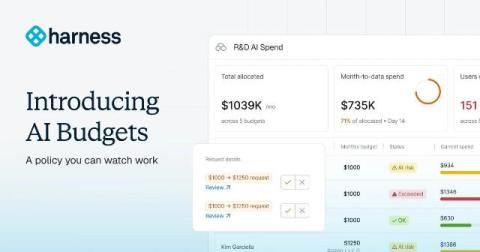
Introducing AI Budgets: A Policy You Can Watch Work

AI Budgets turns an AI cost policy into a limit customers can watch hold in real time, so overspend gets caught within days instead of surfacing on next month's invoice. With AI Budgets, the Cost Management Agent turns your AI cost policy from a document everyone signed once and forgot into a limit you can see working. ‍ In our last post, we showed why 73% of organizations have an AI cost policy, but only 13% can tell whether it's working.

Telemetry Cost Management: Routing, Tiering, and Governance Without Blind Spots

TL;DR Cutting telemetry volume is only half of cost management. The other half is sending each signal to the right destination and storage tier, adjusting policies as traffic and incidents change, and rolling out every change in phases that teams can measure and reverse.