Operations | Monitoring | ITSM | DevOps | Cloud

The latest News and Information on Monitoring for Websites, Applications, APIs, Infrastructure, and other technologies.

Azure Event Grid dead letter monitoring

Microsoft Azure provides a completely managed event routing service called Azure Event Grid. It allows you to respond to events received from various Azure services and external applications and forward them to different Azure services and endpoints. Azure Event Grid provides a unified way to manage events in Azure with event-driven programming. With Event Grids, you can create event-driven applications in a serverless environment, cutting down costs and performance lags.

Run Azure Functions locally in Visual Studio 2022

Azure Functions offers a serverless solution that streamlines the development process, minimizes infrastructure overhead, and results in cost savings. The beauty of this approach is that you no longer need to grapple with server deployment and maintenance; the cloud infrastructure automatically furnishes the essential resources to support your applications.

15 Ways to Use UptimeRobot to Track Changes & Improve Your Web Prowess

In this blog you will learn: Keyword monitoring, or simply put, the practice of checking if a specific word is still present on a website, has many uses beyond just monitoring your uptime and errors. Keyword monitoring allows you to receive alerts about updates to content, or checking the content of a JSON file based on the words or phrases you’re interested in.

State of the Internet: Monitoring SaaS Application Performance

Kentik's State of the Internet Overview: With the increasing reliance on SaaS applications in organizations and homes, monitoring connectivity and connection quality is crucial. However, gaining insights into third-party networks like Google's DNS, Microsoft 365, or Zoom is challenging. Kentik's "State of the Internet" offers a solution. Part of Kentik's network observability platform, it deploys hundreds of test agents globally to monitor popular SaaS providers, major public clouds, and DNS services.

Auto-Instrumenting OpenTelemetry for Kafka

Apache Kafka, born at LinkedIn in 2010, has revolutionized real-time data streaming and has become a staple in many enterprise architectures. As it facilitates seamless processing of vast data volumes in distributed ecosystems, the importance of visibility into its operations has risen substantially. In this blog, we’re setting our sights on the step-by-step deployment of a containerized Kafka cluster, accompanied by a Python application to validate its functionality. The cherry on top?

Rootless Containers - A Comprehensive Guide

Containers have gained significant popularity due to their ability to isolate applications from the diverse computing environments they operate in. They offer developers a streamlined approach, enabling them to concentrate on the core application logic and its associated dependencies, all encapsulated within a unified unit.

OpenTelemetry metrics: A guide to Delta vs. Cumulative temporality trade-offs

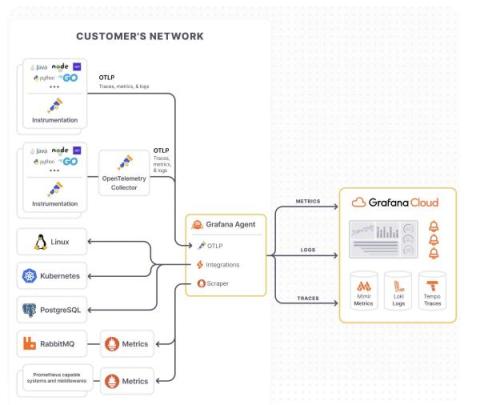
In OpenTelemetry metrics, there are two temporalities, Delta and Cumulative and the OpenTelemetry community has a good guide on the different trade-offs of each. However, the guide tackles the problem from the SDK end. It does not cover the complexity that arises from the collection pipeline. This post takes that into account and covers the architecture and considerations that are involved end-to-end for picking the temporality.

5 reasons to switch to the OpsLogix VMware Management Pack

5 reasons to switch to the OpsLogix VMware Management Pack When you are choosing a solution to monitor your VMware infrastructure in System Center Operations Manager (SCOM), you need to consider several different factors to ensure making the best choice possible. You want to find a solution that is cost-effective, includes all of the necessary features, and that is continuously updated.

Navigating Data Overload with Cribl

So many businesses today are playing “Hungry, Hungry, (Data) Hippo,” devouring every marble of information they can get their hands on. While it seems like every company has a robust data aggregation system, what most companies don’t have is an efficient way to control what data they store and where that data goes. We all want to make data-driven business decisions, but sorting through tons of data to find useful business insights can be like finding a needle in a whole farm.