Operations | Monitoring | ITSM | DevOps | Cloud

Faster MQTT Data Collection with InfluxDB

Native MQTT eliminates the need to write custom code, orchestrate additional technology layers or incorporate additional hosting services. MQTT is a powerhouse within the Internet of Things (IoT) space. Its pub/sub model and lack of defined payload structure make it infinitely adaptable to the needs of modern sensors, devices and systems. IoT data is also time-series data.


SpiceWorld 2022: It was good to be back

Ah SpiceWorld. One of NinjaOne’s favorite conferences – and a personal favorite of mine. So after two years of the show being virtual, we were thrilled to learn that SpiceWorld would be back in-person this year (with a virtual element too). We couldn’t wait to see everyone in person again! Conversations with customers in the NinjaOne booth Now that the show is over, I didn’t want to miss the opportunity to showcase what Ninja was up to and highlight the great work of our team.

Announcing general availability of Elastic APM .NET agent profiler auto-instrumentation

A few months back, we introduced the beta release of Elastic APM.NET agent profiler auto-instrumentation. Fast forward to today, we're excited to announce the general availability (GA) of this powerful capability that allows the.NET APM agent to automatically instrument.NET Framework, .NET Core, and.NET applications without requiring code changes or recompilation.

Elastic Enterprise Search 8.5: Machine learning for intuitive search experiences

The latest release of Elastic Enterprise Search introduces a suite of new features and capabilities for building world-class search experiences for your mission-critical applications, websites, online stores, or anything in-between: With this release, building search experiences for your ecommerce retail site, enhancing your employees’ ability to access relevant HR documentation, or building a custom application to quickly draw analytic insights can draw on the power of using the trained model of

Current DevOps Problems & How Scout APM Solves Them

Most software companies rely on DevOps at some scale to aid their software development and deployment processes. DevOps has recently seen a major increase in popularity due to the advent of cloud-based tools and automation possibilities. DevOps can help you completely forget the woes of deploying software and focus better on building better apps and providing a holistic experience for your end user. However, just like other things in tech, DevOps is not perfect.

Getting started with EKS and Calico

Cloud-native applications offer a lot of flexibility and scalability, but to leverage these advantages, we must create and deploy a suitable environment that will enable cloud-native applications to work their magic. Managed services, self-managed services, and bare metal are three primary categories of Kubernetes deployment in a cloud environment.

Watch Grafana Labs CEO, Co-founder Raj Dutt discuss why companies need observability

Grafana Labs CEO and Co-founder Raj Dutt sat down with “NYSE Floor Talk” ahead of ObservabilityCON to discuss why companies are increasingly focused on observability as a means to improve customer satisfaction. In his conversation with Judy Khan Shaw, host of “NYSE Floor Talk,” Dutt also talked about Grafana Labs’ big tent philosophy and the growth of Grafana Labs and the Grafana open source community.

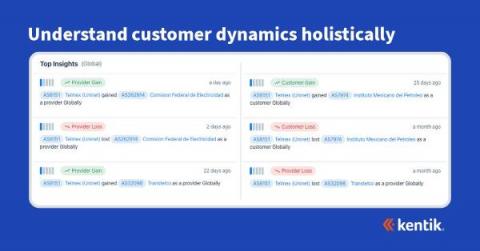
Kentik Market Intelligence just increased its IQ - introducing KMI Insights!

Early this year we launched Kentik Market Intelligence (KMI). If you missed it, KMI enumerates transit and peering relationships as well as produces rankings based on the volume of IP space transited by ASes in different geographies. Using tables and charts, KMI offers a global view of the internet out-of-the-box without any configuration or setup. KMI uses public BGP routing data to rank ASes based on their advertised IP space.

Three ways end user self-service tools can save you time

Countless times in the MSP world I’ve had to ask myself, “why can’t the end users handle this?” Typically, the answer boils down to the fact that they are paying the MSP to take that stress and labor off their hands. However, there are occasions when end users, providing they’re properly trained, can legitimately take some of the workload off the MSP’s hands.