Operations | Monitoring | ITSM | DevOps | Cloud

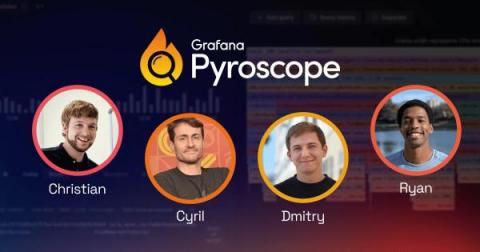
Meet the minds behind Grafana Pyroscope: Christian, Cyril, Dmitry, and Ryan

What do you get when you combine the wit, wisdom, and weird humor of four talented tech minds? As it turns out, a surprisingly lively Q&A! As Grafana Pyroscope emerges from the union of Grafana Phlare and Pyroscope, it’s time to really get to know the people behind these continuous profiling projects. That’s why we brought together the Pyroscope founders, Dmitry Filimonov and Ryan Perry, and Phlare technical leads, Cyril Tovena and Christian Simon, for this light-hearted conversation.

How to Benchmark Cloud FinOps Effectively

Cloud FinOps is rapidly becoming popular among organizations in today’s digital age due to its ability to help manage financial operations more efficiently. This is because it allows organizations to track, measure, and optimize their cloud spend with greater visibility. It also helps improve operational efficiency by automating numerous financial processes, including billing, budgeting, auditing, and reporting.

The Ultimate Guide to Digital Workplace Observability

The digital workplace has evolved dramatically over the past decade, both in terms of the increased reliance on technology for daily operations and the complexity of that technology. In order to manage an improve the digital workplace, service desk teams need more than just a comprehensive view of their IT environments — they need to be able to analyze that data in real-time to make faster, more continuously effective decisions. Enter: digital workplace observability.

How Are SASE and SD-WAN Related?

SD-WAN and SASE both build on traditional network models, such as those used to connect a company’s offices. While the two models share some features and advantages, they have different structures and approaches. In the simplest terms, an SD-WAN inspects and routes data more efficiently, while a SASE combines networking and security functions into a single service. Here’s what you need to know.

N-central Patch Monitoring Best Practices and Recommendations

The best part about patching in N-able N-central is the ability to fully automate the process, but even if that is accomplished correctly there is still a need to have the right amount of sensitivity of patch monitoring in place. I have always monitored patches in terms of age, I did so with WSUS v3 (15 years ago) and have always done so in N-central.

Outlook Zero-Day (CVE-2023-23397) Fix for N-central and N-sight

As you likely be all too aware, there is a Microsoft Outlook zero-day vulnerability listed under CVE-2023-23397. With the increased attacks on Outlook this month, Microsoft has pushed out fixes for about 80 Windows flaws. More information on some of those patches can be found in my colleague Lewis Pope’s March 2023 Patch Tuesday blog. Lewis was also kind enough to send over the remediation script for both N-able N-central and N-able N-sight.

How to Set Up a GitHub Profile README

What’s up!? My name is Mikaela Caron, I’m an iOS Engineer at Lickability, and also a freelance developer, GitKraken Ambassador, and content creator. I make content on YouTube, Instagram, and Mastodon / Twitter about iOS development and freelancing. I also organize a monthly online meetup called iOS Dev Happy Hour. I wrote this article to explain the benefits of having a profile README, how to create your own, and show a few examples of public profiles.

Control and Audit Remote Control Actions for Security

In an article a few months ago, my colleague covered the functionality within eG Enterprise that ensures secure and traceable audit trails for both users and admins of eG Enterprise allowing automated auditing and reporting for regulatory compliance and security, see Auditing Capabilities in IT Monitoring Tools | eG Innovations. Today, I will follow from this article and cover how eG Enterprise also controls and audits the execution of Remote Control Actions and scripts.

Introduction to Kubernetes Observability

Cloud has become the de-facto standard for new application development. Kubernetes solves many problems of modern-day cloud infrastructure. It has made microservices-based distributed software systems possible, enabling organizations to provide on-demand scaling. But at the same time, Kubernetes has also increased operational complexity. In simple terms, Kubernetes is a container orchestration tool. Container environments are dynamic and ephemeral.