5 Things to Consider When Choosing a CMS for Your Project
What to consider when choosing a CMS for your project? Despite the fact that your circumstances will differ, the following five points are crucial.


When businesses look at how best to understand the performance levels of their platforms, some of the best incident management metrics to look at are Mean Time Between Failures (MTBF) and Mean Time ToResolution(MTTR). These two measurements will give an excellent indication of the health and speed of the system, as well as the ability of the platform to take care of any anomalies that have been detected or to flag them up for others to take action to resolve them.
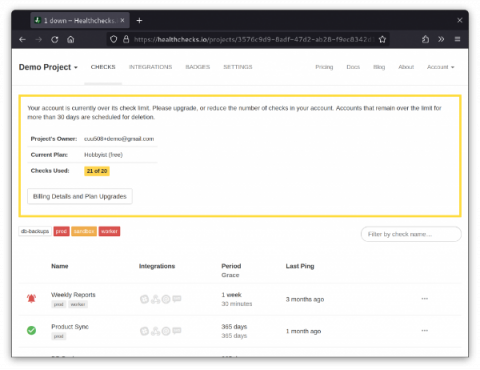
Healthchecks recently gained a new feature: check auto-provisioning. When you send a ping request to a slug URL, and a check with the specified slug does not exist, Healthchecks can now automatically create the missing check. This feature requires opt-in: to use it, add a?create=1 query parameter to the ping URL.
Generally, data monitoring can be referred to as a continuous process of observing and tracking data in order to ensure its integrity, quality, and conformance with specific standards or requirements. Data monitoring often involves systematic data collection, analysis, and reporting to identify patterns, trends, anomalies, and potential issues.
Managing school stocks is essential for all educational institutions. In summer, when schools are closed, it is important to take advantage of this period to optimize inventory management. Here are six practical tips to improve management.
As a leading full-stack observability platform, Coralogix enables you to gather, monitor and analyze your infrastructure and application telemetry. And Coralogix now offers synthetic monitoring for proactive end-to-end testing across development with Checkly.
Maybe you came across the term “vector database” and are wondering whether it’s the new kid on the block of data retrieval systems. Maybe you are confused by conflicting claims about vector databases. The truth is, the approach used by vector databases has been around for a few years.