Operations | Monitoring | ITSM | DevOps | Cloud

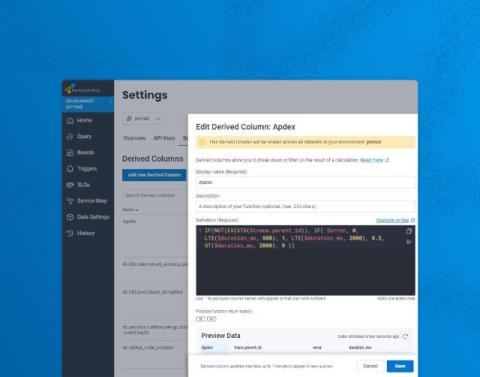
Apdex in Honeycomb

“How is my app performing?” is one of the most common, yet hardest questions to answer. There are myriad ways to measure this, like error rate, average response time, and so on. Enter the Application Performance Index (aka Apdex), a single metric that attempts to answer, “Are my application’s users happy?” Apdex is an open standard that was formalized in 2005 by the Apdex Alliance.

Ensure Full Stack Observability Between Mainframe and Cloud/Container Applications with AIOps from Broadcom

As enterprises advance on their cloud/modernization journeys, many teams struggle to achieve full stack observability. These teams are finding that mainframe systems are a ”critical path” for applications that deliver business-critical digital services to customers, partners, and employees.

8 Key Insights for My Clients from the OpsRamp State of Observability Report

The OpsRamp State of Observability 2024 report not only presents fascinating data from a strong sample of IT leaders, but also outlines many highly actionable findings. As an independent analyst and advisor, I appreciate how this report outlines a powerful action plan for any CIO, CTO, or other IT leader who has not yet adopted or achieved success with observability.

The New Era of Autonomous Debugging: Transforming the SDLC

The software world is changing rapidly due to advancements in GenAI. These technologies are disrupting traditional processes and driving automation across every part of the SDLC. The market for AI code tools is estimated to reach $30 billion by 2032. It started with code generation, then moved to testing, QA, automatic pull requests, and beyond.

Unleashing Deep Observability with eBPF-Based Topology in Virtana AM

In today’s dynamic and complex IT landscapes, maintaining visibility into application topologies is crucial for ensuring optimal performance, troubleshooting issues, and delivering exceptional end-user experiences. Did you know that 73% of IT leaders report increased difficulty in managing application performance due to rising complexity?

Monitoring, Observability, & Debuggability Explained

Monitoring tools are great at letting you know when something is broken and the overall impact. We should know, we make an error monitoring tool. Observability tools are good for well, observing. But here’s the thing, you (we) don’t observe code. We (you) push code. So what the collective “we” need is a tool that makes it easy to ship, improve, and maintain reliable and performant code.

Making Room for Some Lint

It’s one of my strongly held beliefs that errors are constructed, not discovered. However we frame an incident’s causes, contributing factors, and context ends up influencing the shape of the corrective items (if any) that get created. I’ll cover these ideas by using our June 3rd incident where a database migration caused a large outage by locking up a shared database and making it run out of connections.

Elastic vs Splunk [Detailed Comparison 2024]

Elasticsearch and Splunk are two leading solutions renowned for their capabilities in processing, analyzing, and visualizing large datasets in real-time. Both platforms have carved out significant roles in the fields of data analytics and log management, each offering unique features tailored to different needs. This article aims to provide a comprehensive comparison of Elasticsearch and Splunk, highlighting their strengths and weaknesses, and introducing Uptrace as a compelling alternative.
Sponsored Post

What's new in Avantra 24.2

It's my pleasure to announce the release of Avantra 24.2. The second update of Avantra 24, building upon 24.1 which brought performance and customer requested bug fixes, 24.2 brings new innovations and enhancements to our Avantra platform. With over 300 changes in our development management system, Avantra 24.2 feels like a major release to us and we have something new everywhere you look. Let's dive deeper into the new features.