Operations | Monitoring | ITSM | DevOps | Cloud

Jaeger vs. Grafana Tempo: A Comprehensive Comparison for Distributed Tracing

When it comes to monitoring, diagnosing, and optimizing the performance of complex systems today, you can’t really go wrong with tracing tools. And while OpenTelemetry has become the go-to choice for instrumenting apps and collecting traces, there are several other options in the backend that can effectively store, manage, and analyze traces sent by OpenTelemetry. Two of these open-source tools are Jaeger and Grafana Tempo. In this article, we’ll compare and contrast the two.
Navigating IT complexity: Observability vs. monitoring for Australian SMEs' digital transformation

While traditional IT monitoring holds back Australian small and medium-sized enterprises (SMEs) in digital transformation, these organizations do realize that in the realm of IT operations, observability represents a significant advancement over traditional monitoring approaches. Unlike conventional methods that primarily focus on metrics like uptime and error rates, IT observability provides a comprehensive view of system behavior by integrating logs, metrics, traces, and events.

The CoPE and Other Teams, Part 2: Custom Instrumentation and Telemetry Pipelines

The previous post laid out the basic idea of instrumentation and how OpenTelemetry’s auto-instrumentation can get teams started. However, you can’t rely only on auto-instrumentation. This post will discuss the limitations in more detail and how a CoPE can help teams overcome them.

Monitor your Anthropic applications with Datadog LLM Observability

Anthropic is an AI research and development company focused on building reliable and safe artificial intelligence systems. Their flagship product is Claude, an advanced language model and conversational AI assistant known for its strong capabilities in natural language processing, reasoning, and task completion. Anthropic places a particular emphasis on AI safety and ethics, and its models and APIs are used by organizations across various industries to build powerful, safe, and performant AI applications.

Elastic Observability 8.15: AI Assistant, OTel, and log quality enhancements

Elastic Observability 8.15 announces several key capabilities: New and enhanced native OpenTelemetry capabilities: Elastic AI Assistant enhancements: Large language model (LLM) observability for Azure OpenAI: Elastic Observability now provides deep visibility on the usage of the Azure OpenAI Service. The integration includes an out-of-the-box dashboard that summarizes the most relevant aspects of the service usage, including request and error rates, token usage, and chat completion latency.

Managing Observability Pipeline Chaos

The cloud environment has generated an unprecedented volume of data, making it increasingly difficult for enterprises to manage. With multiple SaaS and cloud-based applications in play, differentiating which data needs processing for analysis versus storage for regulatory compliance is a significant challenge. The growing number of data sources only complicates this further. So, getting clarity and control over this chaos is the goal, without having to overhaul your entire system.

Top 10 Observability Tools in 2024

Evolution of distributed systems and microservices architectures has increased the complexity of modern IT infrastructures. This complexity demands robust observability solutions to ensure optimal system performance, rapid incident response, and informed decision-making. This comprehensive guide explores the top observability Tools in 2024, detailing their features, strengths, and potential drawbacks to help organizations make informed choices in their observability strategies.

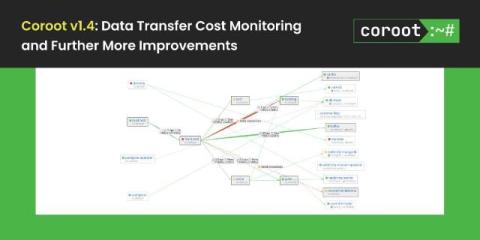
Coroot v1.4: Data Transfer Cost Monitoring and More

We’re excited to announce the release of Coroot v1.4! Along with various UI improvements, this update brings a new feature: network traffic monitoring. Now, you can easily see how much data is being transferred between your applications and, more importantly, how much it costs. Let’s dive into the details. In this post, we’ll explore the enhancements and new features included in this release.

Topology for Confident Observability and Digital Resilience

In recent years, we’ve significantly advanced how we think about and use topology within AIOps and Observability solutions from Broadcom, while solidly building on our innovative domain tools. We’re eager to share these innovations, advancements, and benefits for IT operations. In this blog post, we level-set on the topic of topology, clarify several important concepts, and discuss the decisive role topology plays in delivering powerful capabilities for AIOps and Observability from Broadcom.