Alexa, How Can I Get AWS Credits?
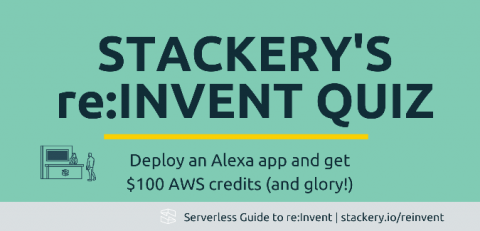
We are excited to announce that if you deploy our AWS Trivia Alexa Skill from Stackery we will send you $100 AWS credits and an Amazon Echo!


We are excited to announce that if you deploy our AWS Trivia Alexa Skill from Stackery we will send you $100 AWS credits and an Amazon Echo!
Think about the impact of artificial intelligence (AI) capabilities on something as ubiquitous as search. We all use search in our everyday lives, and our preferred search engine responds with pages and pages of highly relevant information, definitions, reviews and recommendations, history, and so much more. But this type of consumer-life use case can be miles away from how we use search in the enterprise. In that context, what may seem simple gets a lot more complicated.
Needless to say, 2020 has been a year to remember. So it goes without saying that re:Invent 2020 will be unforgettable as well, but this time, in a good way. For starters, instead of hopping on a plane and spending four days in Las Vegas, we get three weeks of it from the comfort of our home offices. As usual, the event will be jam-packed with speakers, presentations, hands-on learning sessions. They’ll be helmed by experts in the cloud computing, DevOps, and the open source community.
Heroku and AWS (Amazon Web Services) are the two most commonly used cloud services in present times. It lets a business deploy, monitor, and scale mobile and web applications. Both services are great for hosting applications and offer cloud computing resources. Choosing the best hosting service becomes difficult when you take a glance at the plethora of products that AWS offers. In case you are planning to switch to AWS from Heroku, you have come to the right place.
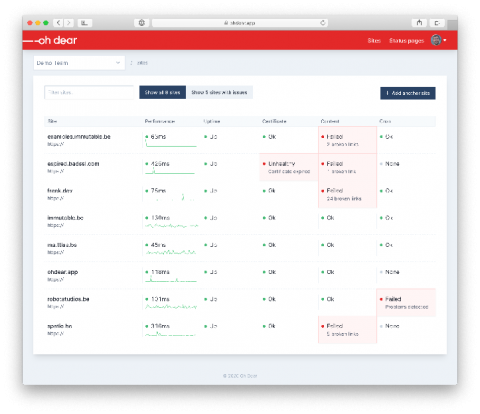
We just launched our brand new monitoring dashboard to all clients, giving a modern new look & feel to Oh Dear! There are plenty of improvements under the hood, so let's dive right in.
Computer networks all around the world generate daily records of events occurring in their system. Some events are routine while others indicate potential security breaches or weak network health. Event log files consist of log information that can help organizations reduce their exposure against malware, intruders, damages and legal obligations.
Welcome to 2020: the year in which having a business simply can’t happen without having a website. And, in recent years, not just ANY website. Business owners must have THE website: an online virtual space that is so magnificently created and intuitive to use, not to mention flame up emotions we never knew existed that users simply can’t forget. But how do you achieve this in a world with SO MANY WEBSITES without having to spend weeks if not MONTHS creating it?
When analysing data one of the biggest questions you may often face is: what is causing this situation? In this blog, we’re going to look at how causal inference can be used to understand in more detail what the biggest influencing factors are across a dataset. Traditionally in Splunk, we talk about correlation; does metric x go up or down in accordance with metric y or is there a relationship between x and y?
IT executives, operators, and administrators can quickly assess end-user availability and performance experience based on Microsoft 365 services’ critical data from end-to-end monitoring. This eases their day-to-day tasks by reliable reporting data, troubleshooting information, and end user experience for their Microsoft 365 services.