Operations | Monitoring | ITSM | DevOps | Cloud

The latest News and Information on DevOps, CI/CD, Automation and related technologies.

Service Desk vs. Help Desk: What's the Difference (and Where Does ITSM Fit In)?

A help desk is the front-line function that receives user issues and requests, records them, provides basic troubleshooting, and routes unresolved work to the appropriate specialist. Its goal is to restore user productivity quickly. Typical help desk activities include: The work is usually tactical and reactive. A user cannot connect, open an application, or complete a task, so the help desk responds.

eBPF: Correlating rustls Plaintext to TCP Connections Without a File Descriptor

In Under the Hood with Go TLS and eBPF, I left socket tracking as an exercise for later. The example used bpf_get_current_pid_tgid() and explicitly excluded concurrent TLS operations. Capturing plaintext was enough for that post. With rustls, later arrived: I could read the HTTP payload perfectly and still attach it to the wrong TCP connection. That’s a frustratingly convincing failure. The request looks right. The response looks right. The application works.

Find code faster: Introducing our new & improved search experience

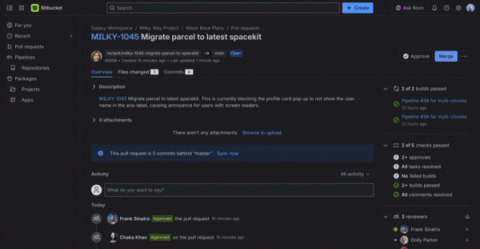
Finding code across your repositories in Bitbucket just got a major upgrade. We’ve rolled out code search in open beta for Bitbucket Cloud: a faster, more integrated search experience built to help you find code across your workspace without interrupting your workflow. For many developers, search is one of the fastest ways to explore an unfamiliar codebase, investigate an incident, audit API usage, or scope a refactor.

Are SOC 2's days numbered? #SOC2 #CodeReview #AICoding #DevOps #SoftwareDevelopment #LLM #SpeedScale

As companies adopt AI coding tools, code review processes are breaking down. Traditional compliance methods are slowing teams down, but human engineers aren't going to spend hours reading AI-generated low-level code forever. How will SOC 2 adapt to the era of AI-driven development? Drop your thoughts in the comments and subscribe for more tech insights! Learn more: speedscale.com.

Cloud Migration Strategies, the 6 Rs, and How to Avoid Getting Stuck Mid-Move

Consider a platform team that spends four months building a thorough migration plan. Its pilot, a stateless order-status API, runs on AWS within three weeks. Six months later, that API is still the only workload in the cloud. In this scenario, the blockers are not exotic technical failures.

You Can Have Your Pi and Kepler It Too

One of the features I have been wanting in Kepler for a long time was the ability to use Pi as my agent when spinning up tasks. Pi is such a minimal harness that it doesn’t prompt for approval for every little thing and it’s system prompt let’s the model just be itself. That minimalism comes at a cost, though. Pi doesn’t have ACP support out of the box, so that means we haven’t been able to officially support it in Kepler, yet.

JFrog Agent Power for AWS Kiro

JFrog is bringing software supply chain governance to AWS Kiro. Operating as a power plugin within Kiro, JFrog delivers package safety, agentic access to the JFrog platform, and the JFrog AI Catalog. With simple setup, AI agents make supply chain aware decisions right inside the IDE, ensuring dependencies come directly from Artifactory rather than unverified public registries.

First Look: Build Grafana Dashboards with AI using the MetricFire MCP Server

Get a first look at what’s coming next to the MetricFire MCP Server: AI-powered dashboard creation and management. We’re connecting the Hosted Graphite HTTP Dashboard API to our MCP Server, letting compatible AI clients work with your monitoring data and Grafana dashboards directly through an AI-assisted workflow. Soon, you’ll be able to use natural language prompts to reference metrics stored in Hosted Graphite and create, update, and manage dashboards.

What Is Immutable Backup and Why Does It Matter for Ransomware Recovery?

Learn how immutable backups protect data from deletion, encryption, and ransomware attacks so organizations can recover clean copies. Table of Contents Ransomware attacks are a major threat to modern organizations. Cybercriminals encrypt an organization’s data and demand payments to restore access to it. Modern ransomware also attempts to destroy existing backup files to prevent recovery. Therefore, you must protect backup targets with strong data isolation controls.