Mailchimp
Not subscribed to OpsMatters Newsletter


Businesses are generating vast amounts of data from various sources, including applications, servers, and networks. As the volume and complexity of this data continue to grow, it becomes increasingly challenging to manage and analyze it effectively. Centralized logging is a powerful solution to this problem, providing a single, unified location for collecting, storing, and analyzing log data from across an organization’s IT infrastructure.
Contrary to Betteridge’s Law of Tabloid Headlines, the answer to the question, "does OpenTelemetry in.NET cause performance degradation?" is yes, but context is important. I get this question so often that I thought it was time to get some stats on it. I’ve heard comments like: I can only assume that these are based on previous versions, or things like OpenTracing / OpenCensus (the heritage frameworks that were the feeders for OpenTelemetry).
As developers, we all seek to build web applications that can scale seamlessly, adapt to changing needs and do so without incurring excessive costs. One way to achieve this is by migrating web applications to AWS Lambda, which can provide scalability, flexibility, and cost savings. To make this process even easier, AWS provides the Lambda web adapter, a simple and efficient tool that enables you to migrate your web apps quickly.
Within enterprises, it used to be that applications ran on a single server. Owners could directly monitor that discrete machine, conveniently access all the logs they needed, see all the metrics that mattered, and hit the reboot button, without needing to confer with “everyone.” Those days are gone. Modern application architectures stretch the definitions of the words “federated” and “distributed.” We now have distributed applications.
Last Updated on April 14, 2023 Logistics, put plainly, is the management of resources that are either in transit, or need to be. Resources, in this context, refer to anything of value. This includes people, tangible goods, materials used to produce something else, or again, practically anything of worth that is in transit or, eventually, will be.
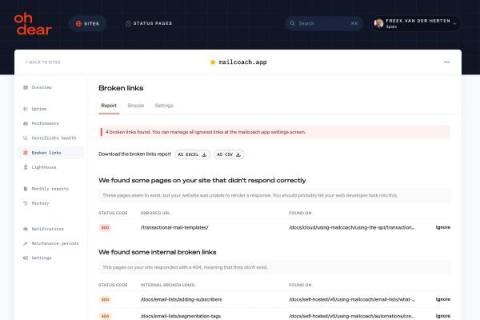
One of the unique features of Oh Dear is that we crawl your entire site and report any broken links. Our broken links report had two main categories: In both categories, the problem is caused by something related to the site's content. In most cases, a page you're linking to was removed or archived. The solution is often letting the content manager of the site fix this. Today, we're introducing a third category in our report: internal broken links that resulted in a 5xx status code.