Operations | Monitoring | ITSM | DevOps | Cloud

Intelligently Monitor Your Work From Home Infrastructure for Business Continuity

Working remotely is becoming the norm for more and more businesses. Many companies have offices spread throughout the world, decentralized employees or contractors, or they simply have a flexible work from home (WFH) policy. Remote work is an aspect of digital transformation that is often left out of conversations when it comes to ensuring business continuity and driving growth.

How to visualize free disk space available in Azure via Microsoft and 3rd party technologies

We are delighted to have a guest blog from Cameron Fuller, System Center MVP for Cloud and Datacenter Management, Solution Director for Catapult Systems and automation evangelist. Today, Cameron shares how we can visualize free disk space in Azure using Microsoft tools and third party solutions. Scroll down to final section to see what he's got to say about SquaredUp!

InfluxDB Community Office Hours - April 2020

InfluxDB Community Office Hours are one-hour, monthly online sessions, held on the 3rd Wednesday of the month at 10:00 am Pacific Time, by our Influxers to answer your questions about any topic related to InfluxDB or time series. We host this monthly live webinar so that users can directly ask a panel of Influxers questions and talk in real time. We record these sessions and post them on YouTube. InfluxDB Community Office Hours are part of our commitment to open source, developer happiness, and time to awesome.

IT Teams Under "High Stress" Resolving Faster Than Ever Before

Seemingly simple digital moments, like checking into a flight, trigger a complex technical flow of events under the IT covers. A simple swipe or click relies on a complex IT ecosystem made up of millions of lines of code, spanning multiple software applications, hybrid and multi-cloud technologies, state-of-the-art IT infrastructure, security apps, and more.

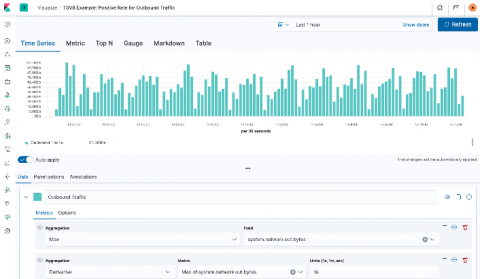
Visualizing observability with Kibana: Event rates and rate of change in TSVB

When working with observability data, a good portion of it comes in as time series data — things like CPU or memory utilization, network transfer, even application trace data. And the Elastic Stack offers powerful tools within Kibana for time series analysis, including TSVB (formerly Time Series Visual Builder). In this blog post, I’m going to attempt to demystify rates in TSVB by walking through three different types: positive rates, rate of change, and event rates.