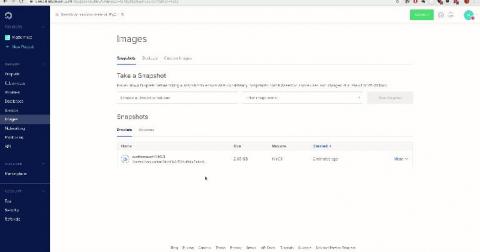
Today, we’re excited to announce Mattermost is available on the DigitalOcean Marketplace. Our 1-click install enables teams to run open source messaging and collaboration in the cloud with a frictionless developer experience.
In part 1 of the GitOps blog series, we discussed the value of using GitOps for Calico policies, and how to roll out such a framework. In this second part of the series, we will expand the scope to include decentralized deployment and GitOps.
If you're one of the lucky ones, 2019 was a great year for you. All the fortune cookies came true, and for that, we're happy for you. Some of us were not as lucky, as our fortune cookies were full of lies and false hopes. Simply hearing the word "2019" is so triggering we need a safe space. Deep breaths—2020 will be better. Regardless of anyone's personal experience with 2019, one thing is for sure regarding this little corner of the internet: the Ivanti blog totally slayed.
AWS Lambda has become the most widely used deployment pattern for serverless applications. It allows developers to set aside worrying about server provisioning, maintenance, idle capacity management and scaling, and instead to focus solely on writing business logic. But that’s not entirely true. Because while Lambda is a self-managed AWS service, it still requires careful design to get the best performance out of the computation capabilities it provides.
What better way to start off the new year than reflecting on the past 12 months and conducting a retrospective of your systems, processes, and culture at your organization? For instance, what did your overall incident response look like in 2019? Was it a smooth and streamlined process or did chaos reign during incident conference calls? But when burning sage and holding magic crystals don’t refresh your office vibes or your incident response process, PagerDuty University has got you covered.
Amazon recently announced the rollout of their new AWS Savings Plans, a new way to reduce your cloud compute costs. These allow you to achieve the discounts associated with their popular Reserved Instances (up to 72% off on-demand pricing) without having to engage in the headache of managing the same. With the new plans, you would commit to a particular hourly spend of your choosing on either a 1 year or 3 year fixed term.
Honeycomb now offers SLOs, aka Service Level Objectives. This is the second in a set of of essays on creating SLOs from first principles. Previously, in this series, we created a derived column to show how a back-end service was doing. That column categorized every incoming event as passing, failing, or irrelevant. We then counted up the column over time to see how many events passed and failed. But we had a problem: we were doing far too much math ourselves.
When it comes to having visibility and detecting threats on macOS, one of the best sources of information for file system events, process events, and network events is the kernel. MacOS kernel extensions provide the ability to receive data about these events in real time with great detail. This is good for providing quick visibility into detecting anomalies and identifying possible threats.
While open source technologies have seen widespread adoption over the last two decades, there is no denying the huge market share that proprietary (closed source) software commands in the enterprise. The largest software vendors like Microsoft, Oracle, IBM, SAP, and VMware have a variety of products that are market leaders in their respective technology categories.