Operations | Monitoring | ITSM | DevOps | Cloud

The latest News and Information on CyberSecurity for Applications, Services and Infrastructure, and related technologies.

Remote Admin Tools (RATs): The Swiss Army Knives of Cybercrime

The cybercrime threatscape is constantly changing as hackers adapt and repurpose the use of many different types of tools and attack vectors, and a recent report by Kaspersky Lab indicates that the use of remote administration tools (RATs) has increased during 2018. RATs are commonly developed as legitimate software suites with bundled functionalities to support system administrators and other power users.

7 Ways To Tell If Your Website Has Been Hacked

In this day in age, businesses rely heavily upon their website as a means of driving sales and reaching customers. It is usually the first point of contact between a potential customer and the business, and thus, it commands a level of investment. Because of this, it can be frustrating and upsetting to have one’s web page hacked and rendered useless.

How to Implement Network Policy in Google GKE to Secure Your Cluster

By default, pods are non-isolated; they accept traffic from any source. The Google GKE solution to this security concern is Network Security Policy that lets developers control network access to their services. Google GKE comes configured with Network Security Policy using Project Calico which can be used to secure your clusters. This class will describe a few use cases for network security policy and a live demo implementing each use case.

How to deploy an app to AWS: App security

AWS security is an ongoing battle that you must address during every release, every change, and every CVE. When you’re first launching your production application, it’s impossible to check all the boxes; you simply don’t have the time. Until your application gets more adoption, you only have the time to do the bare essentials of security.

Getting up and running with Calico Host Micro segmentation Protection on AWS

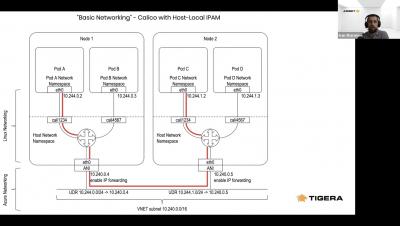
In this online training, we will explain how to install and configure Calico on a vm/host to apply network policy to resources outside your K8s cluster. The talk will be primarily a walkthrough and demo and you will receive all manifests and instructions to do the demo on your own after the session.

Calico and K8s Network Policies - An Overview and Comparison

Kubernetes Network Policy is the native way to implement network security controls in Kubernetes. Calico Policy is a superset of Kubernetes Network Policy that adds additional capabilities that help meet common real-world use cases. In this talk, we will educate you on the basics of Kubernetes Network Policy, the differences with Calico Policy, example use cases, and demos. You’ll walk away from this session with knowledge that will help you decide which network policy is right for you.

How to Implement Network Policy in Amazon EKS to Secure Your Cluster

By default, pods are non-isolated; they accept traffic from any source. The Amazon EKS solution to this security concern is Network Policy that lets developers control network access to their services. Amazon EKS comes configured with Network Policy using Project Calico which can be used to secure your clusters. This class will describe a few use cases for network policy and a live demo implementing each use case.

Security configurations-Part one: 7 reasons why security configurations are crucial to your security blueprint

Security configurations are security-specific settings used to secure heterogeneous endpoints such as servers, desktops, laptops, mobile devices, and tablets. As endpoints in your network diversify, securing each endpoint becomes a challenge. One way to ensure effective endpoint security is by automating it, which is where security configurations come into play. Security configurations are utilized to secure and control every facet of your network.