Operations | Monitoring | ITSM | DevOps | Cloud

The latest News and Information on Monitoring for Websites, Applications, APIs, Infrastructure, and other technologies.

Introduction to Go Custom Metrics with Logz.io RemoteWrite SDK from Logz.io

We recently announced the release of our RemoteWrite SDK to support custom metrics from applications using several different languages – The first SDKs allow shipping of metrics from Golang (Go), Python, Java, Node.js, and.NET. This tutorial will cover the Golang SDK. The SDKs cover not just Logz.io, but can be used by any platform that supports the Prometheus remote write endpoint.
What is Magento Performance Monitoring?

When it comes to creating an online business, Magento is one of the greatest options. Magento is used by 31.4% of the top 100,000 eCommerce stores, according to data. 15 percent are utilizing Magento's community edition, and 5% are using Magento's enterprise edition, which is also known as Adobe Commerce. Magento offers a wealth of features, out-of-the-box functionality, and customization options to help businesses attract and convert more leads.

Understanding the Three Pillars of Observability

Observability and its implementation may look different to different people. But, underneath all the varying definitions is a single, clear concept: Most software that’s run today uses microservices or loosely coupled distributed architecture. While this design makes scaling and managing your system more straightforward, it can make troubleshooting issues more difficult. The three pillars of observability are different methods to track software systems, especially microservices.

How To Monitor Network Traffic

In today’s digital world, almost every business is driven by technology, whether big or small. With the advancement of technology, the associated threats to the security of the IT infrastructure come hand in hand. Therefore, businesses need network traffic analysis tools to keep an eye on their network. Monitoring network traffic continuously gives a business the insight to optimize and manage performance, minimize attack surfaces, intensify security, and better manage its resources.

Network AF, Episode 2: Backbone engineering and interconnection with Nina Bargisen

In episode 2 of Network AF, meet Nina Bargisen. Nina has spent over two decades in network engineering and talks to podcast host Avi Freedman about her history in interconnection and peering. She’s worked for companies like Netflix and TDC (formerly Tele Danmark Communications). Now Nina is Kentik’s director of GTM strategy focused on supporting service providers. Nina joins Avi on the Network AF podcast to discuss: Nina’s entry into networking was non-standard.

The benefits of hybrid cloud for financial institutions

Financial institutions and their service providers have traditionally owned and run their technology infrastructure on their own premises or in their own data centres. However, that’s changing with the advent of powerful public cloud services, such as Amazon Web Services, Google Cloud and Microsoft Azure.

How to check NFT supply with AWS Lambda?

Non-Fungible Tokens, or short NFTs, are all the rage right now. Everyone and their pets are starting an NFT project. Some people got rich from using NFTs; others did not. Some say it’s the savior that will rip the power away from big corporations and give it back to the creators; others say it’s just a giant pyramid scheme.

Why Hybrid, Multi-Cloud Visibility Is Everybody's Problem

When you have workloads running in a hybrid, multi-cloud environment, it’s hard to get a unified view of your entire infrastructure. In fact, Virtana’s recently published State of Hybrid Cloud and FinOps survey reveals that only 36% of respondents said they have comprehensive, unified visibility and management capabilities across all their public clouds, leaving more than two-thirds (68%) with less-than-ideal conditions for managing their multi-cloud infrastructure.

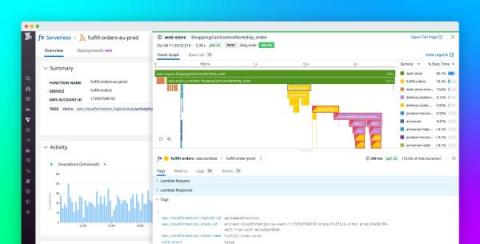
Resolve AWS Lambda function failures faster by monitoring invocation payloads

In a serverless application, AWS Lambda functions are typically invoked by JSON-formatted events from other AWS services—like API Gateway, S3, and DynamoDB—and respond with JSON-formatted payloads. Having visibility into these function request and response payloads can provide context around your function invocations and help you uncover the root causes of Lambda function failures.