Using SLOs to Increase Software Reliability
The partnership between Nobl9 and SolarWinds® Pingdom® is the bridge between business and technology everyone’s been waiting for.


Service virtualization is not new. In fact, the concept and technology were established 20 years ago. At its core, service virtualization offers the ability to simulate behavior, data, and performance characteristics of applications and services. Through service virtualization, teams can ensure they have an on-demand environment to support their testing needs.
Redis is an open-sourced, BSD 3 licensed, highly efficient in-memory data store that can be easily used as a distributed, in-memory key-value store, cache, or message broker. It is known for being extremely fast, reliable, and supporting a wide variety of data structures, making it a very versatile tool widely adopted across the industry. Redis was architectured with speed in mind and is designed in a way that it keeps all the data in memory.
I joined GoCardless as a junior engineer. It was one of my first coding jobs, and in my time there I progressed to senior much faster than I had expected. When I reflect on how this happened, one pattern stands out to me; the big step changes in my understanding, and my ability to solve larger and more complex engineering problems, came as a result of incidents.
Software operators are steadily revolutionising how we deploy and run complex distributed systems. They offer the promise of low-intervention, self-driving software – ideally leading to service reliability gains and better uptime. For an introduction to Kubernetes operators, check out our introductory webinar or download our guide to Kubernetes operators.
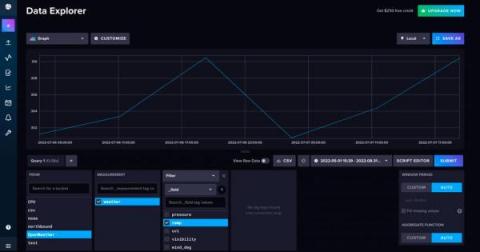
In this tutorial we’ll learn how to use Python to get time series data from the OpenWeatherMap API and convert it to a Pandas DataFrame. Next we’ll write that data to InfluxDB, a time-series data platform, with the InfluxDB Python Client. We’ll convert the JSON response from our API call to a Pandas DataFrame because I find that that’s the easiest way to write data to InfluxDB.
For the past 25 years, I’ve been monitoring networks, applications, services, basically anything digital on a quest to understand “when is it safe to cross the road”! We all know, just blindly crossing a road is EXTREMELY dangerous!
Companies must effectively monitor their assets and networks in today's competitive setting, get the most significant result, and react swiftly to problems. However, such a situation is unusual with companies that continue to run in a traditional, isolated setting. These companies frequently don't have precise asset performance tracking procedures.