Operations | Monitoring | ITSM | DevOps | Cloud

Getting started with continuous integration for Nest.js APIs

Nest.js is a scalable and efficient server-side Node.js framework built with TypeScript. Nest.js was created to provide a structural design pattern to the Node.js development world. It was inspired by Angular.js and uses Express.js under the hood. Nest.js is compatible with the majority of Express.js middleware. In this tutorial, I will lead you through building a RESTful API with Nest.js. The tutorial will familiarize you with the fundamental principles and building blocks of Nest.js.

How did Site24x7 monitor your infrastructure in 2021?

2021 was not much different from 2020 concerning the pandemic. However, it did give many the opportunity to focus on the way forward with offices around the globe opening up, at least partially. At Site24x7, we also started to focus on monitoring other IT components along with remote work infrastructure. Grab a look at our infrastructure monitoring releases if you missed our announcements and “what's new” updates.

Top tips to extend SCOMs monitoring

In today’s monitoring world most SCOM admins are pulling data from a range of tools and applications, as well as cloud platforms. It can be difficult to sift through all this data, let alone distill it down into a useful format. SCOM is a great resource for making this happen, and if it’s done well can be a superb monitoring hub for your other applications. But how do you get SCOM to consume data from other sources?

Year in Review: A Look Back at Mattermost in 2021

For all intents and purposes, 2021 was a jam-packed year for Mattermost, our contributors, employees, customers, and extended community. We broke through the muck that was a challenging 2020, and shared in celebration as we delivered the first open source collaboration platform to feature messaging, project and workflow management all in one convenient suite. But 2021 was about more than just our major platform 6.0 announcement in October.

A successful Monitoring as a Service Case: Refinery and Base Oil Industry

Saving time, money, and resources while keeping your IT infrastructure better monitored than ever – that’s what one of our customers in the refinery and base oil industry did. By implementing our Monitoring as a Service, they managed to turn unstructured monitoring into high quality, consistent such. Their biggest pain point was the lack of time allocated for monitoring activities.

How to deploy the Google Cloud Ops Agent with Ansible

Site Reliability Engineering (SRE) and Operations teams responsible for operating virtual machines (VMs) are always looking for ways to provide a more reliable, more scalable environment for their development partners. Part of providing that stable experience is having telemetry data (metrics, logs and traces) from systems and applications so you can monitor and troubleshoot effectively. Many Google Cloud services, including Google Compute Engine, provide basic system metrics out of the box.

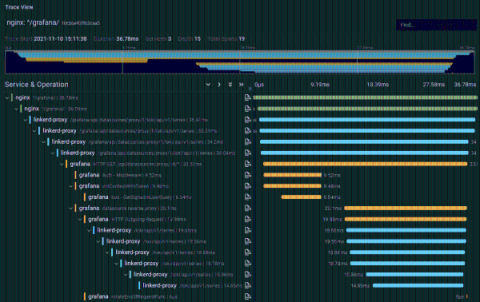
Configuring Grafana Tempo and Linkerd for distributed tracing

Anders Østhus is a DevOps Engineer on the Digital Tools team at Proactima AS, a consulting firm based in Norway that offers services and expertise in risk management, cybersecurity, healthcare, environmental solutions, and more. It can be difficult to orient yourself in the distributed tracing space, and getting all the parts of a tracing setup to play well with each other can be a bit tricky. But the benefits of tracing are undeniable.

What is a Workflow?

Workflows are no stranger in the DevOps world. But where did this term come from, and what does it really mean? Perhaps it’s no surprise that workflows originated from the industrial revolution, which brought powerful machinery for mobilizing huge workforces unlike ever before. To maximize the potential of these new industrial tools, people had to first figure out the best way to use them to get work done as efficiently as possible.