Operations | Monitoring | ITSM | DevOps | Cloud

Sponsored Post

Essential digital experience metrics for development teams

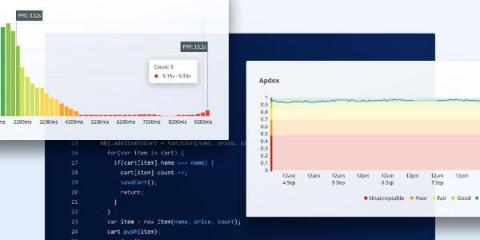
For the team that's down in the trenches untangling legacy code, writing unit tests, and just trying to come up with sensible variable names, it's easy to lose sight of the other end of the process, where code meets customer. You test, you deploy, nothing breaks, and you move on. However, it's just as important to keep an eye on code quality in production, and how it's experienced. Experience, though, is hard to quantify. What do you measure? How do you measure it? How do you improve it? And why do you care? We lay out answers in this post.
Auvik Named a Leader Across G2's Winter 2026 Reports for Network Management

In G2’s Winter 2026 reports, Auvik earned top recognition as a leader in network management tools across small-business, mid-market, and enterprise categories. IT professionals rated Auvik highly for implementation, usability, results, relationship, and overall Grid® performance, reflecting one thing above all: real-world trust from the IT professionals who use Auvik every day.

2026 Observability & AI Outlook for IT Leaders

IT operations have outgrown the model they were built on. Enterprises now monitor tens of thousands of metrics, ingest terabytes of logs, and generate thousands of alerts daily, all while managing increasingly complex infrastructures that span on-prem data centers, multiple cloud environments, and emerging AI workloads. Yet despite all this telemetry, too many teams still learn about outages from customers before they see them in their tools.

OpenTelemetry Collector Contrib - A Hands-on Guide

As application systems grow more complex, it becomes ever more important to understand how services interact across distributed systems. Observability sheds light on the behavior of instrumented applications and the infrastructure they run on. This enables engineering teams to gain better track system health and prevent critical failures. OpenTelemetry (OTel) has standardized how we generate and transmit telemetry, and the OpenTelemetry Collector is the engine that processes and export this data.

How to Monitor Network Performance for Call Centers (Remote & On-Site)

A customer calls to place an urgent order. Your agent's VoIP line cuts out mid-sentence. Is it their home connection? Your network? The ISP? The phone system? You have no visibility, and by the time you figure it out, the customer's gone. This is the reality for modern call centers. Whether your agents work from a central office, from home, or split between both. Network issues don't just slow operations; they destroy customer experiences in real-time.

What is OTLP and How It Works Behind the Scenes

If you have worked with observability tools in the last decade, you have likely managed, and been burnt by, a fragmented collection of tools and libraries. Each observability signal required its own tool, data formats were incompatible and had little or no correlation. For example, log records would not link to traces, meaning you had to guess which traces led to which events. The OpenTelemetry Protocol (OTLP) solves this by decoupling how telemetry is generated from where it is analyzed.

Website Monitoring: What, Why, and Best Practices

In modern times where digital presence dictates business success, understanding website monitoring is no longer optional, whether you run an e-commerce store, SaaS platform, or enterprise website it’s a fundamental pillar of modern operations. Even a few minutes of website downtime can result in lost revenue, damaged credibility, and frustrated users.

2026 observability trends and predictions from Grafana Labs: unified, intelligent, and open

After a decade of dashboards, alerts, and ever-expanding telemetry pipelines, observability is changing. No longer just the domain of engineering, the most innovative organizations are extending observability to all areas of the business to better understand system behavior, emerging risks, and customer impact. At the same time, rising cloud costs and increasing complexity are forcing organizations to be more intentional about what they observe and why.

Troubleshoot faster with the GitLab Source Code integration in Datadog

Developers and SREs who rely on GitLab to develop their services often face significant friction when troubleshooting errors or fixing issues that degrade code quality. To understand the context of a problem, they resort to tab-hopping between observability tools and GitLab, connecting stack traces, spans, and profiles back to the right files and commits.