Check our September 2022 health report on the top most popular cloud providers. We analyze the health of the cloud providers based on the number of outages and problems during the month. The source of the data is made available by the cloud providers themselves via their status page. We normalize it and use it to generate the report.
At MetricFire, we treat your data as our data, and we secure our data. Security is prioritized at every level of our infrastructure so you can have peace of mind that your data is sent and stored safely. Keeping MetricFire secure is fundamental to the nature of our business. One of our key priorities is to secure our customers’ metrics and trust. We diligently ensure that we comply with industry security standards so that our customers can trust that their metrics are safeguarded.
Wi-Fi has untangled humanity, quite literally. Those jumbled Ethernet cables with their confusing ports are banished to backstage. Now, all we need is one connection to a Wi-Fi router and voila! Internet. Wi-Fi networks simplify your IT infrastructure. WLAN networks makes an office look less like a scene from The Matrix and more like a creative workspace, but it can bring an array of difficulties as well. Unlike the sturdy Ethernet cable, Wi-Fi connections fluctuate.
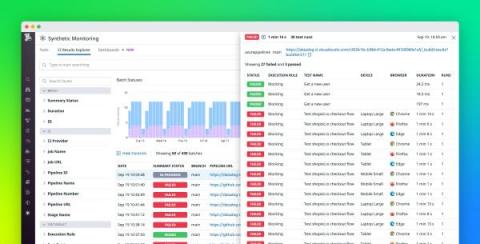
Continuous integration (CI) demands continous testing: shifting left helps prevent faulty code from spreading, which is one of the core aims of CI. Datadog’s new Azure DevOps extension enables you to seamlessly incorporate integration and end-to-end tests into existing CI/CD workflows on Azure Pipelines, a dedicated CI/CD service that automatically runs builds, performs tests, and deploys your services and applications via cloud-hosted pipelines.
Azure Container Apps is a serverless platform that enables you to deploy containerized applications and microservices—regardless of their code or framework—without managing any underlying cloud infrastructure or orchestrators. By using serverless containers, Azure Container Apps can automatically scale based on HTTP requests or events supported by Kubernetes event-driven autoscaling (KEDA) in order to accommodate peak demand and meet your budgeting goals.
MongoDB is a cross-platform NoSQL database that uses JSON-like documents with optional schema to store data. It was designed for high availability, high performance for high-data persistance use cases, and automatic scaling. Of course, all with the right infrastructure in mind. It is usually a good choice for document-oriented use cases when you need quick prototyping or massive scale. With the massive scale comes massive traffic, though.
The following guest post addresses how to improve your services’s performance with Sentry and other application profilers for Python. Check out this post to learn more about application profiling and Sentry’s upcoming mobile application profiling offering. We’re making intentional investments in performance monitoring to make sure we give you all the context to help you solve what’s urgent faster.
Exceptions are the outcomes you do not usually expect in your application. But as a developer, expecting the unexpected is essential to capture exceptions and handle them appropriately. Exception handling is not only applicable to web development projects but also to Unity applications. This article brings everything you need to know as a beginner to Unity exception handling, including methods to handle exceptions, when to use them, and how to manage exceptions easier using distributed logging.
UC Today, the leading online publication for Unified Communications and Collaboration technology, recently did a deep dive on Martello’s Microsoft-recommended Vantage DX solution for monitoring Microsoft Teams and found out that delivering exceptional user experiences and avoiding a Microsoft Teams outage can be easy with the right solution in place.