Operations | Monitoring | ITSM | DevOps | Cloud

Unity Performance Testing Tools & Benchmarks

The following guest post addresses how to improve your services’ performance with Sentry and other application profilers for Unity. Learn more about Sentry’s Profiling product or try it out now if you’re already a Sentry user. We’re making intentional investments in performance monitoring to give relevant context to help you solve what’s urgent faster.

Incident response: Unlocking knowledge and breaking down silos

In a world of monolithic applications and microservices, responding to incidents can be a painful process, involving multiple people with siloed knowledge jumping between different tools to find the relevant data and take action. Individuals within a business often hold the knowledge of how a particular component works, or how it depends on other services. The key to successfully responding to incidents is unlocking this knowledge and breaking down the silos between teams.

Monitoring Strategies: An Introductory Guide With 5 Examples

Monitoring is an integral part of most organizations. The monitoring process usually consists of several tools that, combined, show you information about whatever you're monitoring - applications, infrastructure, networks and so forth. While monitoring may seem like an obvious practice to some, it can be challenging to establish the best monitoring strategy for your organization.

We have redesigned our entire service

As of today, Oh Dear is in a brand new jacket. We've totally redesigned Oh Dear's UI. Our app doesn't only look better, but we've also made it much easier to use. We feel that our new design should speak for itself, so we highly recommend visiting the home page, browsing a bit around, register an account, or log in, and discover the redesigned app yourself. If you've been using Oh Dear before, you'll notice that we polished everything, and the UX should be much better.

Cloud Monitoring further embraces open source by adding PromQL

As Kubernetes monitoring continues to standardize on Prometheus as a form factor, more and more developers are becoming familiar with Prometheus’ built-in query language, PromQL. Besides being bundled with Prometheus, PromQL is popular for being a simple yet expressive language for querying time series data. It’s been fully adopted by the community, with lots of great query repositories, sample playbooks, and trainings for PromQL available online.

10 Tools for Monitoring Mobile Apps from a Network Point of View

With so many apps to choose from, mobile users no longer have much patience for apps that don’t work well. This isn’t just about bugs and crashes; users also think about how fast the app works and how much battery it uses. But have you ever thought about what would happen to the business if your live applications running on the client’s systems went down or didn’t work as expected?

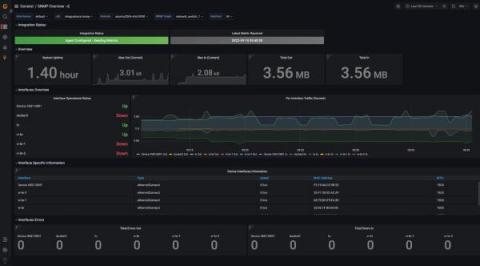
Set up instant SNMP monitoring with the new SNMP integration in Grafana Cloud

Simple Network Management Protocol (SNMP) is an internet protocol that is used to collect information about network devices and manage them. Most of the modern devices connected to a network support SNMP, such as routers, switches, servers, printers, and more. There are three different versions of SNMP (v1, v2, and v3). It most commonly operates on UDP ports 161 and 162. The most common versions being used are v1 and v2. The data can be collected from a network device through SNMP via polling.

Feature Focus: September 2022

Another month has come to a close, so I’m back again to take you through what’s new and noteworthy from the month of September. If you missed last month’s blog, this will be a monthly recurring series to keep you posted with the latest and greatest at Honeycomb. There’s a ton to cover, so I’ll dispense with the preamble and dive right in.

Sponsored Post

Why Composable Analytics Matter for Multi-Cloud AIOps

There’s plenty of loaded terminology and buzzword bingo when it comes to the latest advances in cloud application delivery. Especially when it comes to multi-cloud – which should merely mean multiple cloud instances when modern cloud applications really leverage multiple hybrid IT operating models, atop both existing business silos and newer microservices application workloads.

Using Lumigo OpenTelemetry Distributions with other backends

When we set out to trace applications running outside of AWS Lambda, there was little doubt in our minds that building on top OpenTelemetry was by far the best course of action. There are many reasons for this, but chiefly, it is a question of coverage. At its most fundamental level, achieving coverage requires as-wide-as-possible support for technologies, and interoperability among instrumentations.