Operations | Monitoring | ITSM | DevOps | Cloud

The latest News and Information on DevOps, CI/CD, Automation and related technologies.

Complete Your Cloud Kubernetes Registry With Terraform Repositories in Artifactory

When developing container-based services that will be orchestrated by Kubernetes, Terraform is an essential part of your artifact ecosystem. These infrastructure-as-code configuration files help automate the provisioning and maintenance of the cloud environments where your K8s applications will run. That’s why it’s great news that you can now store your Terraform modules, providers, and remote state files in Artifactory as a part of your software supply chain.
6 Ways Topology-Powered Observability Gives Back Time to Your Organization

Having enough time available is a struggle we all experience. Technological innovations enable us to develop and deploy software at lightning speed: Sometimes we can push more to production than our organizations’ IT environments can handle. At the same time, we want to increase customer satisfaction by reducing downtime. But how are you going to keep customer satisfaction rates high if a large majority of incidents are caused by changes?

More Tools + More People = Increased Complexity

Consider what happens if digital apps or services go down. Companies lose revenue, decrease productivity, compromise customer loyalty and the list of repercussions goes on, depending on the business. Indeed, modern business continuity is contingent on a well-functioning suite of consumer and commercial apps and services.

Monitoring Applications Declaratively with Terraform

Running infrastructure at scale almost always guarantees dizzying complexity and anxiety-inducing pressure to maintain systems in a production environment. This is further exacerbated when multiple delivery teams require slight variations of the same infrastructure components, across several cloud providers, each with a different set of observability requirements. Gradually, production environments become large, unmanageable, difficult to change, and perhaps resembling the figure below.

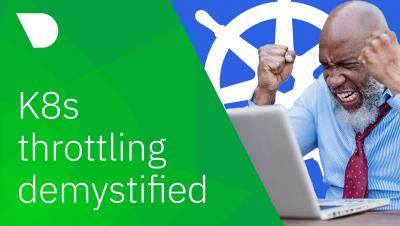
Kubernetes throttling? It doesn't have to suck!

Kubernetes has a bad habit of throttling CPU resources—with the result that you can suffer severely degraded performance or find yourself paying a fortune for extra, unnecessary infrastructure. Watch this video to learn how K8s clusters protect themselves from what they see as heavy CPU usage, and how you can monitor and troubleshoot the problem. We demonstrate how you can:– Use Netdata to reduce API response times by a factor of 7– Expect to reduce infrastructure resource requirements by 60-75%

Compliance And The Cloud

Having achieved almost consumer-grade accessibility, public cloud adoption is increasingly driven by individual business functions. Enterprise teams no longer need to understand how the technology works, or even where the service operates from. To buy a cloud product they just need a web browser and a credit card. But this level of simplicity raises challenges of its own when it comes to regulatory concerns.