

Operations | Monitoring | ITSM | DevOps | Cloud

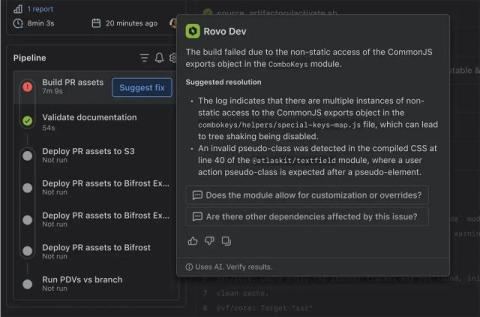
Reimagining software delivery with AI-powered workflows in Jira & Bitbucket

If you’re like most developers, you know that writing code isn’t the bottleneck anymore. AI has made it faster than ever, and chances are you’re already using it. Yet, delivering software is still complex because of everything else you have to manage: fixing vulnerabilities, reducing tech debt, cleaning up feature flags, ensuring test coverage, writing documentation, and the list goes on. That’s why we built Rovo Dev, a context-aware AI agent for developers.


Elastic named a Leader in the IDC MarketScape: Worldwide Observability Platforms 2025 Vendor Assessment

We're proud to share that Elastic has been named a Leader in the IDC MarketScape: Worldwide Observability Platforms 2025 Vendor Assessment (doc, November 2025). We believe this recognition validates our ongoing mission: to deliver an observability platform that is open, extensible, and AI-driven to power full-stack observability that unifies operational and business data at scale, allowing SRE teams to move from detect and resolve problems faster.

Expanding Access, Not Risk: Using the Read-Only Role in Honeycomb Teams

Observability works best when everyone who needs visibility can get it without the risk of unintentional changes. Honeycomb’s role-based access control system helps teams strike that balance with a selection of Owner, Member, and Read-Only member roles. This control gives teams more flexibility in how they share access across their organization, helping you scale visibility safely without sacrificing control.

Beyond Isolated AI: How the Selector MCP Server Connects Agents, Context, and Action

AI in network operations is evolving faster than ever. But while new models and agents are emerging almost daily, they’re often working alone, with each confined to its own context, data, and domain. One model might analyze telemetry, another handles automation scripts, and a third generates summaries or recommendations. Each model might be intelligent on its own, but without a way to share context, they end up thinking in isolation, limiting what they can achieve together.

Bringing Observability to Data

While observability practices have evolved in recent years, they have largely focused on application services and infrastructure. Yet it is data what powers our applications, businesses, and AI models. When data issues occur, the consequences can be far reaching, from poor product experiences to billing errors to misinformed AI outcomes. In this session, Jonathan Morin, Group Product Manager at Datadog, shares real-world examples of incidents and explains how data observability can address them, helping teams detect issues earlier, reduce costly downtime, and restore trust in their data.

Azure Synapse Explained: Analytics And Business Value

Traditionally, companies had to use separate tools for ETL, data storage, and analytics. Often, this resulted in slow, complex, and expensive data workflows A good example is PwC’s Deals, Insights & Analytics (DIA) team, which faced similar challenges. According to Microsoft, bespoke solutions often took months to build and were difficult to merge, slowing projects and driving up costs. That changed when PwC adopted Azure Synapse Analytics. The result?