Operations | Monitoring | ITSM | DevOps | Cloud

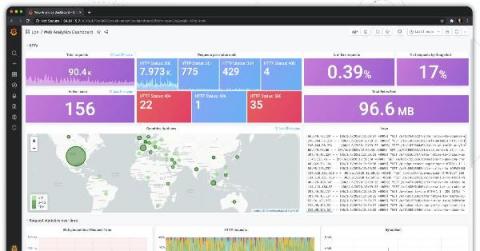
Grafana and NGINX are partnering to give the open source community a turnkey experience for visibility

Over the past few years, NGINX users have naturally gravitated toward Grafana, and vice versa. These days, it’s not uncommon to see these two open source tools used together in the wild. And for good reason. F5, which acquired NGINX last year, is prioritizing building visibility across the entire product set, to make it easy for customers to quickly gain the insights that they need. Meanwhile, Grafana has evolved into the primary visualization and analysis tool in the open source market.

Scaling Queue Workers Efficiently with AppSignal Metrics

Most web apps can benefit from a background queue, often used to process error-prone or time-consuming side jobs. These background jobs can vary from sending emails, to updating caches, to performing core business logic. As any background queueing system scales the number of jobs it needs to process, the pool of workers processing those jobs needs to scale as well.

SLOs for AWS-based infrastructure

In our latest two-part series blog, Gigi Sayfan, author of “Mastering Kubernetes”, discusses managing complex infrastructure on AWS with an eye towards SLOs (service level objectives). Though there are many ways to discuss the management of infrastructure, in this two-part series, he covers SLOs for AWS, Observability on AWS, Quotas Limits, and Optimizing cost on AWS and in the second part, he uses the lens of Kubernetes to compare and contrast compute infrastructure on AWS with Kubernetes.

SUSE Enters Into Definitive Agreement to Acquire Rancher Labs

I’m excited to announce that Rancher has signed a definitive agreement to be acquired by SUSE. Rancher is the most widely used enterprise Kubernetes platform. SUSE is the largest independent open source software company and a leader in enterprise Linux. By combining Rancher and SUSE, we not only gain massive engineering resources to further strengthen our market-leading product, we are also able to preserve our unique 100% open source business model.

Introduction to multi cluster security using Calico Enterprise

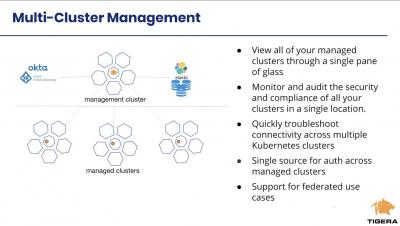
Now that you’ve deployed your network policies to secure your Kubernetes cluster, how do you deploy your policies to other clusters? What do you do each time a new cluster is provisioned? And how do you deploy changes to your policies? Most organizations have a set of central security policies, and many are deploying Kubernetes across multiple clouds and on-prem. Scaling security becomes a formidable challenge. Calico Multi-Cluster Management is a feature in Calico Enterprise that Federates network security policies across multiple clusters – whether on-prem, hybrid, or multi-cloud.

Getting up and running with Calico on your on premises K8s Cluster

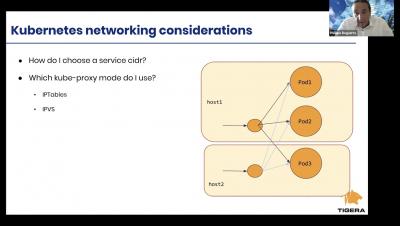
If you are deploying Kubernetes on-premises in your datacenter, you won’t want to miss this talk and demo. The first thing you’re thinking about might not be networking, but without some knowledge of the networking decisions you’ll need to make, and what the right option is given your environment, you’re likely to get stuck or make the wrong assumptions that may limit your ability to scale or integrate with the rest of the datacenter network.

Getting up and running with Calico Enterprise on your Rancher K8s Cluster

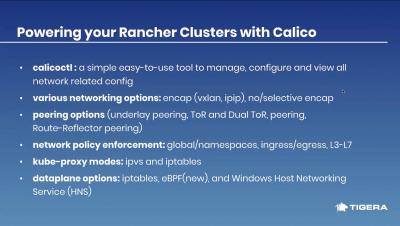
In this training and demo you’ll learn about the various networking options available to you in Rancher and considerations to take into account in order to select the best option for your environment. We will also showcase how to bootstrap and configure your Rancher cluster along with sample policy deployments.

DevOps your way using the Jira Cloud mobile & desktop apps - Demo Den

Rayen, a Jira Cloud Product Manager, demos improvements to the mobile and desktop apps to help you better manage development work. Three new use cases are available: reporting, code visibility, and release management. Thanks for watching and don't forget to subscribe to our channel! Take a look below for download links.